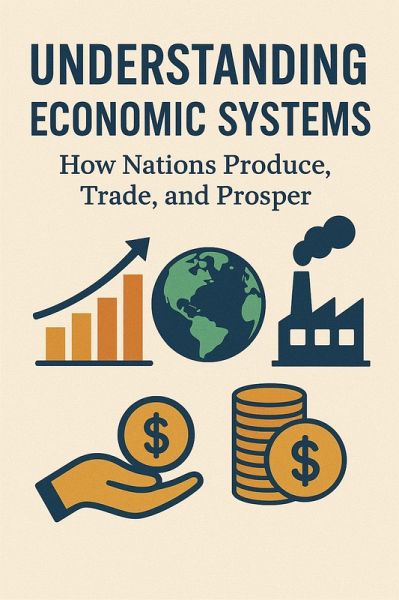
Understanding Economic Systems: How Nations Produce, Trade, and Prosper (eBook, ePUB)

PAYBACK Punkte
0 °P sammeln!

"Understanding Economic Systems: How Nations Produce, Trade, and Prosper" is a comprehensive, accessible exploration of how different societies organize their economies, why they choose particular models, and what these choices mean for growth, fairness, and stability. Drawing on examples from around the world, it explains in clear language how basic economic questionswhat to produce, how to produce, and for whomare answered in practice by markets, governments, and communities. The book moves from foundational concepts like scarcity, opportunity cost, and productivity into a wide-ranging tour ...
"Understanding Economic Systems: How Nations Produce, Trade, and Prosper" is a comprehensive, accessible exploration of how different societies organize their economies, why they choose particular models, and what these choices mean for growth, fairness, and stability. Drawing on examples from around the world, it explains in clear language how basic economic questionswhat to produce, how to produce, and for whomare answered in practice by markets, governments, and communities. The book moves from foundational concepts like scarcity, opportunity cost, and productivity into a wide-ranging tour of capitalism, socialism, mixed and traditional systems, and the vast informal and hybrid arrangements that shape everyday life.
Across its chapters, the book shows how nations structure production in agriculture, industry, and services; how labor markets determine wages, employment, and the future of work; and how capital, investment, money, and banking underpin modern economies. It examines the roles of governments in taxation, public spending, and welfare, and unpacks how prosperity is measured through GDP and alternative indicators that capture inequality, poverty, and human development more fully. Global dimensions are treated in depth, with chapters on trade, globalization, global value chains, and recurring cycles of booms, busts, and crises.
Later chapters focus on development and the catch-up challenge facing emerging economies, the management of natural resources and environmental limits, and the transition toward more sustainable, knowledge- and innovation-driven growth. The book also analyzes competing economic modelsfrom liberal market systems to coordinated and state-led capitalismand the institutional foundations of successful economies: governance quality, the rule of law, and effective regulation. It concludes by confronting the future of work, welfare, and the social contract in an age of automation, demographic change, and climate risk, inviting readers to think critically about how nations can design economic systems that are not only productive, but also inclusive, resilient, and compatible with planetary boundaries.
Across its chapters, the book shows how nations structure production in agriculture, industry, and services; how labor markets determine wages, employment, and the future of work; and how capital, investment, money, and banking underpin modern economies. It examines the roles of governments in taxation, public spending, and welfare, and unpacks how prosperity is measured through GDP and alternative indicators that capture inequality, poverty, and human development more fully. Global dimensions are treated in depth, with chapters on trade, globalization, global value chains, and recurring cycles of booms, busts, and crises.
Later chapters focus on development and the catch-up challenge facing emerging economies, the management of natural resources and environmental limits, and the transition toward more sustainable, knowledge- and innovation-driven growth. The book also analyzes competing economic modelsfrom liberal market systems to coordinated and state-led capitalismand the institutional foundations of successful economies: governance quality, the rule of law, and effective regulation. It concludes by confronting the future of work, welfare, and the social contract in an age of automation, demographic change, and climate risk, inviting readers to think critically about how nations can design economic systems that are not only productive, but also inclusive, resilient, and compatible with planetary boundaries.
Dieser Download kann aus rechtlichen Gründen nur mit Rechnungsadresse in A, B, CY, CZ, D, DK, EW, E, FIN, F, GR, H, IRL, I, LT, L, LR, M, NL, PL, P, R, S, SLO, SK ausgeliefert werden.
Andere Kunden interessierten sich für