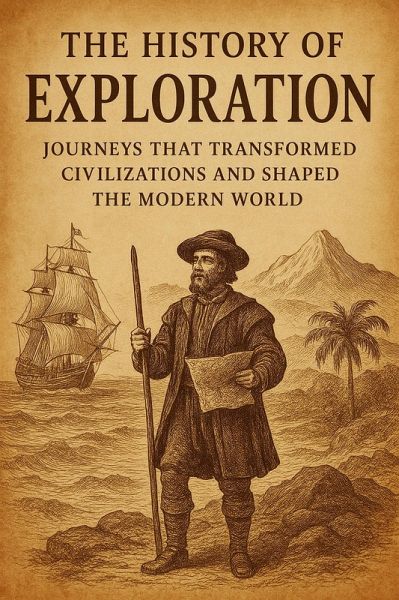
The History of Exploration: Journeys That Transformed Civilizations and Shaped the Modern World (eBook, ePUB)

PAYBACK Punkte
0 °P sammeln!

This book is a sweeping narrative history of exploration that follows humanity's journeys from the first prehistoric wanderings to the speculative frontiers of tomorrow. It opens with our earliest migrations out of Africa, when small bands of hunter-gatherers slowly peopled the globe without maps or written records, guided only by memory, observation, and oral tradition. From there it traces how river civilizations, desert caravans, and maritime cultures like the Phoenicians, Greeks, Romans, and seafaring societies of the Islamic and Chinese worlds slowly stitched together a connected Old Worl...
This book is a sweeping narrative history of exploration that follows humanity's journeys from the first prehistoric wanderings to the speculative frontiers of tomorrow. It opens with our earliest migrations out of Africa, when small bands of hunter-gatherers slowly peopled the globe without maps or written records, guided only by memory, observation, and oral tradition. From there it traces how river civilizations, desert caravans, and maritime cultures like the Phoenicians, Greeks, Romans, and seafaring societies of the Islamic and Chinese worlds slowly stitched together a connected Old World long before Europe's "Age of Discovery."
The middle chapters examine the oceanic turning point: Iberian ventures down the African coast, the westward gamble that led to the encounter with the Americas, and the emergence of Atlantic empires built on conquest, mapping, and forced labor. English, French, and Dutch voyages in the northern seas, early circumnavigations, and Enlightenment-era scientific expeditions show exploration becoming increasingly systematic, tied to cartography, natural history, and state power. Interior journeys into Africa, Asia, the Pacific, and the polar regions then push beyond mapped coasts to the mountains, deserts, ice fields, and ocean depths that remained the last "blank spaces" on the globe.
As the narrative enters the modern era, it broadens from heroic journeys to the infrastructures that quietly shrink distance: railways, telegraphs, steamships, and eventually aircraft. The focus shifts toward mapping the invisible systems that govern the planet-oceans, atmosphere, and the deep Earth-and then beyond Earth itself, into space. Chapters on rocketry, orbital flight, Moon landings, and robotic missions to other worlds are paired with accounts of digital and robotic exploration on our own planet: satellites, deep-sea submersibles, drones, and algorithms that allow humanity to "see" places no person has directly visited.
Crucially, the book never presents exploration as a one-sided triumph. A dedicated section re-centres Indigenous perspectives, showing how so-called discovery often appeared from the ground as invasion and dispossession, and how local knowledge, resistance, and adaptation shaped every major phase of expansion. The ethical and ecological costs of exploration-disease, slavery, environmental damage, cultural loss-are confronted alongside its intellectual and technological achievements. The final chapters look forward, asking how future journeys into space, deep oceans, and virtual realms can be guided by principles of justice, sustainability, and shared stewardship. Overall, the book offers a richly layered, critical yet hopeful account of how journeys have transformed civilizations and how exploration might evolve in a world that is, for the first time, both globally mapped and acutely vulnerable.
The middle chapters examine the oceanic turning point: Iberian ventures down the African coast, the westward gamble that led to the encounter with the Americas, and the emergence of Atlantic empires built on conquest, mapping, and forced labor. English, French, and Dutch voyages in the northern seas, early circumnavigations, and Enlightenment-era scientific expeditions show exploration becoming increasingly systematic, tied to cartography, natural history, and state power. Interior journeys into Africa, Asia, the Pacific, and the polar regions then push beyond mapped coasts to the mountains, deserts, ice fields, and ocean depths that remained the last "blank spaces" on the globe.
As the narrative enters the modern era, it broadens from heroic journeys to the infrastructures that quietly shrink distance: railways, telegraphs, steamships, and eventually aircraft. The focus shifts toward mapping the invisible systems that govern the planet-oceans, atmosphere, and the deep Earth-and then beyond Earth itself, into space. Chapters on rocketry, orbital flight, Moon landings, and robotic missions to other worlds are paired with accounts of digital and robotic exploration on our own planet: satellites, deep-sea submersibles, drones, and algorithms that allow humanity to "see" places no person has directly visited.
Crucially, the book never presents exploration as a one-sided triumph. A dedicated section re-centres Indigenous perspectives, showing how so-called discovery often appeared from the ground as invasion and dispossession, and how local knowledge, resistance, and adaptation shaped every major phase of expansion. The ethical and ecological costs of exploration-disease, slavery, environmental damage, cultural loss-are confronted alongside its intellectual and technological achievements. The final chapters look forward, asking how future journeys into space, deep oceans, and virtual realms can be guided by principles of justice, sustainability, and shared stewardship. Overall, the book offers a richly layered, critical yet hopeful account of how journeys have transformed civilizations and how exploration might evolve in a world that is, for the first time, both globally mapped and acutely vulnerable.
Dieser Download kann aus rechtlichen Gründen nur mit Rechnungsadresse in A, B, CY, CZ, D, DK, EW, E, FIN, F, GR, H, IRL, I, LT, L, LR, M, NL, PL, P, R, S, SLO, SK ausgeliefert werden.
Andere Kunden interessierten sich für