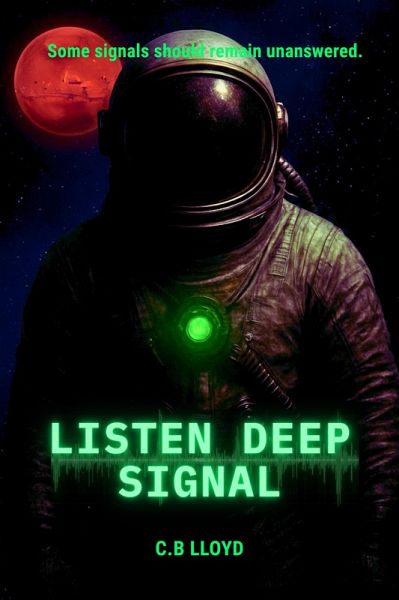
Listen Deep Signal (eBook, ePUB)

PAYBACK Punkte
0 °P sammeln!

Listen Deep Signal is not a book you read-it is a transmission you receive.Dr. Aris Thorne travels eighteen billion kilometers from home only to discover that distance is measured in the silence between words left unsaid. Aboard the Chronos Research Station orbiting dead world Luyten-b, this epistolary descent into cosmic grief asks: What if the signal we've been searching for is the sound of our own regret, broadcast backward through time?On Sol 287, Thorne logs an anomaly-a signal exhibiting fractal entropy too deliberate to be natural. It behaves like something alive. Something listening. T...
Listen Deep Signal is not a book you read-it is a transmission you receive.
Dr. Aris Thorne travels eighteen billion kilometers from home only to discover that distance is measured in the silence between words left unsaid. Aboard the Chronos Research Station orbiting dead world Luyten-b, this epistolary descent into cosmic grief asks: What if the signal we've been searching for is the sound of our own regret, broadcast backward through time?
On Sol 287, Thorne logs an anomaly-a signal exhibiting fractal entropy too deliberate to be natural. It behaves like something alive. Something listening. The signal learns. It mimics. It speaks in Thorne's own voice, whispering his name before he records it, echoing his breath with a half-second delay. The horror is not the unknown, but the unbearably familiar.
Through log entries, readers witness consciousness fracturing under isolation's weight. The signal plays back memories he never recorded-Elena's final breath, Mira's laughter, his own voice saying "Don't leave me here" three years before he spoke those words. The station becomes alive: walls breathe, corridors stretch impossibly, quantum foam reconstructs Elena's coffee mug.
The genius of Cornelius B. Lloyd's narrative lies in its recursive structure. Thorne discovers he's not the first version of himself here. Log files reveal dozens of iterations, each believing they were original. The signal transmits from deep time, looping through Thorne's consciousness, waiting for a version broken enough to surrender.
The final revelation recontextualizes everything: Elena built the signal before her death. She encoded her voice into quantum foam to reach the husband she'd already lost to the stars. What seemed cosmic horror was actually love so desperate it refuses entropy, grief so profound it rewrites physics.
Operating at the intersection of Ted Chiang's conceptual rigor and Jeff VanderMeer's atmospheric dread, this story explores fathers who fail daughters, husbands who lose wives to ambition, and whether consciousness is generated or merely received. By the end, Thorne becomes a message-a self-sustaining loop. The novel's triumph: it transforms cosmic horror into cosmic compassion, proving love can be preserved as grammar.
For readers craving science fiction that prioritizes psychological depth, this offers slow-burn dread and emotional payoff. The book doesn't conclude-it echoes.
This is not a story about reaching across the void. It is the void, finally answering back.
Dr. Aris Thorne travels eighteen billion kilometers from home only to discover that distance is measured in the silence between words left unsaid. Aboard the Chronos Research Station orbiting dead world Luyten-b, this epistolary descent into cosmic grief asks: What if the signal we've been searching for is the sound of our own regret, broadcast backward through time?
On Sol 287, Thorne logs an anomaly-a signal exhibiting fractal entropy too deliberate to be natural. It behaves like something alive. Something listening. The signal learns. It mimics. It speaks in Thorne's own voice, whispering his name before he records it, echoing his breath with a half-second delay. The horror is not the unknown, but the unbearably familiar.
Through log entries, readers witness consciousness fracturing under isolation's weight. The signal plays back memories he never recorded-Elena's final breath, Mira's laughter, his own voice saying "Don't leave me here" three years before he spoke those words. The station becomes alive: walls breathe, corridors stretch impossibly, quantum foam reconstructs Elena's coffee mug.
The genius of Cornelius B. Lloyd's narrative lies in its recursive structure. Thorne discovers he's not the first version of himself here. Log files reveal dozens of iterations, each believing they were original. The signal transmits from deep time, looping through Thorne's consciousness, waiting for a version broken enough to surrender.
The final revelation recontextualizes everything: Elena built the signal before her death. She encoded her voice into quantum foam to reach the husband she'd already lost to the stars. What seemed cosmic horror was actually love so desperate it refuses entropy, grief so profound it rewrites physics.
Operating at the intersection of Ted Chiang's conceptual rigor and Jeff VanderMeer's atmospheric dread, this story explores fathers who fail daughters, husbands who lose wives to ambition, and whether consciousness is generated or merely received. By the end, Thorne becomes a message-a self-sustaining loop. The novel's triumph: it transforms cosmic horror into cosmic compassion, proving love can be preserved as grammar.
For readers craving science fiction that prioritizes psychological depth, this offers slow-burn dread and emotional payoff. The book doesn't conclude-it echoes.
This is not a story about reaching across the void. It is the void, finally answering back.
Dieser Download kann aus rechtlichen Gründen nur mit Rechnungsadresse in A, B, CY, CZ, D, DK, EW, E, FIN, F, GR, H, IRL, I, LT, L, LR, M, NL, PL, P, R, S, SLO, SK ausgeliefert werden.
Andere Kunden interessierten sich für