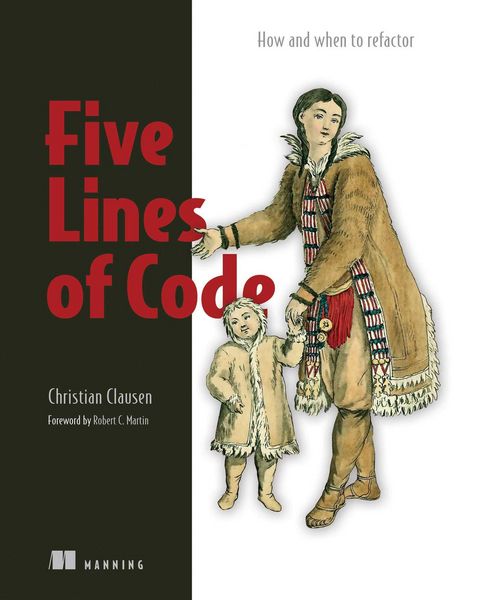
Five Lines of Code How and when to refactor
-
- Taschenbuch
- eBook ausgewählt
-
Form:Einzelkauf Download
-
Sprache:Englisch
49,44 €
inkl. gesetzl. MwSt.Beschreibung
Produktdetails
Format
ePUB
Kopierschutz
Ja
Family Sharing
Ja
Text-to-Speech
Ja
Erscheinungsdatum
09.11.2021
Verlag
ManningSeitenzahl
336 (Printausgabe)
Dateigröße
1656 KB
Sprache
Englisch
EAN
9781638356370
Five Lines of Code teaches refactoring that's focused on concrete rules and getting any method down to five lines or less! There's no jargon or tricky automated-testing skills required, just easy guidelines and patterns illustrated by detailed code samples.
In Five Lines of Code you will learn:
The signs of bad code
Improving code safely, even when you don't understand it
Balancing optimization and code generality
Proper compiler practices
The Extract method, Introducing Strategy pattern, and many other refactoring patterns
Writing stable code that enables change-by-addition
Writing code that needs no comments
Real-world practices for great refactoring
Improving existing coderefactoringis one of the most common tasks you'll face as a programmer. Five Lines of Code teaches you clear and actionable refactoring rules that you can apply without relying on intuitive judgements such as code smells. Following the author's expert perspectivethat refactoring and code smells can be learned by following a concrete set of principlesyou'll learn when to refactor your code, what patterns to apply to what problem, and the code characteristics that indicate it's time for a rework.
Foreword by Robert C. Martin.
About the technology
Every codebase includes mistakes and inefficiencies that you need to find and fix. Refactor the right way, and your code becomes elegant, easy to read, and easy to maintain. In this book, you'll learn a unique approach to refactoring that implements any method in five lines or fewer. You'll also discover a secret most senior devs know: sometimes it's quicker to hammer out code and fix it later!
About the book
Five Lines of Code is a fresh look at refactoring for developers of all skill levels. In it, you'll master author Christian Clausen's innovative approach, learning concrete rules to get any method down to five linesor less! You'll learn when to refactor, specific refactoring patterns that apply to most common problems, and characteristics of code that should be deleted altogether.
What's inside
The signs of bad code
Improving code safely, even when you don't understand it
Balancing optimization and code generality
Proper compiler practices
About the reader
For developers of all skill levels. Examples use easy-to-read Typescript, in the same style as Java and C#.
About the author
Christian Clausen works as a Technical Agile Coach, teaching teams how to refactor code.
Table of Contents
1 Refactoring refactoring
2 Looking under the hood of refactoring
PART 1 LEARN BY REFACTORING A COMPUTER GAME
3 Shatter long function
4 Make type codes work
5 Fuse similar code together
6 Defend the data
PART 2 TAKING WHAT YOU HAVE LEARNED INTO THE REAL WORLD
7 Collaborate with the compiler
8 Stay away from comments
9 Love deleting code
10 Never be afraid to add code
11 Follow the structure in the code
12 Avoid optimizations and generality
13 Make bad code look bad
14 Wrapping up
In Five Lines of Code you will learn:
The signs of bad code
Improving code safely, even when you don't understand it
Balancing optimization and code generality
Proper compiler practices
The Extract method, Introducing Strategy pattern, and many other refactoring patterns
Writing stable code that enables change-by-addition
Writing code that needs no comments
Real-world practices for great refactoring
Improving existing coderefactoringis one of the most common tasks you'll face as a programmer. Five Lines of Code teaches you clear and actionable refactoring rules that you can apply without relying on intuitive judgements such as code smells. Following the author's expert perspectivethat refactoring and code smells can be learned by following a concrete set of principlesyou'll learn when to refactor your code, what patterns to apply to what problem, and the code characteristics that indicate it's time for a rework.
Foreword by Robert C. Martin.
About the technology
Every codebase includes mistakes and inefficiencies that you need to find and fix. Refactor the right way, and your code becomes elegant, easy to read, and easy to maintain. In this book, you'll learn a unique approach to refactoring that implements any method in five lines or fewer. You'll also discover a secret most senior devs know: sometimes it's quicker to hammer out code and fix it later!
About the book
Five Lines of Code is a fresh look at refactoring for developers of all skill levels. In it, you'll master author Christian Clausen's innovative approach, learning concrete rules to get any method down to five linesor less! You'll learn when to refactor, specific refactoring patterns that apply to most common problems, and characteristics of code that should be deleted altogether.
What's inside
The signs of bad code
Improving code safely, even when you don't understand it
Balancing optimization and code generality
Proper compiler practices
About the reader
For developers of all skill levels. Examples use easy-to-read Typescript, in the same style as Java and C#.
About the author
Christian Clausen works as a Technical Agile Coach, teaching teams how to refactor code.
Table of Contents
1 Refactoring refactoring
2 Looking under the hood of refactoring
PART 1 LEARN BY REFACTORING A COMPUTER GAME
3 Shatter long function
4 Make type codes work
5 Fuse similar code together
6 Defend the data
PART 2 TAKING WHAT YOU HAVE LEARNED INTO THE REAL WORLD
7 Collaborate with the compiler
8 Stay away from comments
9 Love deleting code
10 Never be afraid to add code
11 Follow the structure in the code
12 Avoid optimizations and generality
13 Make bad code look bad
14 Wrapping up
Noch keine Bewertungen vorhanden
Verfassen Sie die erste Bewertung zu diesem Artikel
Helfen Sie anderen Kundinnen und Kunden durch Ihre Meinung.
Kurze Frage zu unserer Seite
Vielen Dank für dein Feedback
Wir nutzen dein Feedback, um unsere Produktseiten zu verbessern. Bitte habe Verständnis, dass wir dir keine Rückmeldung geben können. Falls du Kontakt mit uns aufnehmen möchtest, kannst du dich aber gerne an unseren Kund*innenservice wenden.
zum Kundenservice