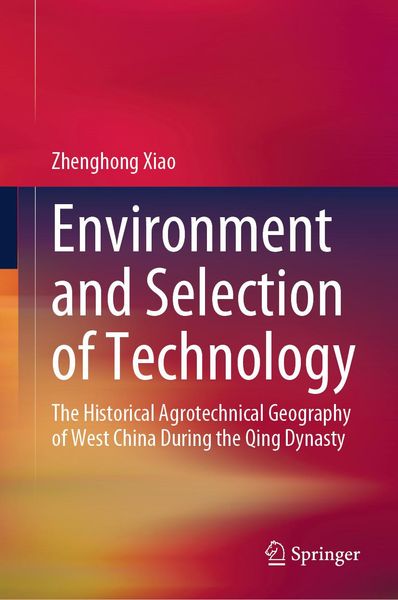
Environment and Selection of Technology The Historical Agrotechnical Geography of West China During the Qing Dynasty
139,09 €
inkl. MwStBeschreibung
Details
Format
Kopierschutz
Nein
Family Sharing
Nein
Text-to-Speech
Nein
Erscheinungsdatum
28.08.2024
Verlag
Springer Nature SingaporeSeitenzahl
342 (Printausgabe)
Dateigröße
11551 KB
Übersetzt von
Xiaomin Xu
Sprache
Englisch
EAN
9789819718528
This book makes an insightful investigation of historical agrotechnical geography in West China in the Qing Dynasty from the perspective of historical geography and the history of agricultural technology. This study first divides West China into four regions, i.e., the Loess Plateau, Northwest China except the Loess Plateau, the Qinghai-Tibet Plateau, and Southwest China. Based on a systematic analysis of the geographical factors, such as heat, moisture, topography, soil, this study discusses the distribution and differentiation of the major technology types in these regions, ranging from the most primitive shifting cultivation and extensive cultivation to the most intensive cultivation, which are manifested in the crop structure and distribution, planting technology, water conservancy, tools, etc., as well as various combinations of these technologies. The diverse types and forms of technology and their specific combinations in different geographical spaces are mainly determined bythe diverse environmental conditions, which embodies the multi-factor correlation between technology mode and geographical environment and the internal unity of regional agricultural technology mode.
In addition to the relationship between agricultural technology and geographical factors, it also takes social-economic, religious, and other cultural factors as important parameters, which were unique in West China, and significantly influence the trend of agrotechnological development. Through this study, it constructs the basic theoretical framework of historical agrotechnical geography and enlarges the scope of historical geography studies. And, since the author chose West China in the Qing Dynasty as the research subject, which was characterized by significant diversity and complexity in terms of natural geographical factors and socio-economic circumstances like religion and customs, this study provides a typical case for in-depth understanding of West China, so it is still of great academic value and important practical significance for the development of West China today.
Unsere Kundinnen und Kunden meinen
Verfassen Sie die erste Bewertung zu diesem Artikel
Helfen Sie anderen Kund*innen durch Ihre Meinung
Kurze Frage zu unserer Seite
Vielen Dank für dein Feedback
Wir nutzen dein Feedback, um unsere Produktseiten zu verbessern. Bitte habe Verständnis, dass wir dir keine Rückmeldung geben können. Falls du Kontakt mit uns aufnehmen möchtest, kannst du dich aber gerne an unseren Kund*innenservice wenden.
zum Kundenservice