British Scouting in Colonial Hong Kong, 1910-1919: Hesitant Start and Early Demise (eBook, ePUB)

PAYBACK Punkte
0 °P sammeln!

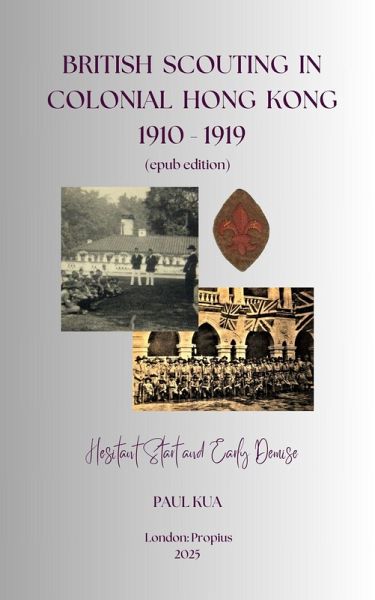
This book deals with the history of the first decade of Hong Kong Scouting. It is divided into six chapters. Chapter 1, First Boy Scouts in Hong Kong, 1910; Chapter 2, Baden-Powell's first and only visit, 1912; Chapter 3, First Hong Kong Scout Troop, 1913; Chapter 4, British Wolf Cub Packs, 1914; Chapter 5, Girl Guiding and winding up of Scout Association, 1916; Chapter 6, Founding-year myth, 1961-2000s.In these early years, citizenship training meant preparing only a small number of British boys for God and the empire. Militarism, religion, sectarianism, and nationalism all mattered. Racial e...
This book deals with the history of the first decade of Hong Kong Scouting. It is divided into six chapters. Chapter 1, First Boy Scouts in Hong Kong, 1910; Chapter 2, Baden-Powell's first and only visit, 1912; Chapter 3, First Hong Kong Scout Troop, 1913; Chapter 4, British Wolf Cub Packs, 1914; Chapter 5, Girl Guiding and winding up of Scout Association, 1916; Chapter 6, Founding-year myth, 1961-2000s.
In these early years, citizenship training meant preparing only a small number of British boys for God and the empire. Militarism, religion, sectarianism, and nationalism all mattered. Racial exclusion through British nationality requirements and cadet enrollment rules, age-based inclusion through Wolf Cubs, and gendered treatment through later and segregated training for girls in Guiding all acted together to create differentiated experiences for youth in Scouting, defined broadly to include Guiding.
The Scout Movement prides itself as an international brotherhood, free of racism. Yet race, assuming the veil of nationality restrictions, excluded most Chinese and many Portuguese boys from Hong Kong Scouting in its first decade.
The Scout Movement teaches duty to God. Yet religion or rather Christian sectarian prejudices retarded the start and hastened the end of Hong Kong Scouting.
The Scout Movement supposedly prepares boys to become good soldiers. Yet war provided an excuse first for excluding many boys from Hong Kong Scouting, and later for winding up the Boy Scouts Association in the colony.
In short, a particular vision of nationality, empire, religion and war informed a hesitant start of Hong Kong Scouting, a rather exclusionary approach to enrollment and an early demise of the movement in these pre-World War One years.
In these early years, citizenship training meant preparing only a small number of British boys for God and the empire. Militarism, religion, sectarianism, and nationalism all mattered. Racial exclusion through British nationality requirements and cadet enrollment rules, age-based inclusion through Wolf Cubs, and gendered treatment through later and segregated training for girls in Guiding all acted together to create differentiated experiences for youth in Scouting, defined broadly to include Guiding.
The Scout Movement prides itself as an international brotherhood, free of racism. Yet race, assuming the veil of nationality restrictions, excluded most Chinese and many Portuguese boys from Hong Kong Scouting in its first decade.
The Scout Movement teaches duty to God. Yet religion or rather Christian sectarian prejudices retarded the start and hastened the end of Hong Kong Scouting.
The Scout Movement supposedly prepares boys to become good soldiers. Yet war provided an excuse first for excluding many boys from Hong Kong Scouting, and later for winding up the Boy Scouts Association in the colony.
In short, a particular vision of nationality, empire, religion and war informed a hesitant start of Hong Kong Scouting, a rather exclusionary approach to enrollment and an early demise of the movement in these pre-World War One years.
Dieser Download kann aus rechtlichen Gründen nur mit Rechnungsadresse in A, B, CY, CZ, D, DK, EW, E, FIN, F, GR, H, IRL, I, LT, L, LR, M, NL, PL, P, R, S, SLO, SK ausgeliefert werden.
Andere Kunden interessierten sich für