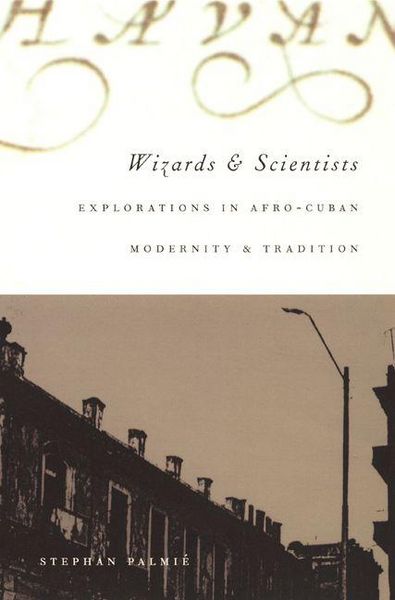
Wizards and Scientists Explorations in Afro-Cuban Modernity and Tradition
-
- Hardcover
- Taschenbuch ausgewählt
- eBook
-
Sprache:Englisch
46,99 €
inkl. gesetzl. MwSt.,
Lieferung nach Hause
Beschreibung
Produktdetails
Einband
Taschenbuch
Erscheinungsdatum
19.03.2002
Verlag
Duke University PressSeitenzahl
416
Maße (L/B/H)
23,5/15,6/2,9 cm
Gewicht
640 g
Sprache
Englisch
ISBN
978-0-8223-2842-1
In Wizards and Scientists Stephan PalmiÉ offers a corrective to the existing historiography on the Caribbean. Focusing on developments in Afro-Cuban religious culture, he demonstrates that traditional Caribbean cultural practices are part and parcel of the same history that produced modernity and that both represent complexly interrelated hybrid formations. PalmiÉ argues that the standard narrative trajectory from tradition to modernity, and from passion to reason, is a violation of the synergistic processes through which historically specific, moral communities develop the cultural forms that integrate them.
Highlighting the ways that Afro-Cuban discourses serve as a means of moral analysis of social action, PalmiÉ suggests that the supposedly irrational premises of Afro-Cuban religious traditions not only rival Western rationality in analytical acumen but are integrally linked to rationality itself. Afro-Cuban religion is as “modern” as nuclear thermodynamics, he claims, just as the Caribbean might be regarded as one of the world’s first truly “modern” locales: based on the appropriation and destruction of human bodies for profit, its plantation export economy anticipated the industrial revolution in the metropolis by more than a century. Working to prove that modernity is not just an aspect of the West, PalmiÉ focuses on those whose physical abuse and intellectual denigration were the price paid for modernity’s achievement. All cultures influenced by the transcontinental Atlantic economy share a legacy of slave commerce. Nevertheless, local forms of moral imagination have developed distinctive yet interrelated responses to this violent past and the contradiction-ridden postcolonial present that can be analyzed as forms of historical and social analysis in their own right.
Noch keine Bewertungen vorhanden
Verfassen Sie die erste Bewertung zu diesem Artikel
Helfen Sie anderen Kundinnen und Kunden durch Ihre Meinung.
Kurze Frage zu unserer Seite
Vielen Dank für dein Feedback
Wir nutzen dein Feedback, um unsere Produktseiten zu verbessern. Bitte habe Verständnis, dass wir dir keine Rückmeldung geben können. Falls du Kontakt mit uns aufnehmen möchtest, kannst du dich aber gerne an unseren Kund*innenservice wenden.
zum Kundenservice