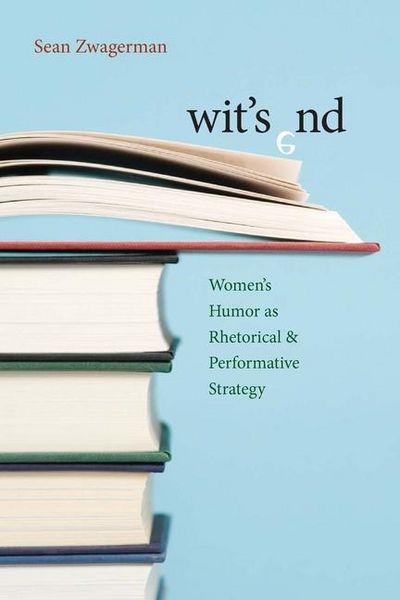
Wit's End Women's Humor as Rhetorical and Performative Strategy
-
- Taschenbuch ausgewählt
- eBook
-
Sprache:Englisch
59,99 €
inkl. gesetzl. MwSt.,
Lieferung nach Hause
Beschreibung
Produktdetails
Einband
Taschenbuch
Erscheinungsdatum
25.04.2010
Verlag
University Of Pittsburgh PressSeitenzahl
264
Maße (L/B/H)
22,4/15,2/2 cm
Gewicht
386 g
Sprache
Englisch
ISBN
978-0-8229-6074-4
In Wit's End, Sean Zwagerman offers an original perspective on women's use of humor as a performative strategy as seen in works of twentieth-century American literature. He argues that women whose direct, explicit performative speech has been traditionally denied, or not taken seriously, have often turned to humor as a means of communicating with men.
The book examines both the potential and limits of women's humor as a rhetorical strategy in the writings of James Thurber, Zora Neale Hurston, Dorothy Parker, Edward Albee, Louise Erdrich, and others. For Zwagerman, these texts "talk back" to important arguments in humor studies and speech-act theory. He deconstructs the use of humor in select passages by employing the theories of J. L. Austin, John Searle, Jacques Derrida, Shoshana Felman, J. Hillis Miller, and Eve Kosofsky Sedgwick. Zwagerman offers arguments both for and against these approaches while advancing new thinking on humor as the "end"--both the goal and limit--of performative strategy, and as a means of expressing a full range of serious purposes. Zwagerman contends that women's humor is not solely a subversive act, but instead it should be viewed in the total speech situation through context, motives, and intended audience. Not strictly a transgressive influence, women's humor is seen as both a social corrective and a reinforcement of established ideologies. Humor has become an epistemology, an "attitude" or slant on one's relation to society. Zwagerman seeks to broaden the scope of performativity theory beyond the logical pragmatism of deconstruction and looks to the use of humor in literature as a deliberate stylization of experiences found in real-world social structures, and as a tool for change.>
Zwagerman seeks to broaden the scope of performativity theory beyond the logical pragmatism of deconstruction and looks to the use of humor in literature as a deliberate stylization of experiences found in real-world social structures, and as a tool for change.
Kundinnen und Kunden meinen
Verfassen Sie die erste Bewertung zu diesem Artikel
Helfen Sie anderen Kund*innen durch Ihre Meinung
Kurze Frage zu unserer Seite
Vielen Dank für dein Feedback
Wir nutzen dein Feedback, um unsere Produktseiten zu verbessern. Bitte habe Verständnis, dass wir dir keine Rückmeldung geben können. Falls du Kontakt mit uns aufnehmen möchtest, kannst du dich aber gerne an unseren Kund*innenservice wenden.
zum Kundenservice