Gutscheinbedingungen

**Gültig vom 15.06.2026 bis 17.06.2026 | Gültig für nicht preisgebundene fremdsprachige Bücher | Einzelne Artikel können ausgeschlossen sein | Maximaler rabattfähiger Warenkorbwert 500 € | Nicht kombinierbar mit weiteren Aktionen | Nur einmal pro Person einlösbar | Nur solange der Vorrat reicht

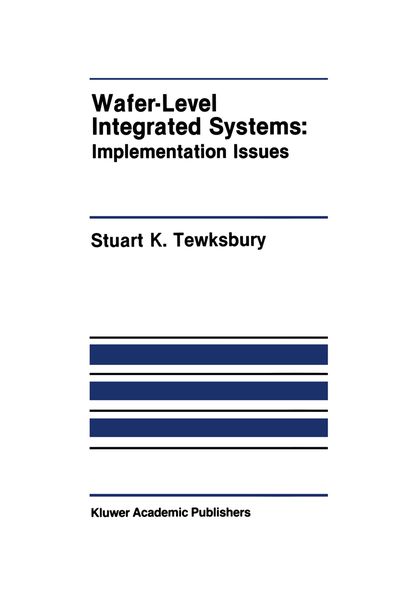
  • Produktbild: Wafer-Level Integrated Systems
  • Produktbild: Wafer-Level Integrated Systems
Band 70

Wafer-Level Integrated Systems Implementation Issues

146,99 €

inkl. gesetzl. MwSt., Versandkostenfrei

Lieferung nach Hause

Beschreibung

Produktdetails

Einband

Taschenbuch

Erscheinungsdatum

09.02.2012

Verlag

Springer Us

Seitenzahl

456

Maße (L/B/H)

23,5/15,5/2,6 cm

Gewicht

715 g

Auflage

Softcover reprint of the original 1st ed. 1989

Sprache

Englisch

ISBN

978-1-4612-8898-5

Beschreibung

Produktdetails

Einband

Taschenbuch

Erscheinungsdatum

09.02.2012

Verlag

Springer Us

Seitenzahl

456

Maße (L/B/H)

23,5/15,5/2,6 cm

Gewicht

715 g

Auflage

Softcover reprint of the original 1st ed. 1989

Sprache

Englisch

ISBN

978-1-4612-8898-5

Herstelleradresse

Springer-Verlag GmbH
Tiergartenstr. 17
69121 Heidelberg
DE

Email: ProductSafety@springernature.com

Kundinnen und Kunden meinen

0 Bewertungen

Informationen zu Bewertungen

Zur Abgabe einer Bewertung ist eine Anmeldung im Konto notwendig. Die Authentizität der Bewertungen wird von uns nicht überprüft. Wir behalten uns vor, Bewertungstexte, die unseren Richtlinien widersprechen, entsprechend zu kürzen oder zu löschen.

Die Bewertungen sind nach Format, Anzahl Sterne und Datum sortiert.

Verfassen Sie die erste Bewertung zu diesem Artikel

Helfen Sie anderen Kund*innen durch Ihre Meinung

Kundinnen und Kunden meinen

0 Bewertungen filtern

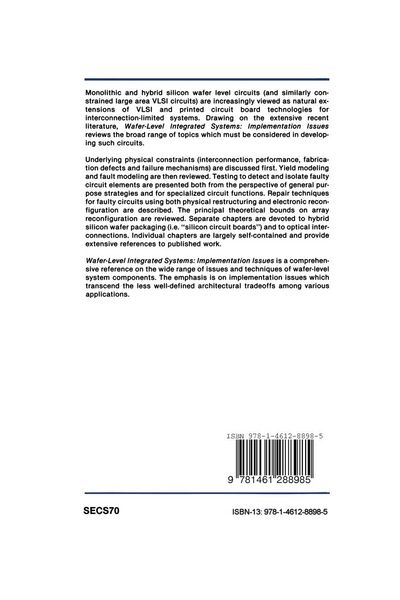
  • Produktbild: Wafer-Level Integrated Systems
  • Produktbild: Wafer-Level Integrated Systems
  • 1. Introduction and Overview.- 1.1 Device vs System Scaling.- 1.2 Major Implementation Issues.- 1.2.1 Reconfiguration Mechanisms.- 1.2.2 Architecural Reconfiguration Issues.- 1.2.3 Defects vs Failures.- 1.2.4 Yield Models.- 1.2.5 Fault Modeling.- 1.2.6 Testing.- 1.2.7 Reconfiguration Algorithms.- 1.2.8 WSI Packaging.- 1.3 ESPRIT 824 WSI Program.- References.- 2. Interconnect Issues.- 2.1 Physical Interconnect Hierarchy.- 2.2 Recursive vs Non-Recursive Interconnect Links.- 2.3 On-Chip Interconnect Lengths.- 2.4 Inter-Chip Connection Lengths.- 2.5 Electrical Models of Interconnection Lines.- 2.6 Minimum Line Capacitance.- 2.7 Scaling of On-Chip Interconnections.- 2.8 Chip-to-Board Interconnect Discontinuity.- 2.9 Comparison of Packaging Schemes.- 2.10 Clock Distribution and Clock Skew.- References.- 3. Fabrication Defects.- 3.1 Substrate defects.- 3.1.1 The “perfect” crystal and Intrinsic Defects.- 3.1.2 Crystal growth and defects.- 3.1.3 Dislocations and stacking faults.- 3.1.4 Gettering for low defect density active regions.- 3.1.5 Wafer flatness distortions.- 3.2 Lithography-induced defects.- 3.2.1 Photoresists-induced defects.- 3.2.2 Resist pattern exposure.- 3.2.3 Mask-to-mask alignment errors.- 3.3 Thin Film Defects.- 3.3.1 Metal line defects.- 3.3.2 Dielectric defects.- 3.3.3 Interlayer vias/contacts.- References.- 4. Reliability and Failures.- 4.1 Failure rate modeling.- 4.1.1 Failure Rate Measures.- 4.1.2 Analytic models.- 4.2 General reliability of IC’s.- 4.2.1 Bathtub reliability rate curve.- 4.2.2 Models for thermally activated failures.- 4.2.3 Oxide breakdown.- 4.2.4 Oxide wearout.- 4.2.5 Hot electron injection induced failure.- 4.3 Failure due to metal electromigration.- 4.4 Failure rates under MOS dimensional and voltage scaling laws.- References.- 5. Yield models and Analysis.- 5.1 General yield models.- 5.2 Early yield models.- 5.3 General IC yield models.- 5.4 VLSI yield models based on yield observations.- 5.5 Defect size distributions and critical areas.- 5.6 Yield simultion in VLSI CAD tools.- 5.7 Appendix.- References.- 6. Fault Modeling.- 6.1 General fault modeling issues.- 6.2 Definitions.- 6.3 Stuck-at faults and weak 0/1 faults.- 6.4 “Stuck” transistor faults.- 6.5 Bridging faults.- 6.6 Metastability in latches and flip-flops.- References.- 7. General testing techniques.- 7.1 General Test issues.- 7.1.1 Manufacturing defect testing.- 7.1.2 In-service testing.- 7.1.3 General purpose vs special purpose testing.- 7.2 Scan path test design.- 7.3 LSSD-based Test Methodologies.- 7.4 Pseudorandom test pattern generators.- 7.5 Test response compression.- 7.5.1 General test response analysis schemes.- 7.5.2 Counting response analysis.- 7.5.3 Signature analysis.- 7.5.4 Parallel data signature analysis.- References.- 8. Function-Specific Testing.- 8.1 Memory testing.- 8.1.1 General memory organization.- 8.1.2 Functions requiring fault models.- 8.1.3 Memory cell array fault models.- 8.1.4 Decoder logic fault models.- 8.1.5 Read/write logic fault models.- 8.1.6 Memory test algorithms.- 8.2 Built-in testing of regular arrays.- 8.2.1 Testing linear iterative arrays.- 8.2.2 C-testable array multipliers.- 8.2.3 Recomputing with shifted operands.- 8.2.4 Algorithm-based fault tolerance.- 8.3 Testable programmable logic arrays.- 8.3.1 Physical and logical fault models.- 8.3.2 Design for testable PLA’s.- References.- 9. Physical Restructuring.- 9.1 General Restructuring Techniques.- 9.2 Laser “zapping” for memory repair.- 9.3 Electronically field-programmable anti-fuses.- 9.4 Laser-assisted chemical processing.- 9.4.1 General laser-enhanced chemical processing.- 9.4.2 General applications.- 9.4.3 Laser-assisted chemical processing for interconnect restructuring.- 9.5 Focussed ion beams for restructuring.- 9.6 Electron beam restructuring.- 9.7 Restructurable VLSI program.- 9.7.1 Laser vertical links.- 9.7.2 Laser diffused link.- 9.7.3 Software tools for RVLSI.- References.- 10. Programmable Electronic Reconfiguration Switches.- 10.1 General switching issues.- 10.1.1 Area overhead.- 10.1.2 General delay issues.- 10.1.3 Comparison of physical and electronic reconfiguration.- 10.2 Reconfigurable processors.- 10.3 WASP (The WAfer-scale Systolic Processor).- 10.4 Representative switch configurations.- 10.5 Non-lattice reconfiguration switch organizations.- References.- 11. Formal Models of Reconfiguration.- 11.1 Introduction.- 11.2 Probabilistic bounds: Linear arrays.- 11.2.1 General results on fault distributions.- 11.2.2 Patching method.- 11.2.3 The minimum spanning tree method of Leighton and Leiserson.- 11.2.4 The minimum spanning tree method of Greene and Gamal.- 11.3 Probabilistic bounds: 2-dimensional arrays.- 11.3.1 Tree-of-meshes algorithm.- 11.3.2 Divide and conquer method.- 11.4 The Diogenes approach of Rosenberg.- 11.5 Self-reconfiguration algorithms.- 11.6 Spare roow/column allocation algorithms.- References.- 12. Silicon Wafer Hybrids.- 12.1 Introduction.- 12.2 Wafer transmission module.- 12.2.1 WTM technology.- 12.2.2 3-D wafer-stacks.- 12.2.3 Performance issues.- 12.3 AVP modules.- 12.4 Programmable hybrid wafer circuits.- 12.5 MicroChannel cooling and chip attachment.- 12.6 Microwave performance issues.- 12.7 Chip Templates.- 12.8 Other Silicon Circuit Board Studies.- 12.8.1 Self-Aligned Solder Bump Chip Attachment.- 12.8.2 Stacked Wafer Modules.- References.- 13. Optical Interconnections.- 13.1 optical interconnects.- 13.1.1 Electronic On-Chip Data Rates.- 13.1.2 Electronic Interconnection Energy Burdens.- 13.1.3 Energy Burden of Optical Links.- 13.1.4 Energy Burden of Wafer-to-Wafer Interconnections.- 13.2 Optical Interconnect Components.- 13.2.1 Optical Transmission Medium.- 13.2.2 Optical “Connectors”.- 13.2.3 Optical Sources and Detectors.- References.