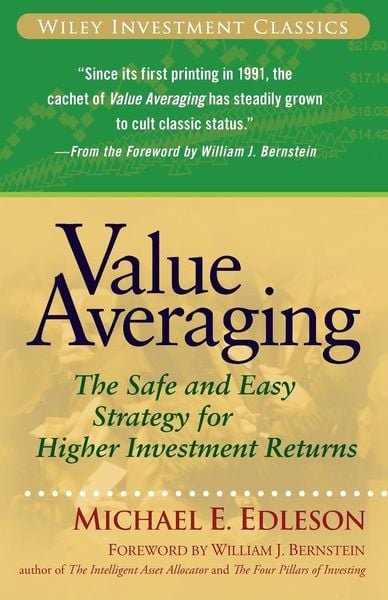
Value Averaging The Safe and Easy Strategy for Higher Investment Returns
Aus der Reihe
Wiley Investment Classic Series
-
- Taschenbuch ausgewählt
- eBook
-
Sprache:Englisch
24,99 €
inkl. gesetzl. MwSt.,
Lieferung nach Hause
Beschreibung
Produktdetails
Einband
Taschenbuch
Erscheinungsdatum
01.10.2006
Verlag
John Wiley & Sons IncSeitenzahl
256
Maße (L/B/H)
21,6/14/1,5 cm
Gewicht
330 g
Auflage
1. Auflage
Sprache
Englisch
ISBN
978-0-470-04977-8
Praise for Value Averaging
"Dollar cost averaging is making a comeback, and Mike Edleson's value averaging approach is dollar cost averaging on steroids. A must-read for serious investors willing to adhere to the principles found in these pages."
--William G. Christie, Frances Hampton Currey Professor of Finance and Professor of Law, Owen Graduate School of Management, Vanderbilt University
"Dr. Edleson's book is truly a classic that needs to be perpetuated. I have spent a significant chunk of my career trying to debunk value averaging, but with no success. I'm a believer!"
--Paul S. Marshall, PhD, Professor of Finance, Widener University
From the First Edition
"Today's best way to invest."
--Money magazine
"Value averaging takes dollar cost averaging one step further. Besides buying low, you sell shares when the markets soar."
--The New York Times
Michael Edleson first introduced his concept of value averaging to the world in an article written in 1988. To satisfy investor interest, he wrote a book entitled Value Averaging, which further detailed this method. Following the publication of the last edition of this highly sought-after book in 1993, it has been nearly impossible to find--until now. With the reintroduction of Value Averaging, you now have access to Edleson's original work on a strategy that can help you accumulate wealth, increase your investment returns, and achieve your financial goals.
"Dollar cost averaging is making a comeback, and Mike Edleson's value averaging approach is dollar cost averaging on steroids. A must-read for serious investors willing to adhere to the principles found in these pages."
--William G. Christie, Frances Hampton Currey Professor of Finance and Professor of Law, Owen Graduate School of Management, Vanderbilt University
"Dr. Edleson's book is truly a classic that needs to be perpetuated. I have spent a significant chunk of my career trying to debunk value averaging, but with no success. I'm a believer!"
--Paul S. Marshall, PhD, Professor of Finance, Widener University
From the First Edition
"Today's best way to invest."
--Money magazine
"Value averaging takes dollar cost averaging one step further. Besides buying low, you sell shares when the markets soar."
--The New York Times
Michael Edleson first introduced his concept of value averaging to the world in an article written in 1988. To satisfy investor interest, he wrote a book entitled Value Averaging, which further detailed this method. Following the publication of the last edition of this highly sought-after book in 1993, it has been nearly impossible to find--until now. With the reintroduction of Value Averaging, you now have access to Edleson's original work on a strategy that can help you accumulate wealth, increase your investment returns, and achieve your financial goals.
Kundinnen und Kunden meinen
Verfassen Sie die erste Bewertung zu diesem Artikel
Helfen Sie anderen Kund*innen durch Ihre Meinung
Kurze Frage zu unserer Seite
Vielen Dank für dein Feedback
Wir nutzen dein Feedback, um unsere Produktseiten zu verbessern. Bitte habe Verständnis, dass wir dir keine Rückmeldung geben können. Falls du Kontakt mit uns aufnehmen möchtest, kannst du dich aber gerne an unseren Kund*innenservice wenden.
zum Kundenservice