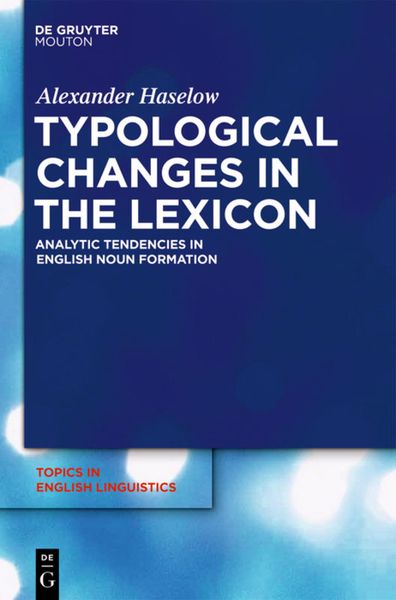
Typological Changes in the Lexicon Analytic Tendencies in English Noun Formation
136,99 €
inkl. gesetzl. MwSt.,
Lieferung nach Hause
Beschreibung
Produktdetails
Einband
Gebundene Ausgabe
Erscheinungsdatum
28.01.2011
Abbildungen
mit 25 Illustrationen, mit 72 tblättern
Verlag
De Gruyter OldenbourgSeitenzahl
316
Maße (L/B/H)
23,6/16/2,4 cm
Gewicht
618 g
Auflage
1
Sprache
Englisch
ISBN
978-3-11-023820-4
This is the first study of the typological change of English from a synthetic towards an analytic language that focuses exclusively on the lexical domain of the language. It presents an innovative approach to linguistic typology by focusing on the different encoding techniques used in the lexicon, providing a theoretical framework for the description of structural types (synthetic, analytic) and encoding techniques (fusional, isolating, agglutinative, incorporating) found in the lexicon of a language.
It is argued that, in the case of English, the change from syntheticity to analyticity did not only affect its inflectional system and the encoding of grammatical information, but also the derivational component. Based on a cognitive approach to derivation, the book provides empirical evidence for a considerable decline in the use of synthetic structures and a trend towards higher degrees of analyticity in a specific lexical domain of English, the formation of nouns by means of derivation. The full extent of this change surfaced during the transition from Old English to early Middle English, but it was later partly reversed though influence from French. The typological shift was thus the result of a global structural reorganization of the language that resulted in a fundamental change of the structure of words.
The book also presents a comprehensive account of the historical development of nominal derivation from the beginnings of Old English until the end of the early Middle English period. Based on empirical data from written sources the study documents the frequency of use of all Germanic-based derivational morphemes for nominalizations over different subperiods and discusses their origin as well as important changes of their semantic and morphological properties.
Kundinnen und Kunden meinen
Verfassen Sie die erste Bewertung zu diesem Artikel
Helfen Sie anderen Kund*innen durch Ihre Meinung
Kurze Frage zu unserer Seite
Vielen Dank für dein Feedback
Wir nutzen dein Feedback, um unsere Produktseiten zu verbessern. Bitte habe Verständnis, dass wir dir keine Rückmeldung geben können. Falls du Kontakt mit uns aufnehmen möchtest, kannst du dich aber gerne an unseren Kund*innenservice wenden.
zum Kundenservice