
Gutscheinbedingungen

**Gültig vom 15.06.2026 bis 17.06.2026 | Gültig für nicht preisgebundene fremdsprachige Bücher | Einzelne Artikel können ausgeschlossen sein | Maximaler rabattfähiger Warenkorbwert 500 € | Nicht kombinierbar mit weiteren Aktionen | Nur einmal pro Person einlösbar | Nur solange der Vorrat reicht

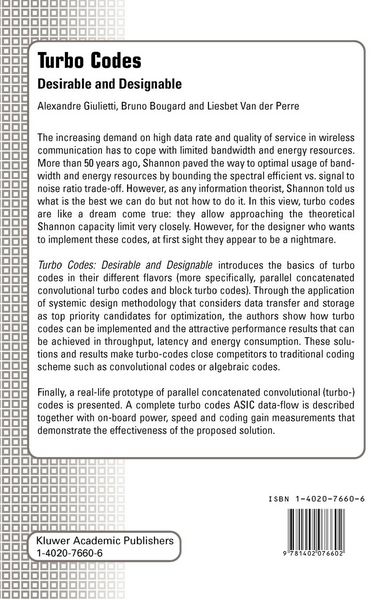
  • Produktbild: Turbo Codes
  • Produktbild: Turbo Codes
- 12%

Turbo Codes Desirable and Designable

12% sparen

93,99 € UVP 106,99 €

inkl. gesetzl. MwSt., Versandkostenfrei

Lieferung nach Hause

Beschreibung

Produktdetails

Einband

Gebundene Ausgabe

Erscheinungsdatum

31.12.2003

Verlag

Springer Us

Seitenzahl

150

Maße (L/B/H)

24,1/16/1,4 cm

Gewicht

434 g

Auflage

2004

Sprache

Englisch

ISBN

978-1-4020-7660-2

Beschreibung

Produktdetails

Einband

Gebundene Ausgabe

Erscheinungsdatum

31.12.2003

Verlag

Springer Us

Seitenzahl

150

Maße (L/B/H)

24,1/16/1,4 cm

Gewicht

434 g

Auflage

2004

Sprache

Englisch

ISBN

978-1-4020-7660-2

Herstelleradresse

Springer-Verlag GmbH
Tiergartenstr. 17
69121 Heidelberg
DE

Email: ProductSafety@springernature.com

Kundinnen und Kunden meinen

0 Bewertungen

Informationen zu Bewertungen

Zur Abgabe einer Bewertung ist eine Anmeldung im Konto notwendig. Die Authentizität der Bewertungen wird von uns nicht überprüft. Wir behalten uns vor, Bewertungstexte, die unseren Richtlinien widersprechen, entsprechend zu kürzen oder zu löschen.

Die Bewertungen sind nach Format, Anzahl Sterne und Datum sortiert.

Verfassen Sie die erste Bewertung zu diesem Artikel

Helfen Sie anderen Kund*innen durch Ihre Meinung

Kundinnen und Kunden meinen

0 Bewertungen filtern

  • Produktbild: Turbo Codes
  • Produktbild: Turbo Codes
  • 1: Turbo CodesIntroducing the communication problem they solve, and the implementation problem they create.- 1.1. A communication and Microelectronics perspective.- 1.1.1 Scientific fathers recalled: Shannon and Shockley.- 1.1.2 Channel coding: from simple engines to turbo.- 1.1.3 IC revolution: from transistors to 4G radios.- 1.1.4 The implementation problem and goals.- 1.2. Turbo codes: desirable channel coding solutions.- 1.2.1 Channel coding: an essential ingredient in digital communication systems.- 1.2.2 Block and Convolutional Channel Codes: the basics.- 1.2.3 Concatenated codes.- 1.2.4 Parallel concatenated convolutional (turbo) codes.- 1.2.5 Decoding parallel concatenated Turbo codes.- 1.2.6 Serially concatenated block codes.- 1.3 Conclusions.- 1.4 References.- 2: Design Methodology: The Strategic PlanGetting turbo-codes implemented at maximum performance/cost.- 2.1 Introduction.- 2.2 Algorithmic exploration.- 2.3 Data Transfer and Storage Exploration.- 2.4 From architecture to silicon integration.- 2.5 Conclusions.- 2.6 References.- 3: Conquering the MapRemoving the main bottleneck of convolutional turbo decoders.- 3.1 Introduction.- 3.2 The MAP decoding algorithm for convolutional turbo codes.- 3.3 Simplification of the MAP algorithm: log-max MAP.- 3.3.1 The log-max MAP algorithm.- 3.4 Trellis termination in convolutional turbo codes.- 3.4.1 No termination.- 3.4.2 Single termination.- 3.4.3 Double termination.- 3.5 MAP architecture definition: systematic approach.- 3.5.1 MAP bottlenecks.- 3.5.2 Data Flow and Loop Transformations.- 3.5.3 Storage Cycle Budget Distribution.- 3.5.4 Memory organization.- 3.6 Conclusions.- 3.7 References.- 4: Demystifying the Fang-Buda AlgorithmBoosting the block turbo decoding.- 4.1. Introduction.- 4.2. Soft decoding of algebraic codes.- 4.2.1 Maximum likelihood decoding of block codes.- 4.2.2 The Chase algorithm.- 4.2.3 The Fang-Buda Algorithm (FBA).- 4.3. FBA Optimization and Architecture Derivation.- 4.3.1 Data Type Refinement.- 4.3.2 Data and control flow transformations.- 4.3.3 Data Reuse Decision and Storage Cycle Budget Distribution.- 4.3.4 Memory allocation and assignment.- 4.4. FBA-based BTC decoder performance.- 4.5. Conclusions.- 4.6. References.- 5: Mastering the InterleaverDivide and Conquer.- 5.1. Introduction.- 5.2. Basic elements of the interleaver.- 5.3. Collision-free interleavers.- 5.4. Case study: the 3GPP interleaver and a 3GPP collision-free interleaver.- 5.5. Optimized scheduling for turbo decoding: collision-free interleaving and deinterleaving.- 5.6. References.- 6: T@MPO CodecFrom theory to real life silicon.- 6.1. Introduction.- 6.2. Positioning oneself in the optimal performance-speed-cost space.- 6.3. Design flow.- 6.4. Decoder final architecture.- 6.5. Synthesis results.- 6.6. Measurements results.- 6.7. T@MPO features.- 6.8. References.- Abbreviations list.- Symbol list.