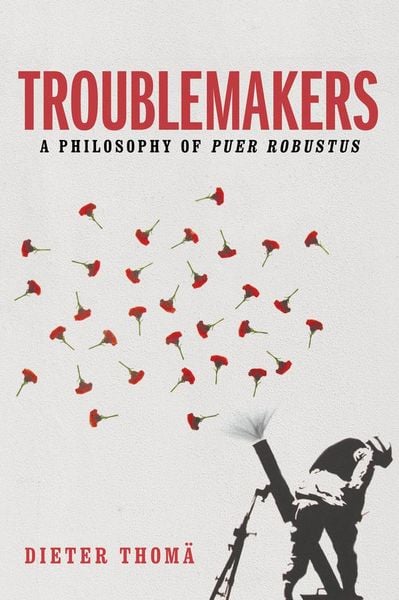
Troublemakers A Philosophy of Puer Robustus
52,99 €
inkl. gesetzl. MwSt.,
Lieferung nach Hause
Beschreibung
Produktdetails
Einband
Gebundene Ausgabe
Erscheinungsdatum
19.04.2019
Verlag
John Wiley & SonsSeitenzahl
400
Maße (L/B/H)
23,2/15,4/4,4 cm
Gewicht
862 g
Auflage
1. Auflage
Übersetzt von
Jessica Spengler
Sprache
Englisch
ISBN
978-1-5095-2558-4
The political crises and upheavals of our age often originate from the periphery rather than the center of power. Figures like Edward Snowden, Julian Assange, and Chelsea Manning acted in ways that disrupted power, revealing truths that those in power wanted to keep hidden. They are thorns in the side of power, troublemakers in the eyes of the powerful, though their actions may be valuable and lead to positive changes.
In this important new book, Dieter Thomä examines the crucial but often overlooked function of these figures on the margins of society, developing a philosophy of troublemakers from the seventeenth century to the present day. Thomä takes as his starting point Hobbes's idea of the puer robustus (literally "stout boy"), meaning a figure who rebels against order and authority. While Hobbes saw the puer robustus as a threat, he also recognized the potential, in the right conditions, for figures to rise up and become agents of positive change. Building on this notion, Thomä provides a rich survey of intellectuals who have been inspired by this idea over the past 300 years, from Rousseau, Diderot, Schiller, Victor Hugo, Marx, and Freud to Carl Schmitt, Leo Strauss, and Horkheimer, right up to the recent work of Badiou and Agamben. In doing so, he develops a typology of the puer robustus and a means by which we can evaluate and assess the troublemakers of our own times.
Thomä shows that troublemakers are an inescapable part of modernity, for as soon as social and political boundaries are defined, there will always be figures challenging them from the margins. This book will be of great interest not only to students and scholars in the humanities and social sciences but to anyone seeking to understand the crucial impact of these liminal figures on our world today.
In this important new book, Dieter Thomä examines the crucial but often overlooked function of these figures on the margins of society, developing a philosophy of troublemakers from the seventeenth century to the present day. Thomä takes as his starting point Hobbes's idea of the puer robustus (literally "stout boy"), meaning a figure who rebels against order and authority. While Hobbes saw the puer robustus as a threat, he also recognized the potential, in the right conditions, for figures to rise up and become agents of positive change. Building on this notion, Thomä provides a rich survey of intellectuals who have been inspired by this idea over the past 300 years, from Rousseau, Diderot, Schiller, Victor Hugo, Marx, and Freud to Carl Schmitt, Leo Strauss, and Horkheimer, right up to the recent work of Badiou and Agamben. In doing so, he develops a typology of the puer robustus and a means by which we can evaluate and assess the troublemakers of our own times.
Thomä shows that troublemakers are an inescapable part of modernity, for as soon as social and political boundaries are defined, there will always be figures challenging them from the margins. This book will be of great interest not only to students and scholars in the humanities and social sciences but to anyone seeking to understand the crucial impact of these liminal figures on our world today.
Kundinnen und Kunden meinen
Verfassen Sie die erste Bewertung zu diesem Artikel
Helfen Sie anderen Kund*innen durch Ihre Meinung
Kurze Frage zu unserer Seite
Vielen Dank für dein Feedback
Wir nutzen dein Feedback, um unsere Produktseiten zu verbessern. Bitte habe Verständnis, dass wir dir keine Rückmeldung geben können. Falls du Kontakt mit uns aufnehmen möchtest, kannst du dich aber gerne an unseren Kund*innenservice wenden.
zum Kundenservice