Gutscheinbedingungen

**Gültig bis 10.06.2026 / Gültig für gebrauchte Bücher / Mindestbestellwert 20,00 € / Einzelne Artikel können ausgeschlossen sein / Online auf www.bücher.de.de / Nicht kombinierbar mit anderen Gutscheinen oder Preisaktionen / Nur einmal pro Einkauf einlösbar / Gutschein wird auf max. 500€ Bestellwert angerechnet / Keine Barauszahlung / Nicht gültig für Versandkosten und Services

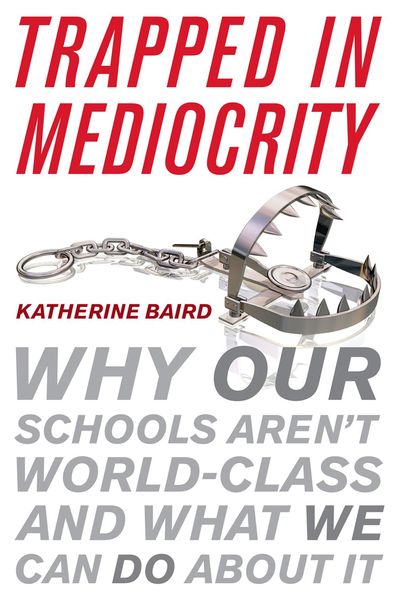
Produktbild: Trapped in Mediocrity

Trapped in Mediocrity Why Our Schools Aren't World-Class and What We Can Do About It

61,99 €

inkl. gesetzl. MwSt., Versandkostenfrei

Lieferung nach Hause

Beschreibung

Produktdetails

Einband

Gebundene Ausgabe

Erscheinungsdatum

09.08.2012

Verlag

Globe Pequot Publishing Group Inc

Seitenzahl

260

Maße (L/B/H)

23/15,9/1,4 cm

Gewicht

522 g

Sprache

Englisch

ISBN

978-1-4422-1547-4

Beschreibung

Zitat

Our high-school and college dropout rates are appalling, and the achievement levels of those students who remain in school don't come close to matching the levels of students in other developed nations. Too many American high-school graduates can't read, and too many college graduates can't appreciate nuanced writing. Baird, economist and academic, details the problem of low standards in American public schools, then goes beyond the statistics to address why it is that the standards are so low. Why do so few elementary schools insist that students begin to learn algebra and geometry rather than wait until high school? She laments that education policies and reform are aimed at the symptoms rather than the root causes. Baird begins with a historical overview of how public education policy has been developed and goes on to detail the social and economic cost to the nation of having such low academic standards, including lower productivity and greater wage inequality. Baird offers specific solutions, including reforming governance of school systems to reduce bureaucracy, setting high national standards, providing support to schools serving disadvantaged students, and providing strong incentives to students to work hard. Booklist Dr. Baird's work is an ambitious synthesis of factors contributing to a problem affecting all of us. It is one she has not only elucidated, but also meticulously documented in a clear and highly readable style. The reader is brought along with summarizations; each premise builds on the last. It is a monumental effort that deserves the attention of educators at all levels. The next phase-i.e. the implementation-requires Dr. Baird's deft hand as well. New York Journal of Books The latest addition to the swelling chorus singing the tune that 'governance is a major part of what's wrong with American K-12 education' is University of Washington economist Katherine Baird, who has just published a perceptive and worthwhile book on how to harmonize our discordant school system. The author brings some unique economics-style analysis to bear, including identification of the 'two principal shortcomings' of today's governance structure, which she dubs the 'Principal-Agent Problem.' The 'Principal' is 'society as a whole, but parents and students in particular' (that is, those who benefit from the system), while the 'Agent' is the mix of adult interests, structures, and organizations that run the system. The Agent is supposed to advance the interests of the Principal but mainly doesn't, in part because the Agent has way too many levels, components, and competing interests. Baird's remedy is to raise standards radically-national standards-and decentralize control of the system to the building level. The Education Gadfly Weekly Baird (economics, Univ. of Washington, Tacoma) presents the major reasons for her conclusion that US public schools are "trapped in mediocrity" and less than "world-class." As an economist, she focuses on economic policy and governance issues. Baird favors a national approach to solving education dilemmas, despite constitutional commitment to state-level control. Above all, she criticizes low academic standards and expectations for students and the "perceived high costs and low benefits" of US schooling...This book is worth reading for the important questions it raises. Summing Up: Recommended. Undergraduate, graduate, research, and professional collections. CHOICE This roadmap to raising aspirations, improving delivery and aligning governance and funding with improved performance builds on the experience of today's highest performing and most rapidly improving education systems. -- Andreas Schleicher, special advisor on education policy to the OECD's Secretary-General and OECD Deputy Director of Education Baird challenges us to overcome educational mediocrity by setting powerful goals and creating the incentives and policies to achieve them. She demonstrates that the cost of educational mediocrity and failure is much higher than is conventionally acknowledged and provides a reasoned and energetic strategy to attain educational success for our students and society. -- Henry Levin, William H. Kilpatrick Professor of Economics & Education, Columbia University Katherine Baird has given us a lucid account of what is wrong with k-12 education in the United States and what we can do about it. She avoids the common temptation to focus on one problem and one magic bullet that would fix it, instead showing how the various issues are intertwined and how other countries have found solutions. Unless fundamental structural defects are addressed by promoting both school-level autonomy and common national standards, she points out, simply raising the competence and status of teachers or improving curriculum will not produce the dramatic improvements that are needed. -- Charles L. Glenn, Boston University

Produktdetails

Einband

Gebundene Ausgabe

Erscheinungsdatum

09.08.2012

Verlag

Globe Pequot Publishing Group Inc

Seitenzahl

260

Maße (L/B/H)

23/15,9/1,4 cm

Gewicht

522 g

Sprache

Englisch

ISBN

978-1-4422-1547-4

Herstelleradresse

Libri GmbH
Europaallee 1
36244 Bad Hersfeld
DE

Email: gpsr@libri.de

Kundinnen und Kunden meinen

0 Bewertungen

Informationen zu Bewertungen

Zur Abgabe einer Bewertung ist eine Anmeldung im Konto notwendig. Die Authentizität der Bewertungen wird von uns nicht überprüft. Wir behalten uns vor, Bewertungstexte, die unseren Richtlinien widersprechen, entsprechend zu kürzen oder zu löschen.

Die Bewertungen sind nach Format, Anzahl Sterne und Datum sortiert.

Verfassen Sie die erste Bewertung zu diesem Artikel

Helfen Sie anderen Kund*innen durch Ihre Meinung

Kundinnen und Kunden meinen

0 Bewertungen filtern

Die Leseprobe wird geladen.
  • Produktbild: Trapped in Mediocrity
  • Preface Perspective of the Book How We Compare Measuring Student Outcomes Plan of the Book PART I: Setting the Stage Chapter 1: A Historical and Comparative Perspective on the United State's Educational System A Brief History of Educational Governance and Policy in America Comparison of Contemporary Education Policy in the United States with Other Countries Centralization Vocational Education Organization Chapter 2: Just How Low Are Our Educational Standards? What Do We Mean by Educational Standards? Educational Standards as Reflected in Stated Objective Educational Requirements and the Educational Environment How Hard is it To Succeed in School? Curriculum and Demands in the Classroom Expectations of Student Performance PART II: Why Low Standards Matter Chapter 3: The Consequences of Low Expectations on Student Effort Low Expectations Cause Low Effort Mixed Messages No One to the Rescue Curricular Tracks and Beliefs Chapter 4: Low Standards Compromise Higher Education's Mission College Preparation and the Growing Reliance on Remedial Classes College Standards Unrealistic Expectations: College Dropouts Chapter 5: Reduced Productivity and Increased Wage Disparities Wages and Wage Inequality National Income and Economic Growth Chapter 6: Low Standards Harm Those We Think Are Helped Educational Outputs Educational Inputs: Uneven School Quality Class and Curriculum Why and How Curriculum Matters Importance of Classes Information and Expectations Summing It Up PART III: Why Low Educational Standards Persist Chapter 7: The Tyranny of Too Many Voices or "Too Many Cooks Spoil the Broth" Local Control and Educational Standards Local Control and Educational Standards: A Theory Local Control and Educational Standards: Practice Schools From An Organizational Perspective The Organization of Schools Poor Coordination and Inconsistency Plausible Deniability Symbolic Compliance Lack of Uniformity Chapter 8: Exit, Voice and the "Something for Everyone" Curriculum Why Rising Demand for a High Quality Education is Consistent with Low Expectations Private Schools Location as a Form of Exit Parental Pressure as a Form of Exit Exit Through Coursework Chapter 9: Soft America Meets Hard America: The Perceived High Costs and Low Benefits of High Expectations The High Cost of Failing to Meet Graduation Standards in the United States Higher Education and the Economics of Second Chances PART IV: The Way Forward Chapter 10: Getting From Here to There Reforming Our Governance Structure School Choice High Expectations Adequate Support for Meeting High Expectations Curriculum Teachers Schools, the Achievement Gap, and Funding Social Policy Stronger Student Incentives for Hard Work The K-12 Higher Education Gap Vocational Education Putting It All Together Epilogue References Index