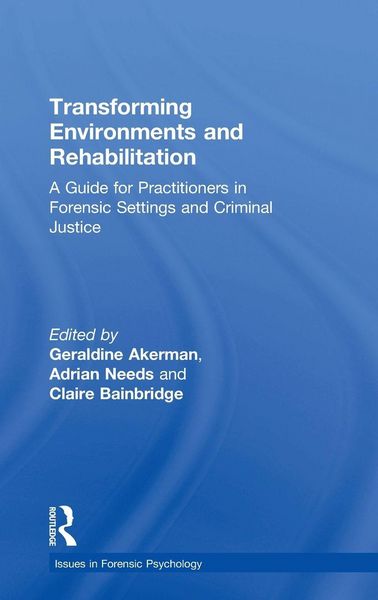

• Produktbild: Transforming Environments and Rehabilitation
  • Produktbild: Transforming Environments and Rehabilitation

Transforming Environments and Rehabilitation A Guide for Practitioners in Forensic Settings and Criminal Justice

233,99 €

inkl. MwSt, Versandkostenfrei

Lieferung nach Hause

Beschreibung

Details

Einband

Gebundene Ausgabe

Erscheinungsdatum

20.09.2017

Abbildungen

schwarz-weiss Illustrationen, Zeichnungen, schwarz-weiss, Tabellen, schwarz-weiss

Herausgeber

Akerman Geraldine + weitere

Verlag

Taylor and Francis

Seitenzahl

394

Maße (L/B/H)

24/16,1/2,7 cm

Gewicht

760 g

Sprache

Englisch

ISBN

978-1-138-95911-8

Beschreibung

Details

Einband

Gebundene Ausgabe

Erscheinungsdatum

20.09.2017

Abbildungen

schwarz-weiss Illustrationen, Zeichnungen, schwarz-weiss, Tabellen, schwarz-weiss

Herausgeber

Verlag

Taylor and Francis

Seitenzahl

394

Maße (L/B/H)

24/16,1/2,7 cm

Gewicht

760 g

Sprache

Englisch

ISBN

978-1-138-95911-8

Herstelleradresse

Libri GmbH
Europaallee 1
36244 Bad Hersfeld
DE

Email: gpsr@libri.de

Unsere Kundinnen und Kunden meinen

0 Bewertungen

Informationen zu Bewertungen

Zur Abgabe einer Bewertung ist eine Anmeldung im Konto notwendig. Die Authentizität der Bewertungen wird von uns nicht überprüft. Wir behalten uns vor, Bewertungstexte, die unseren Richtlinien widersprechen, entsprechend zu kürzen oder zu löschen.

Verfassen Sie die erste Bewertung zu diesem Artikel

Helfen Sie anderen Kund*innen durch Ihre Meinung

Unsere Kundinnen und Kunden meinen

0 Bewertungen filtern

Die Leseprobe wird geladen.
  • Produktbild: Transforming Environments and Rehabilitation
  • Produktbild: Transforming Environments and Rehabilitation
  • Foreword, Rex Haigh, Introduction, Geraldine Akerman, Adrian Needs and Claire Bainbridge 1. Steps to an ecology of human functioning for forensic psychology, Alethea Adair-Stantiall and Adrian Needs 2. The social context of transition and rehabilitation, Adrian Needs and Alethea Adair-Stantiall 3. Only connect: implications of social processes and contexts for understanding trauma, Adrian Needs 4. Trauma-informed care and ‘good lives’ in confinement: acknowledging and offsetting adverse impacts of chronic trauma and loss of liberty, Lawrence Jones 5. A campaign for climate change: the role of therapeutic relationships within a climate of control, Sarah Lewis 6. The importance of personal safety to therapeutic outcome in the prison setting, Andrew Day and James Vess 7. Rehabilitating offenders: the enabling environment of forensic therapeutic communities, Michael Brookes 8. Creating a therapeutic community from scratch: where do we start? Geraldine Akerman and Patrick Mandikate 9. Psychologically informed planned environments: a new optimism for criminal justice provision? Nick Benefield, Kirk Turner, Lucinda Bolger and Claire Bainbridge 10. Democratisation, disability and defence mechanisms: reality confrontation in Rampton, Jon Taylor 11. Relationships, social context and personal change: the role of therapeutic communities, Richard Shuker 12. Wearing two hats: working therapeutically as a discipline prison officer, Emma Guthrie, Laura Smillie, Annette McKeown and Claire Bainbridge 13. The Enabling Environments Award as a transformative process, Sarah Paget and Roland Woodward 14. Creating an Enabling Environment in high security prison conditions: an impossible task or the start of a revolution? Alice L. Bennett and Jenny Tew 15. Establishing Enabling Environment principles with young adult males in a custodial setting, Rachel O’Rourke, Annie Taylor and Kevin Leggett 16. The heart and soul of the transforming environment: how a values-driven ethos sustains a therapeutic community for sexual offenders, Andrew Frost and Jason Ware 17. The role of environmental factors in effective gender-responsive programming for women in the United States: current status and future directions, Dana J. Hubbard and Betsy Matthews 18. Contextual influences in prison-based psychological risk assessment: problems and solutions, Jo Shingler and Adrian Needs 19. The importance of organisational factors in transferring the principles of effective intervention to offender rehabilitation in the real world, Dominic A. S. Pearson 20. Nidotherapy: a systematic environmental therapy, Peter Tyrer and Helen Tyrer