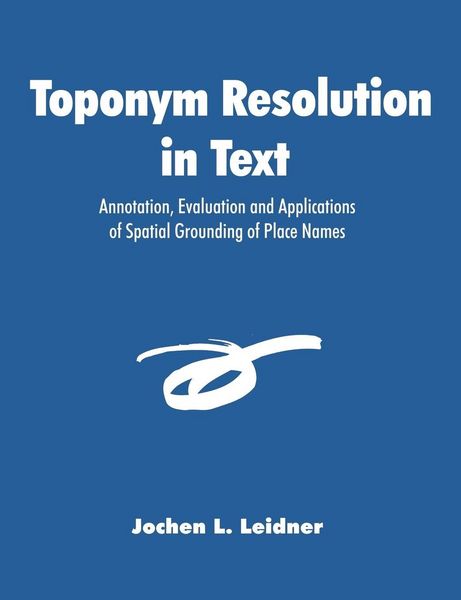
Toponym Resolution in Text Annotation, Evaluation and Applications of Spatial Grounding of Place Names
-
- Englisch ausgewählt
46,99 €
inkl. gesetzl. MwSt.,
Lieferung nach Hause
Beschreibung
Produktdetails
Einband
Taschenbuch
Erscheinungsdatum
15.01.2008
Verlag
Dissertation.ComSeitenzahl
292
Maße (L/B/H)
24,6/18,9/1,6 cm
Gewicht
570 g
Sprache
Englisch
ISBN
978-1-58112-384-5
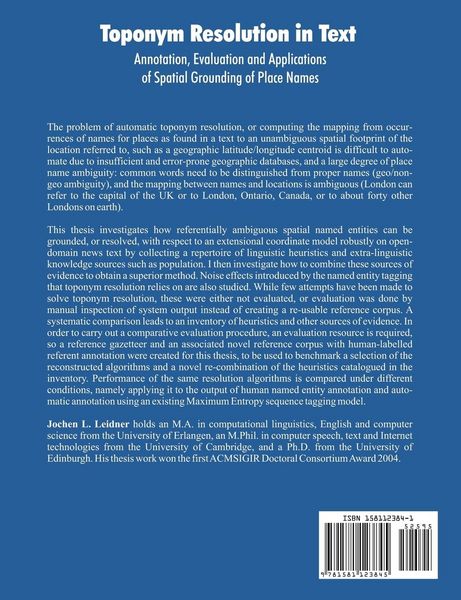
The problem of automatic toponym resolution, or computing the mapping from occurrences of names for places as found in a text to an unambiguous spatial footprint of the location referred to, such as a geographic latitude/longitude centroid is difficult to automate due to insufficient and error-prone geographic databases, and a large degree of place name ambiguity: common words need to be distinguished from proper names (geo/non-geo ambiguity), and the mapping between names and locations is ambiguous (London can refer to the capital of the UK or to London, Ontario, Canada, or to about forty other Londons on earth). This thesis investigates how referentially ambiguous spatial named entities can be grounded, or resolved, with respect to an extensional coordinate model robustly on open-domain news text by collecting a repertoire of linguistic heuristics and extra-linguistic knowledge sources such as population. I then investigate how to combine these sources of evidence to obtain a superior method. Noise effects introduced by the named entity tagging that toponym resolution relies on are also studied. While few attempts have been made to solve toponym resolution, these were either not evaluated, or evaluation was done by manual inspection of system output instead of creating a re-usable reference corpus. A systematic comparison leads to an inventory of heuristics and other sources of evidence. In order to carry out a comparative evaluation procedure, an evaluation resource is required, so a reference gazetteer and an associated novel reference corpus with human-labelled referent annotation were created for this thesis, to be used to benchmark a selection of the reconstructed algorithms and a novel re-combination of the heuristics catalogued in the inventory. Performance of the same resolution algorithms is compared under different conditions, namely applying it to the output of human named entity annotation and automatic annotation using an existing Maximum Entropy sequence tagging model.
Kundinnen und Kunden meinen
Verfassen Sie die erste Bewertung zu diesem Artikel
Helfen Sie anderen Kund*innen durch Ihre Meinung
Kurze Frage zu unserer Seite
Vielen Dank für dein Feedback
Wir nutzen dein Feedback, um unsere Produktseiten zu verbessern. Bitte habe Verständnis, dass wir dir keine Rückmeldung geben können. Falls du Kontakt mit uns aufnehmen möchtest, kannst du dich aber gerne an unseren Kund*innenservice wenden.
zum Kundenservice