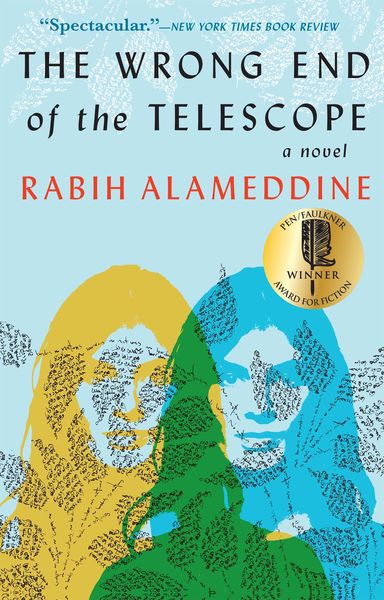
Inspired by his volunteer work at Lesbos refugee camps over the years, Alameddine has written a deeply moving and innovative novel threading together the stories of one refugee family seeking asylum, a trans woman's coming of age, and a writer's struggle over how to relate the scope of such horrific humanitarian crisis.
Told from the point of view of a queer trans woman, the novel intimately explores how Mina came of age in a violent and repressive culture, drawing connections between being displaced from home and country and displaced from one's family and body¿both physically and existentially.
It is also a book about creating meaningful art. Alameddine intricately, suspensefully unspools a strategy by which an author finds the necessary distance from reality in order to write what feels most personal and difficult, achieving a literary balance that has distinguished him as a rare writer whose prose can make you laugh while also breaking your heart.
Mina is the character who comes closest in spirit to Rabih's most popular heroine--and the one he says is nearest to himself¿Aaliyah, of An Unnecessary Woman.
His breakout novel, An Unnecessary Woman was a finalist for the National Book Award, the National Book Critics Circle Award, and the PEN Open Book Award. The novel was named a Best Book of the Year by Washington Post, Kirkus, NPR, Amazon, Christian Science Monitor, Newsday, The Boston Globe, and Wall Street Journal.
His most recent novel, The Angel of History won the Arab American Book Award and the Lambda Literary Award for Gay Fiction, and was named Best Book of the Year by Washington Independent Review of Books, Literary Hub, and Shelf Awareness.
Rabih Alameddine's groundbreaking contributions have also won him the Dos Passos Prize and the Prix Femina Etranger to international acclaim.
Will appeal to fans of Exit West by Mohsin Hamid, The Ungrateful Refugees by Dina Nayeri, The Lazarus Project by Aleksander Hemon, Viet Than Nguyen and Porochista Khakpour.
Unsere Kundinnen und Kunden meinen
5.0
2 Bewertungen
5 Sterne
(2)
4 Sterne
(0)
3 Sterne
(0)
2 Sterne
(0)
1 Sterne
(0)
When her friend calls her,…
Bewertung aus Mainz am 25.09.2021
Bewertungsnummer: 2997298
Bewertet: Buch (Gebundene Ausgabe)
When her friend calls her, Mina Simpson comes to Lesbos to help. The doctor can assist the refugees who land on the island not only physically but, since she is of Lebanese descent, she also speaks the language of the Syrians who risk their life to flee the war raging in their home country. For Mina, the Greek island is the closest she has been to her family for decades, as a trans woman, she never found her place there, only when she came to the USA could she live freely. With the first boat she sees lands the family of Sumaiya who first refuses to be examined by the doctor. But somehow, there is a spark of understanding between the two and Mina quickly understands why the other woman refuses any treatment: she knows already that she is terminally ill and the only thing she wanted to make sure was to bring her family to a save place. “The Wrong End of the Telescope” is the third book I read of the author and again, he did not disappoint my high expectations even though it took me some time to figure out who the narrator is talking to. Just like in “An Unnecessary Woman”, we find a strong heroine who follows her ideas and yet is not totally stubborn and ignorant but sensitive to what her actions do to others. The plot centres around the refugee crisis which has been the top news for some years now and cleverly mixes fact and fiction by also integrating actual incidents. Mina comes to the island with a clear aim: she wants to help. She is trained and thus qualified to do the work. Apart from her, there are many young people who have been attracted by the news, their situation is a bit different. Most of them arrived well-meaning, yet, taking photos of themselves helping and documenting the disastrous situation in the refugee camps seems to be their top priority, actually helping only comes second. Most of them seem to be unaware of their inadequate behaviour; the sensation seeking journalists, on the contrary, know exactly why they are there and that they prof from other people’s sufferance. The protagonist differs strongly here, well, she differs from most people and her personal story is also not without traumatic experiences having grown up in the wrong body in a country where such a concept simply does not exist. She, like the refugees, knows what it means to lose home, to lose the people you love and to start anew in a different country, a different culture not knowing what the future might bring. She is well respected and her knowledge of both cultures allows her to critically comment on the flaws that both exhibit. As an outsider here and there, she is like an unrelated observer who thus can also highlight common traits members might not see. Depending on the side of the telescope you use, you can get a closer or a more distant view of what you are looking at. Alameddine does both in his novel, on the one hand, he closely portrays the fate of one family, one mother, on the other hand, he also widens the frame of the refugee crisis. In addressing Mina’s narration to an unnamed and disillusioned writer, we also get both perspectives: looking at the world’s state on a wide you, you can simply despair, on the other hand, on a more personal level, there is still hope and so much good the single person can do. Without a doubt, Rabih Alameddine is a wonderful narrator with a genius for integrating food for thought into brilliant narration.
Rabih Alameddine - The Wrong End of the Telescope
Miss.mesmerized am 25.09.2021
Bewertungsnummer: 1573650
Bewertet: Buch (Gebundene Ausgabe)
When her friend calls her, Mina Simpson comes to Lesbos to help. The doctor can assist the refugees who land on the island not only physically but, since she is of Lebanese descent, she also speaks the language of the Syrians who risk their life to flee the war raging in their home country. For Mina, the Greek island is the closest she has been to her family for decades, as a trans woman, she never found her place there, only when she came to the USA could she live freely. With the first boat she sees lands the family of Sumaiya who first refuses to be examined by the doctor. But somehow, there is a spark of understanding between the two and Mina quickly understands why the other woman refuses any treatment: she knows already that she is terminally ill and the only thing she wanted to make sure was to bring her family to a save place.
“The Wrong End of the Telescope” is the third book I read of the author and again, he did not disappoint my high expectations even though it took me some time to figure out who the narrator is talking to. Just like in “An Unnecessary Woman”, we find a strong heroine who follows her ideas and yet is not totally stubborn and ignorant but sensitive to what her actions do to others. The plot centres around the refugee crisis which has been the top news for some years now and cleverly mixes fact and fiction by also integrating actual incidents.
Mina comes to the island with a clear aim: she wants to help. She is trained and thus qualified to do the work. Apart from her, there are many young people who have been attracted by the news, their situation is a bit different. Most of them arrived well-meaning, yet, taking photos of themselves helping and documenting the disastrous situation in the refugee camps seems to be their top priority, actually helping only comes second. Most of them seem to be unaware of their inadequate behaviour; the sensation seeking journalists, on the contrary, know exactly why they are there and that they prof from other people’s sufferance.
The protagonist differs strongly here, well, she differs from most people and her personal story is also not without traumatic experiences having grown up in the wrong body in a country where such a concept simply does not exist. She, like the refugees, knows what it means to lose home, to lose the people you love and to start anew in a different country, a different culture not knowing what the future might bring. She is well respected and her knowledge of both cultures allows her to critically comment on the flaws that both exhibit. As an outsider here and there, she is like an unrelated observer who thus can also highlight common traits members might not see.
Depending on the side of the telescope you use, you can get a closer or a more distant view of what you are looking at. Alameddine does both in his novel, on the one hand, he closely portrays the fate of one family, one mother, on the other hand, he also widens the frame of the refugee crisis. In addressing Mina’s narration to an unnamed and disillusioned writer, we also get both perspectives: looking at the world’s state on a wide you, you can simply despair, on the other hand, on a more personal level, there is still hope and so much good the single person can do.
Without a doubt, Rabih Alameddine is a wonderful narrator with a genius for integrating food for thought into brilliant narration.
Kurze Frage zu unserer Seite
Vielen Dank für dein Feedback
Wir nutzen dein Feedback, um unsere Produktseiten zu verbessern. Bitte habe Verständnis, dass wir dir keine Rückmeldung geben können. Falls du Kontakt mit uns aufnehmen möchtest, kannst du dich aber gerne an unseren Kund*innenservice wenden.