• Produktbild: The Working Class at Home, 1790–1940
  • Produktbild: The Working Class at Home, 1790–1940
- 11%

The Working Class at Home, 1790–1940

11% sparen

131,99 € UVP 149,79 €

inkl. MwSt, Versandkostenfrei

Lieferung nach Hause

Beschreibung

Details

Einband

Taschenbuch

Erscheinungsdatum

19.02.2023

Herausgeber

Joseph Harley + weitere

Verlag

Springer

Seitenzahl

260

Maße (L/B/H)

21/14,8/1,6 cm

Gewicht

366 g

Auflage

1st ed. 2022

Sprache

Englisch

ISBN

978-3-030-89275-3

Beschreibung

Rezension

“The main achievements of The Working Class at Home, 1790–1940 mark a key shift in thinking about the Victorian home from space to users; from architectural analysis and social history to the emotional arena of domesticity; from the production of space to the users and their agency in the making of a home. ... this book reframes the issues in Victorian terms and opens new directions for study and publication.” (Lynne Walker, Victorian Studies, Vol. 67 (1), 2024) 


“The Working Class at Home 1790-1940, uncovers hidden aspects of the domestic lives of the working-class in the long nineteenth century. ... The Working Class at Home both combines and builds upon these scopes and sources it reminds us the diversity of working class people … . Bearing in mind the complications of uncovering authentic histories of working-class people but navigated so well in this book ... .” (Tanya Hawkes, The Charles Lamb Bulletin, charleslambsociety.com Issue 176, Winter, 2022)

Portrait

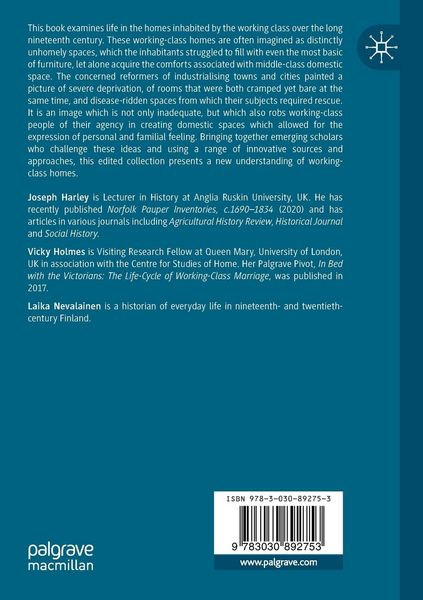
Vicky Holmes is Visiting Research Fellow at Queen Mary, University of London, UK in association with the Centre for Studies of Home. Her Palgrave Pivot,  In Bed with the Victorians: The Life-Cycle of Working-Class Marriage , was published in 2017.

Joseph Harley is Lecturer in History at Anglia Ruskin University, UK. He has recently published Norfolk Pauper Inventories, c.1690-1834 (2020) and has articles in various journals including Agricultural History Review , Historical Journal and Social History .

Laika Nevalainen is a historian of everyday life in nineteenth- and twentieth-century Finland.

Details

Einband

Taschenbuch

Erscheinungsdatum

19.02.2023

Herausgeber

Verlag

Springer

Seitenzahl

260

Maße (L/B/H)

21/14,8/1,6 cm

Gewicht

366 g

Auflage

1st ed. 2022

Sprache

Englisch

ISBN

978-3-030-89275-3

Herstelleradresse

Springer-Verlag GmbH
Tiergartenstr. 17
69121 Heidelberg
DE

Email: ProductSafety@springernature.com

Unsere Kundinnen und Kunden meinen

0 Bewertungen

Informationen zu Bewertungen

Zur Abgabe einer Bewertung ist eine Anmeldung im Konto notwendig. Die Authentizität der Bewertungen wird von uns nicht überprüft. Wir behalten uns vor, Bewertungstexte, die unseren Richtlinien widersprechen, entsprechend zu kürzen oder zu löschen.

Verfassen Sie die erste Bewertung zu diesem Artikel

Helfen Sie anderen Kund*innen durch Ihre Meinung

Unsere Kundinnen und Kunden meinen

0 Bewertungen filtern

  • Produktbild: The Working Class at Home, 1790–1940
  • Produktbild: The Working Class at Home, 1790–1940
  • 1. Introduction: The Working Class at Home, 1790-1940.- Part I:  The Material Home.- 2. ‘I can barely provide the common necessaries of life’: Material Wealth over the Life-cycle of the English poor, 1790-1834.- 3. Politicising the English Working-Class Home, c.1790-1820.- 4. Pulling Back the Covers: Uncovering Beds in the Victorian Working-Class Home.- Part II:   The Emotional and the Exterior Home.- 5. Spaces of Girlhood: Autobiographical Recollections of Late Nineteenth- and Early Twentieth-Century Working-Class Homes.- 6. Songbirds in East London Homes, from Henry Mayhew to Charles Booth.- 7. Chickens, ducks, rabbits, and me dad’s geraniums: The Use and Meanings of Yards, Gardens and Other Outside Spaces of Urban Working-Class Homes, 1890–1930.- Part III: Home beyond Home.- 8. Diligence and Dissipation: The Maid Servant’s Bed Chamber in the Late Eighteenth Century.- 9. Pauper Lunatics at Home in the Asylum, 1845-1906.- 10. Flexible, Portable and Communal Domesticity: Everyday Domestic Practices of Finnish Sailors and Logging Workers, c. 1880s to 1930s.