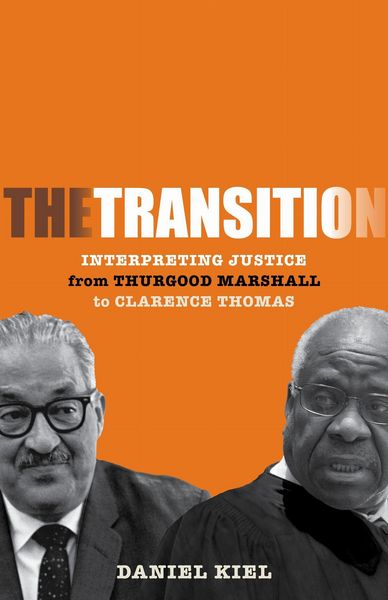
The Transition Interpreting Justice from Thurgood Marshall to Clarence Thomas
-
- Englisch ausgewählt
26,99 €
inkl. gesetzl. MwSt.,
Lieferung nach Hause
Beschreibung
Produktdetails
Einband
Gebundene Ausgabe
Erscheinungsdatum
04.04.2023
Verlag
Stanford University PressSeitenzahl
376
Maße (L/B/H)
23,1/16/3,3 cm
Gewicht
635 g
Sprache
Englisch
ISBN
978-1-5036-3065-9
Every Supreme Court transition presents an opportunity for a shift in the balance of the third branch of American government, but the replacement of Thurgood Marshall with Clarence Thomas in 1991 proved particularly momentous. Not only did it shift the ideological balance on the Court; it was inextricably entangled with the persistent American dilemma of race. In The Transition, this most significant transition is explored through the lives and writings of the first two African American justices on Court, touching on the lasting consequences for understandings of American citizenship as well as the central currents of Black political thought over the past century.
In their lives, Thurgood Marshall and Clarence Thomas experienced the challenge of living and learning in a world that had enslaved their relatives and that continued to subjugate members of their racial group. On the Court, their judicial writings¿often in concurrences or dissents¿richly illustrate the ways in which these two individuals embodied these crucial American (and African American) debates¿on the balance between state and federal authority, on the government's responsibility to protect its citizens against discrimination, and on the best strategies for pursuing justice. The gap between Justices Marshall and Thomas on these questions cannot be overstated, and it reveals an extraordinary range of thought that has yet to be fully appreciated.
The 1991 transition from Justice Marshall to Justice Thomas has had consequences that are still unfolding at the Court and in society. Arguing that the importance of this transition has been obscured by the relegation of these Justices to the sidelines of Supreme Court history, Daniel Kiel shows that it is their unique perspective as Black justices ¿ the lives they have lived as African Americans and the rooting of their judicial philosophies in the relationship of government to African Americans ¿ that makes this succession echo across generations.
Kundinnen und Kunden meinen
Verfassen Sie die erste Bewertung zu diesem Artikel
Helfen Sie anderen Kund*innen durch Ihre Meinung
Kurze Frage zu unserer Seite
Vielen Dank für dein Feedback
Wir nutzen dein Feedback, um unsere Produktseiten zu verbessern. Bitte habe Verständnis, dass wir dir keine Rückmeldung geben können. Falls du Kontakt mit uns aufnehmen möchtest, kannst du dich aber gerne an unseren Kund*innenservice wenden.
zum Kundenservice