Produktbild: The Path to a Modern Economics
- 10%

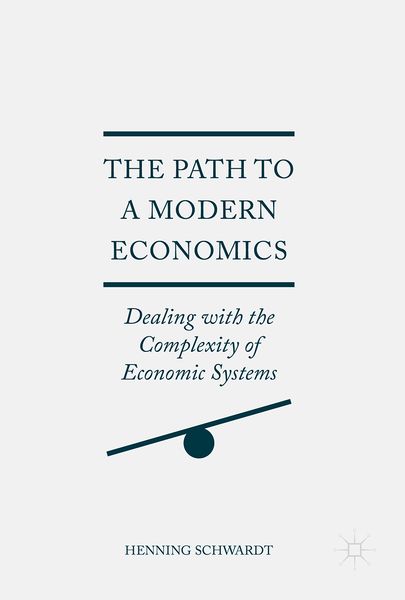
The Path to a Modern Economics Dealing with the Complexity of Economic Systems

10% sparen

124,99 € UVP 139,09 €

inkl. MwSt, Versandkostenfrei

Lieferung nach Hause

Beschreibung

Details

Einband

Gebundene Ausgabe

Erscheinungsdatum

07.08.2017

Verlag

Springer

Seitenzahl

366

Maße (L/B/H)

21,6/15,3/2,5 cm

Gewicht

5913 g

Auflage

1st ed. 2017

Sprache

Englisch

ISBN

978-3-319-52784-0

Beschreibung

Details

Einband

Gebundene Ausgabe

Erscheinungsdatum

07.08.2017

Verlag

Springer

Seitenzahl

366

Maße (L/B/H)

21,6/15,3/2,5 cm

Gewicht

5913 g

Auflage

1st ed. 2017

Sprache

Englisch

ISBN

978-3-319-52784-0

Herstelleradresse

Springer-Verlag GmbH
Tiergartenstr. 17
69121 Heidelberg
DE

Email: ProductSafety@springernature.com

Unsere Kundinnen und Kunden meinen

0 Bewertungen

Informationen zu Bewertungen

Zur Abgabe einer Bewertung ist eine Anmeldung im Konto notwendig. Die Authentizität der Bewertungen wird von uns nicht überprüft. Wir behalten uns vor, Bewertungstexte, die unseren Richtlinien widersprechen, entsprechend zu kürzen oder zu löschen.

Verfassen Sie die erste Bewertung zu diesem Artikel

Helfen Sie anderen Kund*innen durch Ihre Meinung

Unsere Kundinnen und Kunden meinen

0 Bewertungen filtern

  • Produktbild: The Path to a Modern Economics
  • 1. Trends and Changes in Economies.- 1.1. Towards Modern Economic Systems – Changes in Mindsets.- 1.2. Towards Modern Economic Systems – Changes in Structures.- 1.3. Risk Reduction and the Role of the Public Sector.-1.4. Analyzing Complex Economic Systems.-2. Individual, Economic Environment, and Mutual Relation.-2.1. Equilibrium or Process, and the Value of Goods.-2.2. An Approach to a World of Scarcity.-2.3. Suboptimal Outcomes within the Benchmark Framework.-2.4. The Economic System Forcing Beneficial Results for Irrational Agents.-2.5. What if Agents Directly Influence Each Others' Results.-2.6. What if Agents Can Influence Others' Economic Environment.-2.7. What if There is a Mutual Influence Between Individuals and Environment.-2.8. What if There Are Relevant Aspects That Cannot Be Known in Advance.-2.9. Structure Through Rules and Norms.-2.10. Limitations of the Individual and Limitations from the Environment.-2.11. Structure to Enable Activity, and Top-Down vs. Bottom-up Approaches to Formulating an Analytical Framework.-3. The Functioning and the Functioning of Markets.-3.1. Markets, and Individual Agents and Societies.-3.2. Different Markets and Allocation, Effectiveness, and Change.-3.3. Different Products and Different Markets.-3.4. Specific Markets: Labor.-3.5. Specific Markets: Finance.-3.6. Specific Markets: Trade Relations.-3.7. How to Utilize Markets for Societies.-4. Unemployment as Economic Crises.-4.1. Money and Inflation in Top-Down Perspectives.-4.2. Longer Term Unemployment as a Possibility.-4.3. Unemployment and Acute Crises as Normal Aspects of Economic Activity.-4.4. Unemployment as a Permanent State in Economic Systems.- 4.5. Change as a Normal and Ongoing Outcome of Economic Activity.- 4.6. Different Perspectives on Crises in Economies.-5. Frameworks for Economic Policies.-5.1. Communicating Policy Proposals.-5.2. Generic Microeconomic Policy Perspectives.-5.3. Policies for Specific Markets – The Labor Market.-5.4. Policies for Specific Markets – Financial Markets.-5.5. Policies for Specific Markets – Cross-Border Relations: Trade and Development.-5.6. Other Societal Arenas and Economic Activity.-5.7. Policies Concerning Resource Utilization in Economies.-5.8. Contrasting Frameworks for Achieving Economic Objectives.-6. Final Considerations.-