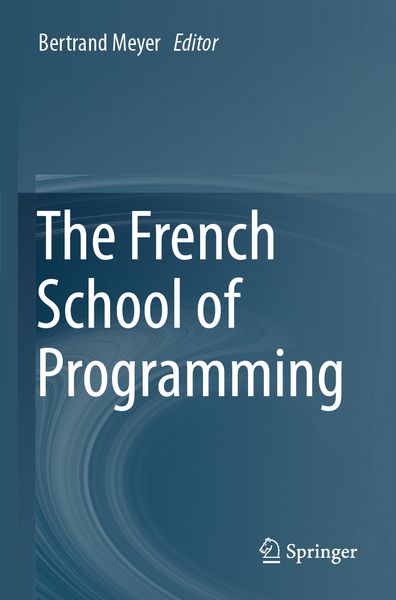
The French School of Programming
-
- Hardcover
- Taschenbuch ausgewählt
- eBook
-
Sprache:Englisch
195,99 €
inkl. MwSt,
Lieferung nach Hause
Beschreibung
Details
Einband
Taschenbuch
Erscheinungsdatum
01.05.2025
Herausgeber
Bertrand MeyerVerlag
SpringerSeitenzahl
439
Maße (L/B/H)
23,5/15,5/2,5 cm
Gewicht
698 g
Sprache
Englisch
ISBN
978-3-031-34520-3
The book is divided into four parts: Software Engineering (A), Programming Language Mechanisms and Type Systems (B), Theory (C), and Language Design and Programming Methodology (D). They are preceded by a Foreword by Bertrand Meyer, the editor of the volume, a Preface by Jim Woodcock providing an outsider’s appraisal of the French school’s contribution, and an overview chapter by Gérard Berry, recalling his own intellectual journey. Chapter 2, by Marie-Claude Gaudel, presents a 30-year perspective on the evolution of testing starting with her own seminal work. In chapter 3, Michel Raynal covers distributed computing with an emphasis on simplicity. Chapter 4, by Jean-Marc Jézéquel, former director of IRISA, presents the evolution of modeling, from CASE tools to SLE and Machine Learning. Chapter 5, by Joëlle Coutaz, is a comprehensive review of the evolution of Human-Computer Interaction. In part B, chapter 6, by Jean-Pierre Briot, describes the sequence of abstractions that led to the concept of agent. Chapter 7, by Pierre-Louis Curien, is a personal account of a journey through fundamental concepts of semantics, syntax and types. In chapter 8, Thierry Coquand presents “some remarks on dependent type theory”. Part C begins with Patrick Cousot’s personal historical perspective on his well-known creation, abstract interpretation, in chapter 9. Chapter 10, by Jean-Jacques Lévy, is devoted to tracking redexes in the Lambda Calculus. The final chapter of that part, chapter 11 by Jean-Pierre Jouannaud, presents advances in rewriting systems, specifically the confluence of terminating rewriting computations. Part D contains two longer contributions. Chapter 12 is a review by Giuseppe Castagna of a broad range of programming topics relying on union, intersection and negation types. In the final chapter, Bertrand Meyer covers “ten choices in language design” for object-oriented programming, distinguishing between “right” and “wrong” resolutions of these issues and explaining the rationale behind Eiffel’s decisions.
This book will be of special interest to anyone with an interest in modern views of programming — on such topics as programming language design, the relationship between programming and type theory, object-oriented principles, distributed systems, testing techniques, rewriting systems, human-computer interaction, software verification… — and in the insights of a brilliant group of innovators in the field.
Unsere Kundinnen und Kunden meinen
Verfassen Sie die erste Bewertung zu diesem Artikel
Helfen Sie anderen Kund*innen durch Ihre Meinung
Kurze Frage zu unserer Seite
Vielen Dank für dein Feedback
Wir nutzen dein Feedback, um unsere Produktseiten zu verbessern. Bitte habe Verständnis, dass wir dir keine Rückmeldung geben können. Falls du Kontakt mit uns aufnehmen möchtest, kannst du dich aber gerne an unseren Kund*innenservice wenden.
zum Kundenservice