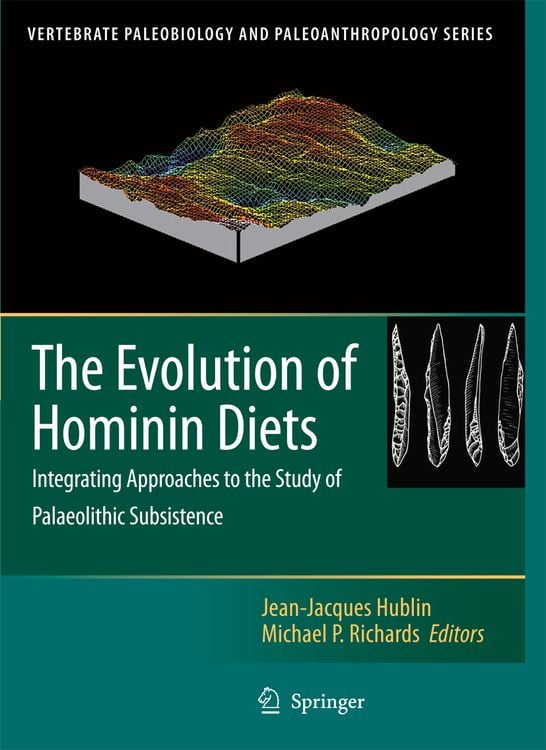
Produktbild: The Evolution of Hominin Diets
- 11%

The Evolution of Hominin Diets Integrating Approaches to the Study of Palaeolithic Subsistence

11% sparen

131,99 € UVP 149,79 €

inkl. MwSt, Versandkostenfrei

Lieferung nach Hause

Beschreibung

Details

Einband

Taschenbuch

Erscheinungsdatum

28.10.2010

Herausgeber

Jean-Jacques Hublin + weitere

Verlag

Springer Netherland

Seitenzahl

270

Maße (L/B/H)

27,9/21/1,6 cm

Gewicht

730 g

Auflage

1. Auflage

Sprache

Englisch

ISBN

978-90-481-8186-5

Beschreibung

Rezension

From the reviews:

"This edited volume illustrates both the current promise and attendant frustrations of some important approaches to exploring ancestral diets as a guide to our evolutionary origins and identity". Jeanne Sept,
American Journal of Physical Anthropology
, 2010

“The papers reflect a wide variety of ap¬proaches to studying hominin diet, ranging from tradi¬tional faunal analyses to lithic and fossil perspectives on the origins of projectile technology. In the brief preface to the volume, the editors express the hope that the book will serve two purposes—first, to provide an up-to-date ac¬count of research on human dietary evolution; and second, to provide an introduction to aspects of research on the topic that are being undertaken in fields that may not be the reader’s own. With a few minor exceptions, the volume succeeds at both of these goals, and as such, it will serve as a useful resource to anyone interested in human evolution more broadly. The volume does admirably well at providing both a summary of current research in the field while also presenting some new per-spectives. It will be a valuable addition to the libraries of those interested in dietary evolution, and would also serve as a useful jumping-off point for graduate-level seminars on the topic.” Jamie L. Clark,
PaleoAnthropology
, 2009

Portrait

Jean-Jacques, Hublin, Ph.D., is currently a Professor at the Max Planck Institute for Evolutionary Anthropology in Leipzig (Germany), where he also serves as the Director of the Department of Human Evolution. Initially his research focuses on the origin and evolution of Neanderthals and he has proposed an accretion model for the emergence of the Neandertal lineage that roots it in time in the middle of the middle Pleistocene. He also worked on the processes associated with the emergence of Homo sapiens and on the interactions between Neanderthals and anatomically modern humans in Europe. He developed the use of medical and virtual imaging in the reconstruction and study of fossil hominids and paid attention to the growth and development issues. He has led field operations in North Africa, Spain and France. In addition to his scientific papers, he has regularly published popular books (with translations in English, Italian, Spanish and Chinese) and articles on the subjects of Neanderthal and early modern human evolution. Significant past research and teaching appointments include: Deputy Director for Anthropology, Prehistory and Paleo-environmental Sciences, Centre National de Recherche Scientifique (2000-2003), Researcher, Centre National de Recherche Scientifique (1981-2000), Visiting Professor, University of California at Berkeley (1992), Harvard University (1997) and Stanford University (1999), Elected member of the French National Committee of Scientific Research (1991-2000)., Ph.D., is currently a Professor at the Max Planck Institute for Evolutionary Anthropology in Leipzig (Germany), where he also serves as the Director of the Department of Human Evolution. Initially his research focuses on the origin and evolution of Neanderthals and he has proposed an accretion model for the emergence of the Neandertal lineage that roots it in time in the middle of the middle Pleistocene. He also worked on the processes associated with the emergence of Homo sapiens and on the interactions between Neanderthals and anatomically modern humans in Europe. He developed the use of medical and virtual imaging in the reconstruction and study of fossil hominids and paid attention to the growth and development issues. He has led field operations in North Africa, Spain and France. In addition to his scientific papers, he has regularly published popular books (with translations in English, Italian, Spanish and Chinese) and articles on the subjects of Neanderthal and early modern human evolution. Significant past research and teaching appointments include: Deputy Director for Anthropology, Prehistory and Paleo-environmental Sciences, Centre National de Recherche Scientifique (2000-2003), Researcher, Centre National de Recherche Scientifique (1981-2000), Visiting Professor, University of California at Berkeley (1992), Harvard University (1997) and Stanford University (1999), Elected member of the French National Committee of Scientific Research (1991-2000).Michael P. Richards is a Professor at the Department of Human Evolution where he runs the archaeological science group. His research interests primarily involve isotope analysis in archaeology, palaeoanthropology and palaeontology, especially for reconstructing past diets and migration patterns. Most of his research has involved the application of stable isotope analysis (C and N) of bone collagen to determine human and animal diets, and especially diet shifts, in Prehistoric and Historic Europe. Particular areas of interest are the shift in diet between the Mesolithic and Neolithic periods in Europe, associated with the adoption of agriculture, and contrasting the diets of Neanderthals and modern humans in Europe. Mike’s current research involves the use of other isotopes to reconstruct climate and migration patterns, as well as the extraction and isotopic analysis of proteins preserved in old or poorly preserved bone and teeth. Mike studied at the Department ofArchaeology, Simon Fraser University, Canada (BA and MA), and the Research Laboratory for Archaeology and the History of Art, University of Oxford, UK (Ph.D.). He held post-doctoral positions at both institutions. He was a Lecturer, Reader and Professor at the Department of Archaeological Sciences, University of Bradford, UK, a position mainly funded by the Wellcome Trust Bioarchaeology programme. In addition to his current post as Professor at the MPI in Leipzig, he also holds a part-time post at the University of Durham, UK, as Professor of Archaeology. Mike’s research has been published in journals such as Nature, PNAS, AJPA, JAS, and Current Anthropology. is a Professor at the Department of Human Evolution where he runs the archaeological science group. His research interests primarily involve isotope analysis in archaeology, palaeoanthropology and palaeontology, especially for reconstructing past diets and migration patterns. Most of his research has involved the application of stable isotope analysis (C and N) of bone collagen to determine human and animal diets, and especially diet shifts, in Prehistoric and Historic Europe. Particular areas of interest are the shift in diet between the Mesolithic and Neolithic periods in Europe, associated with the adoption of agriculture, and contrasting the diets of Neanderthals and modern humans in Europe. Mike’s current research involves the use of other isotopes to reconstruct climate and migration patterns, as well as the extraction and isotopic analysis of proteins preserved in old or poorly preserved bone and teeth. Mike studied at the Department of Archaeology, Simon Fraser University, Canada (BA and MA), and the Research Laboratory for Archaeology and the History of Art, University of Oxford, UK (Ph.D.). He held post-doctoral positions at both institutions. He was a Lecturer, Reader and Professor at the Department of Archaeological Sciences, University of Bradford, UK, a position mainly funded by theWellcome Trust Bioarchaeology programme. In addition to his current post as Professor at the MPI in Leipzig, he also holds a part-time post at the University of Durham, UK, as Professor of Archaeology. Mike’s research has been published in journals such as Nature, PNAS, AJPA, JAS, and Current Anthropology.

Details

Einband

Taschenbuch

Erscheinungsdatum

28.10.2010

Herausgeber

Verlag

Springer Netherland

Seitenzahl

270

Maße (L/B/H)

27,9/21/1,6 cm

Gewicht

730 g

Auflage

1. Auflage

Sprache

Englisch

ISBN

978-90-481-8186-5

Herstelleradresse

Springer-Verlag GmbH
Tiergartenstr. 17
69121 Heidelberg
DE

Email: ProductSafety@springernature.com

Weitere Bände von Vertebrate Paleobiology and Paleoanthropology

Weitere Bände von Vertebrate Paleobiology and Paleoanthropology

Unsere Kundinnen und Kunden meinen

0 Bewertungen

Informationen zu Bewertungen

Zur Abgabe einer Bewertung ist eine Anmeldung im Konto notwendig. Die Authentizität der Bewertungen wird von uns nicht überprüft. Wir behalten uns vor, Bewertungstexte, die unseren Richtlinien widersprechen, entsprechend zu kürzen oder zu löschen.

Verfassen Sie die erste Bewertung zu diesem Artikel

Helfen Sie anderen Kund*innen durch Ihre Meinung

Unsere Kundinnen und Kunden meinen

0 Bewertungen filtern

  • Produktbild: The Evolution of Hominin Diets
  • 1. The diets of non-human primates: frugivory, food processing, and food sharing. G. Hohmann

    2. The Energetics of Encephalization in Early Hominids. J.J. Snodgrass, W.R. Leonard, and M.L. Robertson

    3. Meals vs. snacks and the human dentition and diet during the Paleolithic. P. Lucas, Z.Q. Sui, K.Y. Ang, H.T.W. Tan, S.H. King, B. Sadler, and N. Peri

    4. Modern human physiology with respect to evolutionary adaptations that relate to diet in the past. S. Lindeberg

    5. Hunting and hunting weapons of the Lower and Middle Paleolithic of Europe. P. Villa and M. Lenoir

    6. Neanderthal and modern human diet in Eastern Europe. J. Hoffecker

    7. Hominin subsistence patterns during the Middle and Late Pleistocene in northwestern Europe. S. Gaudzinski-Windheuser and L. Niven

    8. Late Pleistocene subsistence strategies and resource intensification in Africa. T.E. Steele and R.G. Klein

    9. Seasonal Patterns of Prey Acquisition and Inter-group Competition During the Middle and Upper Paleolithic of the Southern Caucasus. .D. S. Adler and G. Bar-Oz

    10. Epipaleolithic subsistence intensification in the southern Levant: the faunal evidence. N. Munro

    11. Paleolithic diet and the division of labor in Mediterranean Eurasia. M.C. Stiner and S.L. Kuhn

    12. Moving north: archaeobotanical evidence for plant diet in Middle and Upper Paleolithic Europe. M. Jones

    13. Diet in early hominin species: a paleoenvironmental perspective. Z. Alemseged and R. Bobe

    14. The Impact of Projectile Weaponry on Late Pleistocene Hominin Evolution. J.J. Shea

    15. The evolution of the human capacity for 'killing at a distance'. S.E. Churchill and J.A. Rhodes

    16. An energetics perspective on the Neandertal record. K. Macdonald, W. Roebroeks, and A. Verpoorte

    17. d13C valuesreflect aspects of primate ecology in addition to diet. M.J. Schoeninger

    18. Increased Dietary Breadth in Early Hominin Evolution: Revisiting Arguments and Evidence with a Focus on Biogeochemical Contributions. M. Sponheimer and D.L. Dufour

    19. Neanderthal dietary habits: Review of the isotopic evidence. H. Bocherens

    20. Stable isotope evidence for European Upper Paleolithic human diets. M.P. Richards