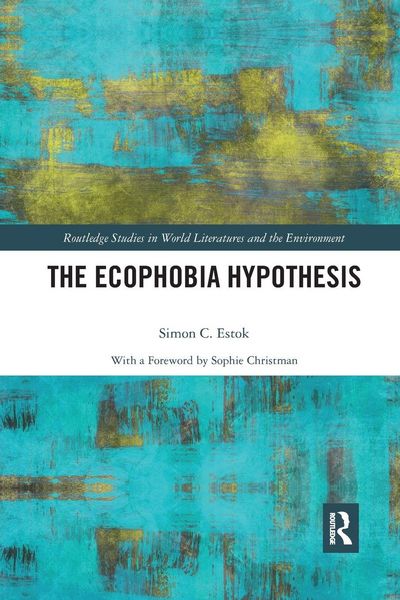

• Produktbild: The Ecophobia Hypothesis
  • Produktbild: The Ecophobia Hypothesis
- 21%

The Ecophobia Hypothesis

21% sparen

52,99 € UVP 67,20 €

inkl. gesetzl. MwSt., Versandkostenfrei

Lieferung nach Hause

Beschreibung

Produktdetails

Einband

Taschenbuch

Erscheinungsdatum

18.12.2020

Verlag

Taylor & Francis

Seitenzahl

218

Maße (L/B/H)

22,9/15,2/1,2 cm

Gewicht

308 g

Sprache

Englisch

ISBN

978-0-367-61664-9

Beschreibung

Rezension

Well researched, vigorously argued, and capaciously framed, The Ecophobia Hypothesis culminates years of careful work by Simon Estok on the intimacy of contemporary environmental catastrophe to an enduring human fear of the natural world-a horror that needs to be thought alongside the much documented love of life which occupies much environmental writing. This book will deeply unsettle its readers. Yet it also offers wider historical, psychological, and material understandings of how we arrived at our state of unremitting crisis ... and why disruption of our comfortable eco-epistemological frameworks is so necessary now. -Jeffrey J. Cohen, Co-President, Association for the Study of Literature and Environment (ASLE), Dean of Humanities, Arizona State University, USA

At the conclusion of his much anticipated, deeply learned, and clearly written study Simon Estok writes that "Understanding how ecophobia prompts environmental injustice (and environmental racism) produces a more comprehensive and wider understanding of the mutually reinforcing ethics that bring about oppression and suffering-social and environmental. Understanding this is what the ecophobia hypothesis seeks." Beginning with exposing the human fear of nature, Estok considers a fresh methodological model in the examination of our complicity in climate change, the most pressing concern of our times. The Ecophobia Hypothesis is essential reading for all students of interdisciplinary literary studies, critical theory and concepts, feminist literature and theory, and of course environmental studies. -William Baker, Distinguished Professor Emeritus, Northern Illinois University

Simon Estok has written his long-awaited, masterful, invigorating, exhaustive, and unequivocally convincing thesis that confronts and corrects the notion of biophilia. Estok is at his very best here. Sure-footed on the slopes of theory, graceful on wing in the skies of controversy, and unrelenting in the arts of persuasion, Estok dazzles with his wide-ranging discussions about ecophobia-discussions that range from the dangerous shoals of genetic materialism to the more calm waters of ecomedia, animal studies, and evolutionary psychology. From its startling insights about "hollow ecology" and "junk agency" to its unapologetic stance arguing the necessity of acknowledging the dark, antagonistic, and exploitative responses and reflexive fears that characterize so much of the collective human response to nature, The Ecophobia Hypothesis is a "must-read" for anyone in the environmental humanities. -Dr. Jonggab Kim, Director of the Body Studies Institute, Konkuk University, Seoul.

Human interactions with the nonhuman world exhibit affinity, antagonism, and a vast array of complicated emotions between the two extremes. The psychology of human attitudes and actions toward nature is fascinating and difficult to explain. Relying on the evidence he finds in a wide range of cultural texts, Simon Estok explores the dark and fearful part of the emotional spectrum in this provocative study of "ecophobia." This may help to explain why our civilization treats the planet so callously. -Paul Slovic, Professor of Psychology, University of Oregon

The irrational fear of the things and beings of the natural world finds its best conceptualization in Simon Estok's The Ecophobia Hypothesis. Estok's riveting conjectures on ecophobia are not only theoretically cogent but also provide affective and cognitive insights into the darkness of human reflexes that induce what he calls "hollow ecology." Estok entangles the reader in the ecopsychological and ecocultural swings of the ecophobia condition through the intersecting mirrors of genetic materialism, animal studies, ecomedia, and ecopsychology. This book will open many eyes to the disquieting reality of humanity's ecological unconscious and liberate the reader from the existential trouble that this unconscious represents. -Serpil Oppermann, President, the European Association for the Study of Literature, Culture, and the Environment of (EASLCE).

This bracing and wide-ranging book demonstrates the importance of Estok's concept of ecophobia not only for ecocriticism and ecomedia studies, but for combating the proliferation of waste, the systemic violence toward nonhuman creatures, and the degradation of planetary life. - Stacy Alaimo, Co-President of ASLE (Association for the Study of Literature and Environment ).

Produktdetails

Einband

Taschenbuch

Erscheinungsdatum

18.12.2020

Verlag

Taylor & Francis

Seitenzahl

218

Maße (L/B/H)

22,9/15,2/1,2 cm

Gewicht

308 g

Sprache

Englisch

ISBN

978-0-367-61664-9

Herstelleradresse

Libri GmbH
Europaallee 1
36244 Bad Hersfeld
DE

Email: [email protected]

Kundinnen und Kunden meinen

0 Bewertungen

Informationen zu Bewertungen

Zur Abgabe einer Bewertung ist eine Anmeldung im Konto notwendig. Die Authentizität der Bewertungen wird von uns nicht überprüft. Wir behalten uns vor, Bewertungstexte, die unseren Richtlinien widersprechen, entsprechend zu kürzen oder zu löschen.

Die Bewertungen sind nach Format, Anzahl Sterne und Datum sortiert.

Verfassen Sie die erste Bewertung zu diesem Artikel

Helfen Sie anderen Kund*innen durch Ihre Meinung

Kundinnen und Kunden meinen

0 Bewertungen filtern

Die Leseprobe wird geladen.
  • Produktbild: The Ecophobia Hypothesis
  • Produktbild: The Ecophobia Hypothesis
  • Contents

    Foreword by Sophie Christman Lavin

    Introduction

    Chapter 1 - Material Ecocriticism, Genes, and the Phobia/Philia Spectrum

    Chapter 2 - Terror and Ecophobia

    Chapter 3 - Ecomedia's Enabling of Globalized Ecophobia: Marketing concerns

    Chapter 4 - From Ecophobia to Hollow Ecology

    Chapter 5 - Animals, Ecophobia, and food

    Chapter 6 - Madness and Ecophobia

    Chapter 7 - The Ecophobic Unconscious: Indifference to Waste and Junk Agency

    Acknowledgements