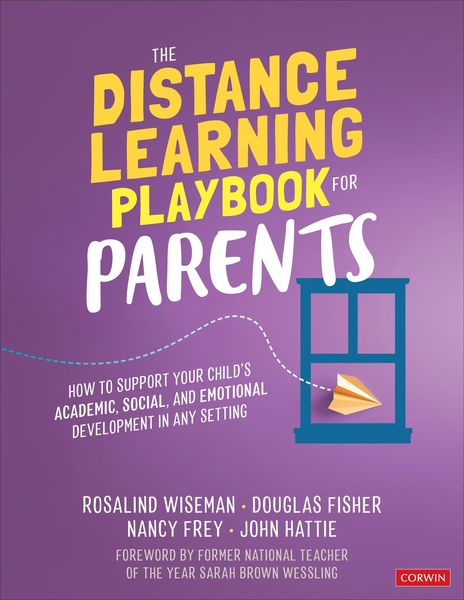
Produktbild: The Distance Learning Playbook for Parents
- 11%

The Distance Learning Playbook for Parents How to Support Your Child's Academic, Social, and Emotional Development in Any Setting

11% sparen

19,99 € UVP 22,50 €

inkl. MwSt, Versandkostenfrei

Lieferung nach Hause

Beschreibung

Details

Einband

Taschenbuch

Erscheinungsdatum

25.11.2020

Verlag

Sage Publications

Seitenzahl

160

Maße (L/B/H)

21,8/28/1,3 cm

Gewicht

430 g

Sprache

Englisch

ISBN

978-1-07-183832-7

Beschreibung

Rezension

"If you want to be a Jedi master of distance learning, read this book! It s a guide for mental strength, practical know-how, and social-emotional support. This is the only pandemic parenting book you ll need, and I m telling all my parent friends about it." 

Rachel Simmons, author and Good Morning America parenting expert

Details

Einband

Taschenbuch

Erscheinungsdatum

25.11.2020

Verlag

Sage Publications

Seitenzahl

160

Maße (L/B/H)

21,8/28/1,3 cm

Gewicht

430 g

Sprache

Englisch

ISBN

978-1-07-183832-7

EU-Ansprechpartner

Zeitfracht Medien GmbH
Ferdinand-Jühlke-Straße 7|99095|Erfurt|DE

Herstelleradresse

SAGE Publications
1 Oliver's Yard 55 City Road|EC1Y 1SP|London|GB

Unsere Kundinnen und Kunden meinen

0 Bewertungen

Informationen zu Bewertungen

Zur Abgabe einer Bewertung ist eine Anmeldung im Konto notwendig. Die Authentizität der Bewertungen wird von uns nicht überprüft. Wir behalten uns vor, Bewertungstexte, die unseren Richtlinien widersprechen, entsprechend zu kürzen oder zu löschen.

Verfassen Sie die erste Bewertung zu diesem Artikel

Helfen Sie anderen Kund*innen durch Ihre Meinung

Unsere Kundinnen und Kunden meinen

0 Bewertungen filtern

  • Produktbild: The Distance Learning Playbook for Parents
  • Foreword
    Letter From the Authors
    Acknowledgments
    How to Use This Book
    Hold Up! Please Read This!
    Distance, Remote, and Blended Learning
    1. THE BASICS
    Establish Routines
    Create a Learning Environment
    Learn the Learning Management System
    Follow Zoom Etiquette
    Ensure That Your Children Sleep
    Monitor Screen Time
    Communicate With Teachers
    Take Care of Yourself
    2. THE VALUE OF . . .
    The Value of Reading Volume
    The Value of Reading Widely
    The Value of Reading Aloud
    The Value of Vocabulary Games
    The Value of Oral Language Development
    The Value of Foundational Reading Skills: Phonemic Awareness
    The Value of Foundational Reading Skills: Alphabetics and Phonics
    The Value of Foundational Reading Skills: Fluency
    The Value of Writing Across the Day
    The Value of Scaffolded Writing Experiences
    The Value of Mathematics Across the Day
    The Value of Supplemental Mathematics Instruction
    The Value of Arts and Music
    The Value of Guiding, Not Telling
    The Value of Wait Time
    The Value of Practice
    3. THE PRINCIPLES OF WELL-BEING
    Social Emotional Learning Is Not Just Soft Skills
    Happiness
    The Power of Dignity
    Separating Dignity From Respect
    Putting Principles Into Action
    Understanding Emotional Regulation
    Emotional Granularity
    Anxiety
    Self-Compassion
    Managing Conflicts
    Friendships in COVID-19
    Teasing: It's Complicated
    Bullying
    Communication With Other Parents
    Pod Teaching: Learning Pods
    4. THE MINDFRAMES
    MINDFRAMES FOR STUDENTS
    Student Mindframe 1: Know your current level of understanding.
    Student Mindframe 2: Know where you are going and have the confidence to take on the challenge.
    Student Mindframe 3: Select tools to guide your learning.
    Student Mindframe 4: Seek feedback and recognize that errors are opportunities to learn.
    Student Mindframe 5: Monitor your progress and adjust your learning.
    Student Mindframe 6: Recognize your learning and teach others.
    THE 10 MINDFRAMES FOR FAMILIES
    Family Mindframe 1: I am an evaluator of my impact on my children's learning.
    Family Mindframe 2: I see the power of collaborating with others in parenting our children.
    Family Mindframe 3: I value what my child brings to the family and world.
    Family Mindframe 4: I understand the centrality of my child.
    Family Mindframe 5: I have appropriately high expectations.
    Family Mindframe 6: I listen, build trust, and know how to gradually release responsibility.
    Family Mindframe 7: I know the balancing act between developing autonomy, relatedness, and competence.
    Family Mindframe 8: I appreciate the power of feedback and the place for praise as well as errors.
    Family Mindframe 9: I know how to work with the school.
    Family Mindframe 10: I am a parent, not a schoolteacher.
    References
    Index
    About the Authors