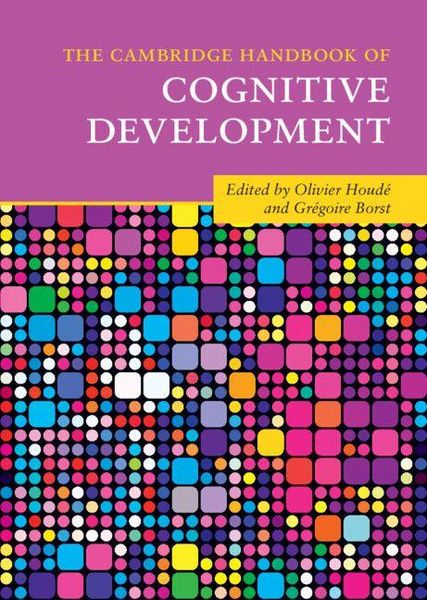

• Produktbild: The Cambridge Handbook of Cognitive Development
  • Produktbild: The Cambridge Handbook of Cognitive Development

The Cambridge Handbook of Cognitive Development

242,99 €

inkl. MwSt, Versandkostenfrei

Lieferung nach Hause

Beschreibung

Details

Einband

Gebundene Ausgabe

Erscheinungsdatum

03.03.2022

Herausgeber

Olivier Houde + weitere

Verlag

Cambridge University Press Academic

Seitenzahl

772

Maße (L/B/H)

24,8/17,6/4,5 cm

Gewicht

1380 g

Sprache

Englisch

ISBN

978-1-108-42387-8

Beschreibung

Details

Einband

Gebundene Ausgabe

Erscheinungsdatum

03.03.2022

Herausgeber

Verlag

Cambridge University Press Academic

Seitenzahl

772

Maße (L/B/H)

24,8/17,6/4,5 cm

Gewicht

1380 g

Sprache

Englisch

ISBN

978-1-108-42387-8

Herstelleradresse

Libri GmbH
Europaallee 1
36244 Bad Hersfeld
DE

Email: gpsr@libri.de

Unsere Kundinnen und Kunden meinen

0 Bewertungen

Informationen zu Bewertungen

Zur Abgabe einer Bewertung ist eine Anmeldung im Konto notwendig. Die Authentizität der Bewertungen wird von uns nicht überprüft. Wir behalten uns vor, Bewertungstexte, die unseren Richtlinien widersprechen, entsprechend zu kürzen oder zu löschen.

Verfassen Sie die erste Bewertung zu diesem Artikel

Helfen Sie anderen Kund*innen durch Ihre Meinung

Unsere Kundinnen und Kunden meinen

0 Bewertungen filtern

Die Leseprobe wird geladen.
  • Produktbild: The Cambridge Handbook of Cognitive Development
  • Produktbild: The Cambridge Handbook of Cognitive Development
  • Part I. Neurobiological Constraints and Laws of Cognitive Development: 1. How life regulation and feelings motivate the cultural mind: a neurobiological account; 2. Epigenesis, synapse selection, cultural imprints and human brain development: from molecules to cognition; 3. Mapping the human brain from the preterm period to infancy using 3D magnetic resonance imaging: cortical folding and early maturation processes; 4. Development and maturation of the human brain from infancy to adolescence; 5. Genetic and experiential factors in brain development: the examples of executive attention and self-regulation; 6. The brain basis underlying the transition from adolescent to adulthood; Part II. Fundamentals of Cognitive Development from Infancy to Adolescence and Young Adulthood: 7. Differences between humans, great apes and monkeys in cognition, communication, language and morality; 8. Individuating and physical reasoning about objects in infancy; 9. Infant categorization; 10. Infant numerical cognition: does primitive number sense provide a foothold for learning formal mathematics?; 11. How sophisticated is infants' theory of mind?; 12. Social cognition and moral evaluation in early human childhood; 13. Scientific thinking and reasoning in infants and young children; 14. Computational approaches to cognitive development in infancy: Bayesian and artificial-neural-network models; 15. Development of qualitative thinking: language and categorization; 16. Development of numerical knowledge; 17. Numerical cognition and executive functions: development as progressive inhibitory control of misleading visuospatial dimensions; 18. Developing theory of mind and counterfactual reasoning in children; 19. Development of executive function skills in childhood: relevance for important life-outcomes; 20. Developing executive functions and flexible adaptation during childhood; 21. Reasoning bias and dual process theory: developmental considerations and current directions; 22. Social cognitive development: the intergroup context; 23. Behavioral and neural development of cognitive control and risky decision-making across adolescence; 24. The Triadic neural systems model through a machine-learning; Part III. Education and School-learning Domains: 25. Linking cognitive neuroscientific research to educational practice in the classroom; 26. Literacy: understanding normal and impaired reading development through personalized large-scale neurocomputational models; 27. Reasoning in mathematical development: neurocognitive foundations and their implications for the classroom; 28. Children's scientific reasoning skills in light of general cognitive development; 29. Working memory training: from the laboratory to schools; 30. Interventions for improving executive functions during development: working memory, cognitive flexibility and inhibition; 31. Curiosity-driven learning in development: computational theories and educational applications; 32. Neurocomputational methods: from models of brain and cognition to artificial intelligence in education.