


Nicht lieferbar
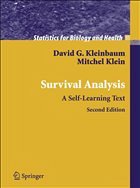
Survival Analysis
A Self-Learning Text

This greatly expanded second edition of Survival Analysis- A Self-learning Text provides a highly readable description of state-of-the-art methods of analysis of survival/event-history data. This text is suitable for researchers and statisticians working in the medical and other life sciences as well as statisticians in academia who teach introductory and second-level courses on survival analysis. The second edition continues to use the unique "lecture-book" format of the first (1996) edition with the addition of three new chapters on advanced topics:Chapter 7: Parametric ModelsChapter 8: Recu...
This greatly expanded second edition of Survival Analysis- A Self-learning Text provides a highly readable description of state-of-the-art methods of analysis of survival/event-history data. This text is suitable for researchers and statisticians working in the medical and other life sciences as well as statisticians in academia who teach introductory and second-level courses on survival analysis. The second edition continues to use the unique "lecture-book" format of the first (1996) edition with the addition of three new chapters on advanced topics:
Chapter 7: Parametric Models
Chapter 8: Recurrent events
Chapter 9: Competing Risks.
Also, the Computer Appendix has been revised to provide step-by-step instructions for using the computer packages STATA (Version 7.0), SAS (Version 8.2), and SPSS (version 11.5) to carry out the procedures presented in the main text.
The original six chapters have been modified slightly to expand and clarify aspects of survival analysis in response to suggestions by students, colleagues and reviewers, and to add theoretical background, particularly regarding the formulation of the (partial) likelihood functions for proportional hazards, stratified, and extended Cox regression models.
Table of contents:
Introduction to Survival Analysis.- Kaplan-Meier Survival Curves and the Log-Rank Test.- The Cox Proportional Hazards Model and Its Characteristics.- Evaluating the Proportional Hazards Assumption.- The Stratified Cox Procedure.- Extension of the Cox Proportional Hazards Model for Time-Dependent Variables.- Parametric Survival Models.-Recurrent Events Survival Analysis.- Competing Risks Survival Analysis.
Chapter 7: Parametric Models
Chapter 8: Recurrent events
Chapter 9: Competing Risks.
Also, the Computer Appendix has been revised to provide step-by-step instructions for using the computer packages STATA (Version 7.0), SAS (Version 8.2), and SPSS (version 11.5) to carry out the procedures presented in the main text.
The original six chapters have been modified slightly to expand and clarify aspects of survival analysis in response to suggestions by students, colleagues and reviewers, and to add theoretical background, particularly regarding the formulation of the (partial) likelihood functions for proportional hazards, stratified, and extended Cox regression models.
Table of contents:
Introduction to Survival Analysis.- Kaplan-Meier Survival Curves and the Log-Rank Test.- The Cox Proportional Hazards Model and Its Characteristics.- Evaluating the Proportional Hazards Assumption.- The Stratified Cox Procedure.- Extension of the Cox Proportional Hazards Model for Time-Dependent Variables.- Parametric Survival Models.-Recurrent Events Survival Analysis.- Competing Risks Survival Analysis.