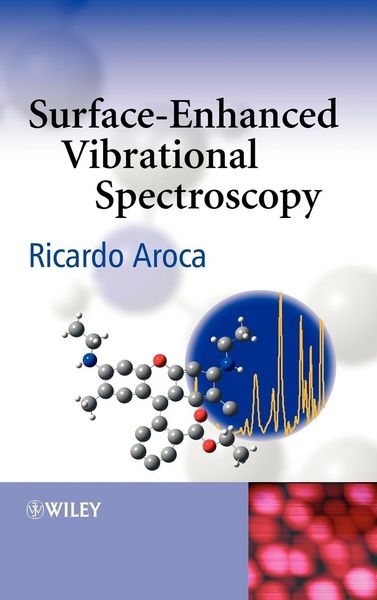
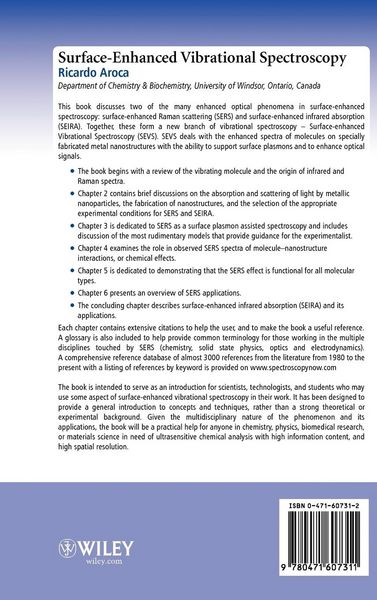
• Produktbild: Surface-Enhanced Vibrational Spectroscop
  • Produktbild: Surface-Enhanced Vibrational Spectroscop

Surface-Enhanced Vibrational Spectroscop

205,99 €

inkl. gesetzl. MwSt., Versandkostenfrei

Lieferung nach Hause

Produktdetails

Einband

Gebundene Ausgabe

Erscheinungsdatum

01.05.2006

Verlag

Wiley

Seitenzahl

260

Maße (L/B/H)

23,5/15,7/1,9 cm

Gewicht

510 g

Sprache

Englisch

ISBN

978-0-471-60731-1

Produktdetails

Einband

Gebundene Ausgabe

Erscheinungsdatum

01.05.2006

Verlag

Wiley

Seitenzahl

260

Maße (L/B/H)

23,5/15,7/1,9 cm

Gewicht

510 g

Sprache

Englisch

ISBN

978-0-471-60731-1

Herstelleradresse

Libri GmbH
Europaallee 1
36244 Bad Hersfeld
DE

Email: Libri GmbH

Kundinnen und Kunden meinen

0 Bewertungen

Informationen zu Bewertungen

Zur Abgabe einer Bewertung ist eine Anmeldung im Konto notwendig. Die Authentizität der Bewertungen wird von uns nicht überprüft. Wir behalten uns vor, Bewertungstexte, die unseren Richtlinien widersprechen, entsprechend zu kürzen oder zu löschen.

Die Bewertungen sind nach Format, Anzahl Sterne und Datum sortiert.

Verfassen Sie die erste Bewertung zu diesem Artikel

Helfen Sie anderen Kund*innen durch Ihre Meinung

Kundinnen und Kunden meinen

0 Bewertungen filtern

  • Produktbild: Surface-Enhanced Vibrational Spectroscop
  • Produktbild: Surface-Enhanced Vibrational Spectroscop
  • Preface.

    Acknowledgments.

    Glossary.

    1. Theory of Molecular Vibrations. The Origin of Infrared andRaman Spectra.

    1.1 Electronic, Vibrational, Rotational and TranslationalEnergy.

    1.2 Separation of Nuclear and Electronic Motions.

    1.3 Vibrations in Polyatomic Molecules.

    1.4 Equilibrium Properties. Dipole Moment andPolarizability.

    1.5 Fundamental Vibrational Transitions in the Infrared andRaman Regions.

    1.6 Symmetry of Normal Modes and Vibrational States.

    1.7 Selection Rules.

    1.8 The Example of ab initio Computation of the Raman andInfrared Spectra.

    1.9 Vibrational Intensities.

    1.10 Definition of Cross-Section.

    1.11 The Units of Energy and Force Constants.

    References.

    2. The Interaction of Light with Nanoscopic Metal Particlesand Molecules on Smooth Reflecting Surfaces.

    2.1 Electric Permittivity and Refractive Index.

    2.2 Propagation of Electromagnetic Waves and the OpticalProperties of Materials.

    2.3 Scattering and Absorption by Nanoscopic Particles.

    2.4 Reflection-Absorption Infrared Spectroscopy on SmoothMetal Surfaces.

    References.

    3. Surface-Enhanced Raman Scattering (SERS).

    3.1 Electromagnetic Enhancement Mechanism.

    References.

    4. Chemical Effects and the SERS Spectrum.

    4.1 Physical and Chemical Adsorption.

    4.2 SERS/SERRS of Physically Adsorbed Molecules.

    4.3 SERS of Chemically Adsorbed Molecules without ElectronicResonance Excitation.

    4.4 SERS of Chemically Adsorbed Molecules with Charge TransferExcitation.

    4.5 Metal-Molecule or Molecule-Metal ChargeTransfer.

    4.6 SERRS from a Surface Complex.

    References.

    5. Is SERS Molecule Specific?

    References.

    6. SERS/SERRS, the Analytical Tool.

    6.1 Average SERS on Metal Colloids. Preparation andProperties.

    6.2 Metal Colloids. The Background SERS.

    6.3 Metal Colloids. Maximizing the Average SERS in Solution.

    6.4 Average SERS on Metal Island Films.

    6.5 Average SERS on Rough Electrodes.

    6.6 Ultrasensitive SERS Analysis and Single MoleculeDetection.

    6.7 Uniqueness of Ultrasensitive Chemical Analysis. The MovingTarget.

    6.8 Applications and Outlook.

    References.

    7. Surface-Enhanced Infrared Spectroscopy.

    7.1 Overview.

    7.2 Theoretical Models for SEIRA.

    7.3 SEIRA-Active Substrates.

    7.4 Interpretation of the Observed SEIRA Spectra.

    7.5 Applications of SEIRA.

    References.

    Index.