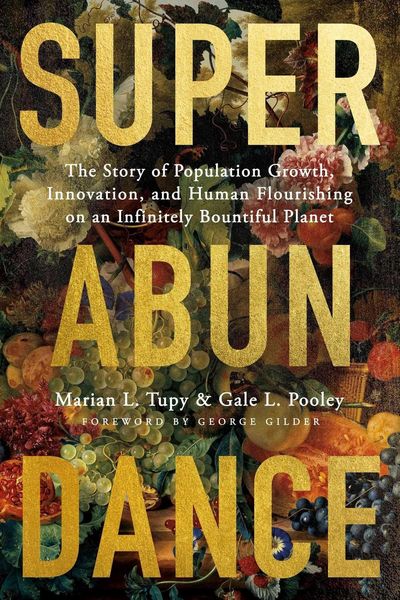
Superabundance The Story of Population Growth, Innovation, and Human Flourishing on an Infinitely Bountiful Planet
-
- Hardcover ausgewählt
- Taschenbuch
- eBook
-
Sprache:Englisch
29,99 €
inkl. gesetzl. MwSt.,
Lieferung nach Hause
Beschreibung
Produktdetails
Einband
Gebundene Ausgabe
Erscheinungsdatum
31.08.2022
Abbildungen
50 Illustrations, color
Verlag
Cato InstituteSeitenzahl
580
Maße (L/B/H)
23,3/16,6/4 cm
Gewicht
1057 g
Sprache
Englisch
ISBN
978-1-952223-39-6
“For centuries, the ivory towers of academia have echoed this sentiment of multitudinous ends and limited means. In this supremely contrarian book, Tupy and Pooley overturn the tables in the temple of conventional thinking. They deploy rigorous and original data and analysis to proclaim a gospel of abundance. Economics—and ultimately, politics—will be enduringly transformed.” —George Gilder, author of Life after Google: The Fall of Big Data and the Rise of the Blockchain Economy
Generations of people have been taught that population growth makes resources scarcer. In 2021, for example, one widely publicized report argued, “The world's rapidly growing population is consuming the planet's natural resources at an alarming rate . . . the world currently needs 1.6 Earths to satisfy the demand for natural resources . . . [a figure that] could rise to 2 planets by 2030.” But is that true?
After analyzing the prices of hundreds of commodities, goods, and services spanning two centuries, Marian Tupy and Gale Pooley found that resources became more abundant as the population grew. That was especially true when they looked at “time prices,” which represent the length of time that people must work to buy something.
To their surprise, the authors also found that resource abundance increased faster than the population—a relationship that they call “superabundance.” On average, every additional human being created more value than he or she consumed. This relationship between population growth and abundance is deeply counterintuitive, yet it is true.
Why? More people produce more ideas, which lead to more inventions. People then test those inventions in the marketplace to separate the useful from the useless. At the end of that process of discovery, people are left with innovations that overcome shortages, spur economic growth, and raise standards of living.
But large populations are not enough to sustain superabundance—just think of the poverty in China and India before their respective economic reforms. To innovate, people must be allowed to think, speak, publish, associate, and disagree. They must be allowed to save, invest, trade, and profit. In a word, they must be free.
Kundinnen und Kunden meinen
Verfassen Sie die erste Bewertung zu diesem Artikel
Helfen Sie anderen Kund*innen durch Ihre Meinung
Kurze Frage zu unserer Seite
Vielen Dank für dein Feedback
Wir nutzen dein Feedback, um unsere Produktseiten zu verbessern. Bitte habe Verständnis, dass wir dir keine Rückmeldung geben können. Falls du Kontakt mit uns aufnehmen möchtest, kannst du dich aber gerne an unseren Kund*innenservice wenden.
zum Kundenservice