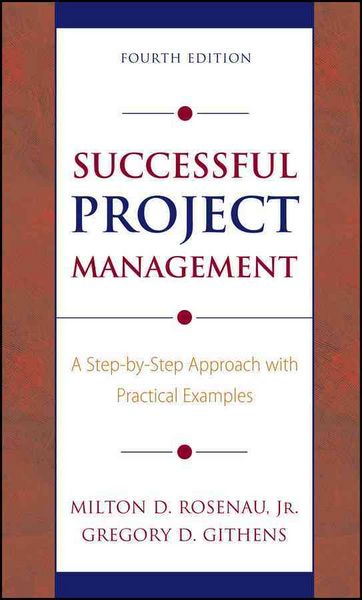
Produktbild: Successful Project Management: A Step-By-Step Approach with Practical Examples

Successful Project Management: A Step-By-Step Approach with Practical Examples A Step-by-Step Approach with Practical Examples

138,99 €

inkl. gesetzl. MwSt., Versandkostenfrei

Lieferung nach Hause

Beschreibung

Produktdetails

Einband

Gebundene Ausgabe

Erscheinungsdatum

01.09.2005

Verlag

John Wiley & Sons Inc

Seitenzahl

380

Maße (L/B/H)

24,3/15,6/2,5 cm

Gewicht

660 g

Auflage

4th edition

Sprache

Englisch

ISBN

978-0-471-29304-0

Beschreibung

Produktdetails

Einband

Gebundene Ausgabe

Erscheinungsdatum

01.09.2005

Verlag

John Wiley & Sons Inc

Seitenzahl

380

Maße (L/B/H)

24,3/15,6/2,5 cm

Gewicht

660 g

Auflage

4th edition

Sprache

Englisch

ISBN

978-0-471-29304-0

Herstelleradresse

Libri GmbH
Europaallee 1
36244 Bad Hersfeld
DE

Email: [email protected]

Kundinnen und Kunden meinen

0 Bewertungen

Informationen zu Bewertungen

Zur Abgabe einer Bewertung ist eine Anmeldung im Konto notwendig. Die Authentizität der Bewertungen wird von uns nicht überprüft. Wir behalten uns vor, Bewertungstexte, die unseren Richtlinien widersprechen, entsprechend zu kürzen oder zu löschen.

Die Bewertungen sind nach Format, Anzahl Sterne und Datum sortiert.

Verfassen Sie die erste Bewertung zu diesem Artikel

Helfen Sie anderen Kund*innen durch Ihre Meinung

Kundinnen und Kunden meinen

0 Bewertungen filtern

Die Leseprobe wird geladen.
  • Produktbild: Successful Project Management: A Step-By-Step Approach with Practical Examples
  • Preface.

    1. What Is a Project?

    Projects Are a Type of Work.

    Projects Distinguished From Tasks and From Processes.

    Programs are Collections of Projects.

    Project Management Maturity.

    Integrated Project Management.

    The Project Management "Hat" is Different From the Technical or Product Management "Hat".

    Effective Project Managers Manage Expectations of Stakeholders.

    A Roadmap of Five Important Program Management Functions.

    Highlights.

    PART 1. DEFINING THE GOALS OF A PROJECT.

    2. Linking the Project to the Product.

    Strategic Alignment of Projects.

    The Product Life Cycle and the Project Life Cycle.

    Project Completion Includes Delivering a Result that Meets the Requirements.

    The Delivering Organization and the Consuming Organization.

    All Projects Involve Agreements.

    Good Boundaries.

    Taking Action.

    Highlights.

    3. Balancing Competing Demands with the Triple Constraint.

    Many Ways to Measure Project Performance.

    The Triple Constraint.

    A Model to Help Evaluate Competing Demands.

    Adjusting Baseline for Risk.

    How the Triple Constraint Helps to Explain Three Common Tradeoffs.

    The Triple Constraint During Control.

    Other Examples of Balancing Competing Demands: Financial Management.

    Project Management as a Decision-Making Process.

    Highlights.

    4. Contracts, Negotiations, and Proposals.

    Contracts.

    Negotiating the Contract.

    Proposals: a Special Kind of Project.

    The Proposal Process.

    Typical Problems.

    International Projects.

    Highlights.

    PART 2. PLANNING A PROJECT.

    5. Why and How to Plan a Project.

    Integrated Project Planning.

    Using Computer Software During Project Planning.

    "The Plan".

    Applying Project Plans During Execution.

    Project Planning is an Investment, Not an Expense.

    Highlights.

    6. The Work Breakdown Structure.

    The Work Breakdown Structure.

    The work Package and the WBS Dictionary.

    Top-down Planning Approach for Developing the WBS.

    Organizing the WBS for Completeness and Control.

    Bottom-Up Planning Approach for Developing the WBS.

    Validating the Work Scope.

    Work Scope is Fundamental to Project Integration.

    Highlights.

    7. Scheduling.

    Overview of Scheduling Formats.

    Bar Charts.

    Milestones.

    Network Diagrams.

    The Network Logic Diagram.

    Why Use a Network Diagram?

    Computer Software.

    Helpful Hints.

    Typical Problems.

    Highlights.

    8. Time Estimating and Compressing the Schedule.

    Types of Time Estimates.

    Earliest and Latest Start and Finish Times.

    Typical Problems.

    Highlights.

    9. Cost Estimating and Budgeting.

    Resource Planning.

    Cost Estimating.

    Project Cost System.

    Budgeting Cost.

    Computer Software.

    Typical Problems.

    Highlights.

    10. The Impact of Limited Resources.

    Resources.

    Computer Software.

    Time Versus Cost Trade-Off.

    Typical Problems.

    Highlights.

    11. Risk and Contingency.

    Ten Steps for Team-Based Risk Management.

    Building a Culture for Good Decision Making.

    Highlights.

    PART 3. LEADING THE PEOPLE WHO WORK ON A PROJECT.

    12. Organizational Design for Delivering Projects.

    Three Organizational Forms.

    Other Organizational Forms.

    The Informal Organization.

    Typical Problems.

    Highlights.

    13. Building the Project Team.

    Core Team and Extended Team.

    Staffing Starts with Project Scope.

    Formal Project Authority.

    Assigning Personnel to the Project.

    Sources of Personnel.

    Compromise.

    Control.

    Task Assignments.

    The Virtual Project Team.

    Turning a Group Into a True Team.

    Computer Software.

    Typical Problems.

    Highlights.

    14. Organizing the Support Team.

    Involvement and Commitment.

    Coordination.

    Interaction With Support Groups.

    Subcontractors.

    Typical Problems.

    Highlights.

    15. The Role of the Project Manager.

    Project Manager Competencies.

    Project Management Career Path.

    What a Project Manager Does.

    Theories of Motivation and Their Implications.

    Three Useful Techniques.

    Typical Problems.

    Highlights.

    16. Practical Tips for Project Managers.

    Communication.

    Conflict Resolution.

    Efficient Time Management.

    Tips.

    Typical Problems.

    Highlights.

    PART 4. CONTROLLING THE PROJECT.

    17. Essential of Project Control.

    Develop a Baseline.

    Develop a Performance Measurement System.

    Measure Performance Against Baseline and Determine Variances.

    Forecasts.

    Corrective Actions.

    Multiple Projects.

    Computer Software.

    Typical Problems.

    Highlights.

    18. Project Reviews.

    The Necessity for Reviews.

    The Conduct of Reviews.

    Periodic Reviews.

    Follow-Up Actions.

    Topical Reviews.

    Typical Problems.

    Highlights.

    19. Project Cost Reports.

    Cost Monitoring.

    Computer Cost Reports.

    Cost Monitoring Problems.

    Earned Value Management.

    Computer Software.

    Typical Problems.

    Highlights.

    20. Handling Project Changes.

    A Project Performance Track Record: Good or Bad?

    The Process of Managing Changes.

    Unmanaged Risks and Issues.

    Typical Problems.

    Highlights.

    21. Solving the Inevitable Problems.

    The General Approach.

    Decision Trees.

    Matrix Array.

    Problem-Solving Meeting Styles.

    Typical Problems.

    Highlights.

    PART 5. COMPLETING A PROJECT.

    22. How to Complete a Project.

    Winding Down the Project.

    Acceptance.

    Managing Scope Change.

    Documentation.

    Increasing Odds of Success.

    Typical Problems.

    Highlights.

    23. Final Wrap-Up.

    People Issues.

    Lessons Learned and Audits.

    Intellectual Property and Other Ownership Rights.

    Typical Problems.

    Highlights.

    PART 6. OTHER ISSUES IN PROJECT MANAGEMENT.

    24. Small Projects.

    Simplified Management.

    Problems.

    Typical Problems.

    Highlights.

    25. New Product Development Projects.

    Why New Product Development Projects Are Unique.

    A General Framework.

    Resource Overloading.

    Typical Problems.

    Highlights.

    26. Project Management Software.

    When and Where to Use Computer Project Management Software.

    Cautions with Computer Project Management Software.

    Other Software.

    Typical Problems.

    Highlights.

    27. Where Do You Go From Here?

    Summary.

    Continuing Project Management Skill Development.

    The Future of Project Management.

    A Final Thought.

    Appendix 1. Abbreviations Used in Project Management.

    Appendix 2. Glossary of Project Management Terms.

    Appendix 3. Examples of Planning Checklists for Project Managers.

    Index.