Gutscheinbedingungen

**Gültig vom 15.06.2026 bis 17.06.2026 | Gültig für nicht preisgebundene fremdsprachige Bücher | Einzelne Artikel können ausgeschlossen sein | Maximaler rabattfähiger Warenkorbwert 500 € | Nicht kombinierbar mit weiteren Aktionen | Nur einmal pro Person einlösbar | Nur solange der Vorrat reicht

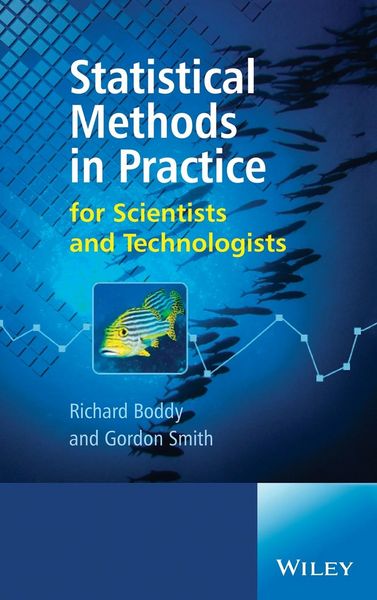
Produktbild: Statistical Methods in Practice

Statistical Methods in Practice for Scientists and Technologists

54,99 €

inkl. gesetzl. MwSt., Versandkostenfrei

Lieferung nach Hause

Beschreibung

Produktdetails

Einband

Gebundene Ausgabe

Erscheinungsdatum

01.10.2009

Verlag

John Wiley & Sons

Seitenzahl

246

Maße (L/B/H)

23,5/15,7/1,8 cm

Gewicht

476 g

Auflage

1. Auflage

Sprache

Englisch

ISBN

978-0-470-74664-6

Beschreibung

Rezension

"Overall, the book could be a clear introduction to a set of useful tools either in self study or used as an aid for instruction for those with no previous exposure." (The American Statistician, 1 February 2011)

Produktdetails

Einband

Gebundene Ausgabe

Erscheinungsdatum

01.10.2009

Verlag

John Wiley & Sons

Seitenzahl

246

Maße (L/B/H)

23,5/15,7/1,8 cm

Gewicht

476 g

Auflage

1. Auflage

Sprache

Englisch

ISBN

978-0-470-74664-6

Herstelleradresse

Libri GmbH
Europaallee 1
36244 Bad Hersfeld
DE

Email: gpsr@libri.de

Kundinnen und Kunden meinen

0 Bewertungen

Informationen zu Bewertungen

Zur Abgabe einer Bewertung ist eine Anmeldung im Konto notwendig. Die Authentizität der Bewertungen wird von uns nicht überprüft. Wir behalten uns vor, Bewertungstexte, die unseren Richtlinien widersprechen, entsprechend zu kürzen oder zu löschen.

Die Bewertungen sind nach Format, Anzahl Sterne und Datum sortiert.

Verfassen Sie die erste Bewertung zu diesem Artikel

Helfen Sie anderen Kund*innen durch Ihre Meinung

Kundinnen und Kunden meinen

0 Bewertungen filtern

  • Produktbild: Statistical Methods in Practice
  • Preface.

    1 Samples and populations.

    Introduction.

    What a lottery!

    No can do.

    Nobody is listening to me.

    How clean is my river?

    Discussion.

    2 What is the true mean?

    Introduction.

    Presenting data.

    Averages.

    Measures of variability.

    Relative standard deviation .

    Degrees of freedom.

    Confidence interval for the population mean.

    Sample sizes.

    How much moisture is in the raw material?

    Problems.

    3 Exploratory data analysis.

    Introduction.

    Histograms: is the process capable of meeting specifications?

    Box plots: how long before the lights go out?

    The box plot in practice.

    Problems.

    4 Significance testing.

    Introduction.

    The one-sample t -test.

    The significance testing procedure.

    Confidence intervals as an alternative to significance testing.

    Confidence interval for the population standard deviation.

    F-test for ratio of standard deviations.

    Problems.

    5 The normal distribution.

    Introduction.

    Properties of the normal distribution.

    Example.

    Setting the process mean.

    Checking for normality.

    Uses of the normal distribution.

    Problems.

    6 Tolerance intervals.

    Introduction.

    Example.

    Confidence intervals and tolerance intervals.

    7 Outliers.

    Introduction.

    Grubbs' test.

    Warning.

    8 Significance tests for comparing two means.

    Introduction.

    Example: watching paint lose its gloss.

    The two-sample t -test for independent samples.

    An alternative approach: a confidence intervals for the difference between population means.

    Sample size to estimate the difference between two means.

    A production example.

    Confidence intervals for the difference between the two suppliers.

    Sample size to estimate the difference between two means.

    Conclusions.

    Problems.

    9 Significance tests for comparing paired measurements.

    Introduction.

    Comparing two fabrics.

    The wrong way.

    The paired sample t -test.

    Presenting the results of significance tests.

    One-sided significance tests.

    Problems.

    10 Regression and correlation.

    Introduction.

    Obtaining the best straight line.

    Confidence intervals for the regression statistics.

    Extrapolation of the regression line.

    Correlation coefficient.

    Is there a significant relationship between the variables?

    How good a fit is the line to the data?

    Assumptions.

    Problems.

    11 The binomial distribution.

    Introduction.

    Example.

    An exact binomial test.

    A quality assurance example.

    What is the effect of the batch size?

    Problems.

    12 The Poisson distribution.

    Introduction.

    Fitting a Poisson distribution.

    Are the defects random? The Poisson distribution.

    Poisson dispersion test.

    Confidence intervals for a Poisson count.

    A significance test for two Poisson counts.

    How many black specks are in the batch?

    How many pathogens are there in the batch?

    Problems.

    13 The chi-squared test for contingency tables.

    Introduction.

    Two-sample test for percentages.

    Comparing several percentages.

    Where are the differences?

    Assumptions.

    Problems.

    14 Non-parametric statistics.

    Introduction.

    Descriptive statistics.

    A test for two independent samples: Wilcoxon-Mann-Whitney test.

    A test for paired data: Wilcoxon matched-pairs sign test.

    What type of data can be used?

    Example: cracking shoes.

    Problems.

    15 Analysis of variance: Components of variability.

    Introduction.

    Overall variability.

    Analysis of variance.

    A practical example.

    Terminology.

    Calculations.

    Significance test.

    Variation less than chance?

    When should the above methods not be used?

    Between- and within-batch variability.

    How many batches and how many prawns should be sampled?

    Problems.

    16 Cusum analysis for detecting process changes.

    Introduction.

    Analysing past data.

    Intensity.

    Localised standard deviation.

    Significance test.

    Yield.

    Conclusions from the analysis.

    Problem.

    17 Rounding of results.

    Introduction.

    Choosing the rounding scale.

    Reporting purposes: deciding the amount of rounding.

    Reporting purposes: rounding of means and standard deviations.

    Recording the original data and using means and standard deviations in statistical analysis.

    References.

    Solutions to Problems.

    Statistical Tables.

    Index.