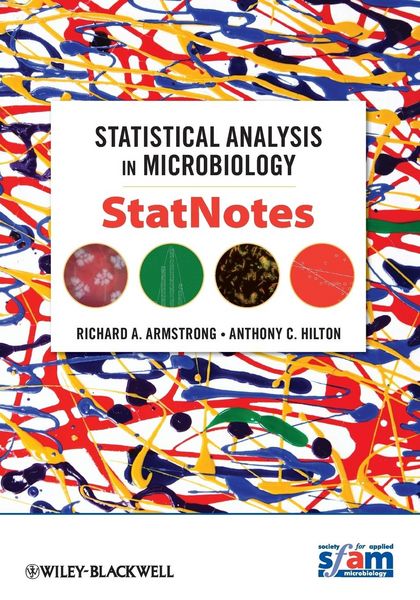
Produktbild: Statistical Analysis in Microbiology

Statistical Analysis in Microbiology StatNotes

75,99 €

inkl. gesetzl. MwSt., Versandkostenfrei

Lieferung nach Hause

Beschreibung

Produktdetails

Einband

Taschenbuch

Erscheinungsdatum

14.12.2010

Verlag

John Wiley & Sons

Seitenzahl

170

Maße (L/B/H)

25,4/17,8/1,1 cm

Gewicht

363 g

Auflage

1. Auflage

Sprache

Englisch

ISBN

978-0-470-55930-7

Beschreibung

Produktdetails

Einband

Taschenbuch

Erscheinungsdatum

14.12.2010

Verlag

John Wiley & Sons

Seitenzahl

170

Maße (L/B/H)

25,4/17,8/1,1 cm

Gewicht

363 g

Auflage

1. Auflage

Sprache

Englisch

ISBN

978-0-470-55930-7

Kundinnen und Kunden meinen

0 Bewertungen

Informationen zu Bewertungen

Zur Abgabe einer Bewertung ist eine Anmeldung im Konto notwendig. Die Authentizität der Bewertungen wird von uns nicht überprüft. Wir behalten uns vor, Bewertungstexte, die unseren Richtlinien widersprechen, entsprechend zu kürzen oder zu löschen.

Die Bewertungen sind nach Format, Anzahl Sterne und Datum sortiert.

Verfassen Sie die erste Bewertung zu diesem Artikel

Helfen Sie anderen Kund*innen durch Ihre Meinung

Kundinnen und Kunden meinen

0 Bewertungen filtern

  • Produktbild: Statistical Analysis in Microbiology
  • Preface.

    Acknowledgments.

    Note on Statistical Software.

    1 ARE THE DATA NORMALLY DISTRIBUTED?

    1.1 Introduction.

    1.2 Types of Data and Scores.

    1.3 Scenario.

    1.4 Data.

    1.5 Analysis: Fitting the Normal Distribution.

    1.6 Conclusion.

    2 DESCRIBING THE NORMAL DISTRIBUTION.

    2.1 Introduction.

    2.2 Scenario.

    2.3 Data.

    2.4 Analysis: Describing the Normal Distribution.

    2.5 Analysis: Is a Single Observation Typical of the Population?

    2.6 Analysis: Describing the Variation of Sample Means.

    2.7 Analysis: How to Fit Confidence Intervals to a Sample Mean.

    2.8 Conclusion.

    3 TESTING THE DIFFERENCE BETWEEN TWO GROUPS.

    3.1 Introduction.

    3.2 Scenario.

    3.3 Data.

    3.4 Analysis: The Unpaired t Test.

    3.5 One-Tail and Two-Tail Tests.

    3.6 Analysis: The Paired t Test.

    3.7 Unpaired versus the Paired Design.

    3.8 Conclusion.

    4 WHAT IF THE DATA ARE NOT NORMALLY DISTRIBUTED?

    4.1 Introduction.

    4.2 How to Recognize a Normal Distribution.

    4.3 Nonnormal Distributions.

    4.4 Data Transformation.

    4.5 Scenario.

    4.6 Data.

    4.7 Analysis: Mann-Whitney U test (for Unpaired Data).

    4.8 Analysis: Wilcoxon Signed-Rank Test (for Paired Data).

    4.9 Comparison of Parametric and Nonparametric Tests.

    4.10 Conclusion.

    5 CHI-SQUARE CONTINGENCY TABLES.

    5.1 Introduction.

    5.2 Scenario.

    5.3 Data.

    5.4 Analysis: 2 x 2 Contingency Table.

    5.5 Analysis: Fisher's 2 x 2 Exact Test.

    5.6 Analysis: Rows x Columns (R x C) Contingency Tables.

    5.7 Conclusion.

    6 ONE-WAY ANALYSIS OF VARIANCE (ANOVA).

    6.1 Introduction.

    6.2 Scenario.

    6.3 Data.

    6.4 Analysis.

    6.5 Assumptions of ANOVA.

    6.6 Conclusion.

    7 POST HOC TESTS.

    7.1 Introduction.

    7.2 Scenario.

    7.3 Data.

    7.4 Analysis: Planned Comparisons between the Means.

    7.5 Analysis: Post Hoc Tests.

    7.6 Conclusion.

    8 IS ONE SET OF DATA MORE VARIABLE THAN ANOTHER?

    8.1 Introduction.

    8.2 Scenario.

    8.3 Data.

    8.4 Analysis of Two Groups: Variance Ratio Test.

    8.5 Analysis of Three or More Groups: Bartlett's Test.

    8.6 Analysis of Three or More Groups: Levene's Test.

    8.7 Analysis of Three or More Groups: Brown-Forsythe Test.

    8.8 Conclusion.

    9 STATISTICAL POWER AND SAMPLE SIZE.

    9.1 Introduction.

    9.2 Calculate Sample Size for Comparing Two Independent Treatments.

    9.3 Implications of Sample Size Calculations.

    9.4 Calculation of the Power (P¿) of a Test.

    9.5 Power and Sample Size in Other Designs.

    9.6 Power and Sample Size in ANOVA.

    9.7 More Complex Experimental Designs.

    9.8 Simple Rule of Thumb.

    9.9 Conclusion.

    10 ONE-WAY ANALYSIS OF VARIANCE (RANDOM EFFECTS MODEL): THE NESTED OR HIERARCHICAL DESIGN.

    10.1 Introduction.

    10.2 Scenario.

    10.3 Data.

    10.4 Analysis.

    10.5 Distinguish Random- and Fixed-Effect Factors.

    10.6 Conclusion.

    11 TWO-WAY ANALYSIS OF VARIANCE.

    11.1 Introduction.

    11.2 Scenario.

    11.3 Data.

    11.4 Analysis.

    11.5 Conclusion.

    12 TWO-FACTOR ANALYSIS OF VARIANCE.

    12.1 Introduction.

    12.2 Scenario.

    12.3 Data.

    12.4 Analysis.

    12.5 Conclusion.

    13 SPLIT-PLOT ANALYSIS OF VARIANCE.

    13.1 Introduction.

    13.2 Scenario.

    13.3 Data.

    13.4 Analysis.

    13.5 Conclusion.

    14 REPEATED-MEASURES ANALYSIS OF VARIANCE.

    14.1 Introduction.

    14.2 Scenario.

    14.3 Data.

    14.4 Analysis.

    14.5 Conclusion.

    15 CORRELATION OF TWO VARIABLES.

    15.1 Introduction.

    15.2 Naming Variables.

    15.3 Scenario.

    15.4 Data.

    15.5 Analysis.

    15.6 Limitations of r.

    15.7 Conclusion.

    16 LIMITS OF AGREEMENT.

    16.1 Introduction.

    16.2 Scenario.

    16.3 Data.

    16.4 Analysis.

    16.5 Conclusion.

    17 NONPARAMETRIC CORRELATION COEFFICIENTS.

    17.1 Introduction.

    17.2 Bivariate Normal Distribution.

    17.3 Scenario.

    17.4 Data.

    17.5 Analysis: Spearman's Rank Correlation (¿, rs).

    17.6 Analysis: Kendall's Rank Correlation (¿).

    17.7 Analysis: Gamma (¿).

    17.8 Conclusion.

    18 FITTING A REGRESSION LINE TO DATA.

    18.1 Introduction.

    18.2 Line of Best Fit.

    18.3 Scenario.

    18.4 Data.

    18.5 Analysis: Fitting the Line.

    18.6 Analysis: Goodness of Fit of the Line to the Points.

    18.7 Conclusion.

    19 USING A REGRESSION LINE FOR PREDICTION AND CALIBRATION.

    19.1 Introduction.

    19.2 Types of Prediction Problem.

    19.3 Scenario.

    19.4 Data.

    19.5 Analysis.

    19.6 Conclusion.

    20 COMPARISON OF REGRESSION LINES.

    20.1 Introduction.

    20.2 Scenario.

    20.3 Data.

    20.4 Analysis.

    20.5 Conclusion.

    21 NONLINEAR REGRESSION: FITTING AN EXPONENTIAL CURVE.

    21.1 Introduction.

    21.2 Common Types of Curve.

    21.3 Scenario.

    21.4 Data.

    21.5 Analysis.

    21.6 Conclusion.

    22 NONLINEAR REGRESSION: FITTING A GENERAL POLYNOMIAL-TYPE CURVE.

    22.1 Introduction.

    22.2 Scenario A: Does a Curve Fit Better Than a Straight Line?

    22.3 Data.

    22.4 Analysis.

    22.5 Scenario B: Fitting a General Polynomial-Type Curve.

    22.6 Data.

    22.7 Analysis.

    22.8 Conclusion.

    23 NONLINEAR REGRESSION: FITTING A LOGISTIC GROWTH CURVE.

    23.1 Introduction.

    23.2 Scenario.

    23.3 Data.

    23.4 Analysis: Nonlinear Estimation Methods.

    23.6 Conclusion.

    24 NONPARAMETRIC ANALYSIS OF VARIANCE.

    24.1 Introduction.

    24.2 Scenario.

    24.3 Analysis: Kruskal-Wallis Test.

    24.4 Analysis: Friedmann's Test.

    24.5 Conclusion.

    25 MULTIPLE LINEAR REGRESSION.

    25.1 Introduction.

    25.2 Scenario.

    25.3 Data.

    25.4 Analysis.

    25.5 Conclusion.

    26 STEPWISE MULTIPLE REGRESSION.

    26.1 Introduction.

    26.2 Scenario.

    26.3 Data.

    22.4 Analysis by the Step-Up Method.

    26.5 Conclusion.

    27 CLASSIFICATION AND DENDROGRAMS.

    27.1 Introduction.

    27.2 Scenario.

    27.3 Data.

    27.4 Analysis.

    27.5 Conclusion.

    28 FACTOR ANALYSIS AND PRINCIPAL COMPONENTS ANALYSIS.

    28.1 Introduction.

    28.2 Scenario.

    28.3 Data.

    28.4 Analysis: Theory.

    28.5 Analysis: How Is the Analysis Carried Out?

    28.6 Conclusion.

    References.

    Appendix 1 Which Test to Use: Table.

    Appendix 2 Which Test to Use: Key.

    Appendix 3 Glossary of Statistical Terms and Their Abbreviations.

    Appendix 4 Summary of Sample Size Procedures for Different Statistical Tests.

    Index of Statistical Tests and Procedures.