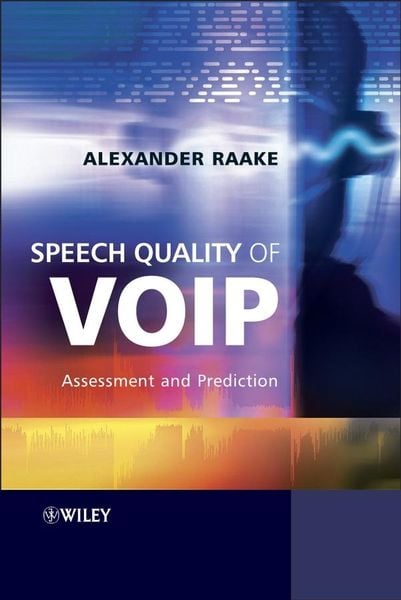
Speech Quality of VoIP Assessment and Prediction
167,99 €
inkl. MwSt,
Lieferung nach Hause
Beschreibung
Details
Einband
Gebundene Ausgabe
Erscheinungsdatum
01.11.2006
Verlag
John Wiley & Sons IncSeitenzahl
336
Maße (L/B/H)
25/17,4/2,5 cm
Gewicht
780 g
Auflage
1. Auflage
Sprache
Englisch
ISBN
978-0-470-03060-8
Speech Quality of VoIP is an essential guide to assessing the speech quality of VoIP networks, whilst addressing the implications for the design of VoIP networks and systems. This book bridges the gap between the technical network-world and the psychoacoustic world of quality perception. Alexander Raake's unique perspective combines awareness of the technical characteristics of VoIP networks and original research concerning the perception of speech transmitted across them.
Starting from the network designer's point of view, the different characteristics of the network are addressed, and then linked to features perceived by users. This book provides an overview of the available knowledge on the principal, relevant aspects of speech and speech quality perception, of speech quality assessment, and of transmission properties of telephone and VoIP networks, and of the related perceptual features and resulting speech quality. Discussing new research into the specific time-varying degradations VoIP brings along, but also the considerable potential of quality improvement to be achieved with wideband speech transmission, Alexander Raake demonstrates how network and service characteristics impact on the users perception of quality.
Speech Quality of VoIP:
* Offers an insight into speech quality of VoIP from a user's perspective.
* Presents an overview of different modelling approaches and a parametric network-planning model for quality prediction in VoIP networks.
* Draws on innovation new research on the quality degradation characteristic of VoIP.
* Explains in detail how telephone speech quality can be enhanced with VoIP's wideband speech transmission capability.
* Assesses the vast collection of references into the technical and scientific literature related to VoIP quality.
* Illustrates concepts throughout with mathematical models, algorithms and simulations.
Speech quality of VoIP is the definitive guide for researchers, engineers and network planners working in the field of VoIP, Quality of Service, and speech communication processing in telecommunications. Advanced undergraduate and graduate students on telecommunication and networking courses will also find this text an invaluable resource.
Starting from the network designer's point of view, the different characteristics of the network are addressed, and then linked to features perceived by users. This book provides an overview of the available knowledge on the principal, relevant aspects of speech and speech quality perception, of speech quality assessment, and of transmission properties of telephone and VoIP networks, and of the related perceptual features and resulting speech quality. Discussing new research into the specific time-varying degradations VoIP brings along, but also the considerable potential of quality improvement to be achieved with wideband speech transmission, Alexander Raake demonstrates how network and service characteristics impact on the users perception of quality.
Speech Quality of VoIP:
* Offers an insight into speech quality of VoIP from a user's perspective.
* Presents an overview of different modelling approaches and a parametric network-planning model for quality prediction in VoIP networks.
* Draws on innovation new research on the quality degradation characteristic of VoIP.
* Explains in detail how telephone speech quality can be enhanced with VoIP's wideband speech transmission capability.
* Assesses the vast collection of references into the technical and scientific literature related to VoIP quality.
* Illustrates concepts throughout with mathematical models, algorithms and simulations.
Speech quality of VoIP is the definitive guide for researchers, engineers and network planners working in the field of VoIP, Quality of Service, and speech communication processing in telecommunications. Advanced undergraduate and graduate students on telecommunication and networking courses will also find this text an invaluable resource.
Unsere Kundinnen und Kunden meinen
Verfassen Sie die erste Bewertung zu diesem Artikel
Helfen Sie anderen Kund*innen durch Ihre Meinung
Kurze Frage zu unserer Seite
Vielen Dank für dein Feedback
Wir nutzen dein Feedback, um unsere Produktseiten zu verbessern. Bitte habe Verständnis, dass wir dir keine Rückmeldung geben können. Falls du Kontakt mit uns aufnehmen möchtest, kannst du dich aber gerne an unseren Kund*innenservice wenden.
zum Kundenservice