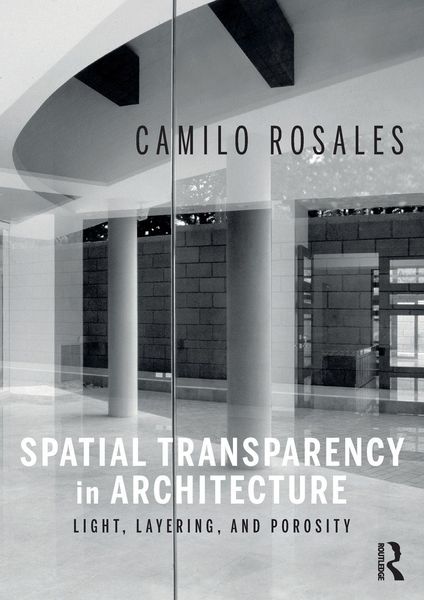
Spatial Transparency in Architecture Light, Layering, and Porosity
-
- Hardcover
- Taschenbuch ausgewählt
- eBook
-
Sprache:Englisch
52,99 €
UVP
65,30 €
inkl. gesetzl. MwSt.,
Beschreibung
Produktdetails
Einband
Taschenbuch
Erscheinungsdatum
12.08.2022
Abbildungen
161 SW-Abb., 153 SW-Fotos, 8 SW-Zeichn.
Verlag
Taylor & FrancisSeitenzahl
288
Maße (L/B/H)
24,6/17,4/1,6 cm
Gewicht
518 g
Sprache
Englisch
ISBN
978-1-03-212165-9
This volume explores the concept of "spatial transparency"; a form of spatial continuity that articulates depth through permeable, layered, or porous three-dimensional organizations where interstitial light is present. Although transparency is a concept largely associated with the modern movement, the use of glazed components, and twentieth-century architectural discourse, spatial transparency is a form of depth awareness through intermediate domains, takes place through the interstitial fabric of a structure, and occurs when several consecutive domains are spatially and visually connected. These immersive environments invite active participation, not as one-way communication but as a series of visual and experiential exchanges, interdependencies, and relationships.
Divided into four parts, the book examines spatial transparency in massive opaque constructions, light constructions, glass assemblies, and hybrid systems. It analyzes both the phenomenon of visual connectivity and continuity through intermediate spaces, and spatial transparency's capacity for promoting and enabling graded, interflowing environmental transactions. Using historical and contemporary examples, it catalogs some of the most common and recurring configurations that manifest these characteristics. Over 20 international case studies from the Americas to Japan are presented to argue that environments exist in porous mediums and that by studying the openings, voids, light, and materials of layered and/or permeable organizations, important insights about space making can be revealed.
Written for students and academics, this book explores various expressions of spatial transparency in architecture and helps connect their abstract ideas with significant built works, analytical drawings, and comparison charts.
Noch keine Bewertungen vorhanden
Verfassen Sie die erste Bewertung zu diesem Artikel
Helfen Sie anderen Kundinnen und Kunden durch Ihre Meinung.
Kurze Frage zu unserer Seite
Vielen Dank für dein Feedback
Wir nutzen dein Feedback, um unsere Produktseiten zu verbessern. Bitte habe Verständnis, dass wir dir keine Rückmeldung geben können. Falls du Kontakt mit uns aufnehmen möchtest, kannst du dich aber gerne an unseren Kund*innenservice wenden.
zum Kundenservice