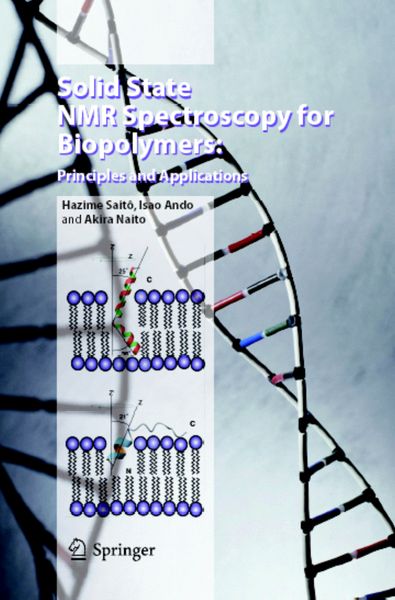
Produktbild: Solid State NMR Spectroscopy for Biopolymers
- 12%

Solid State NMR Spectroscopy for Biopolymers Principles and Applications

12% sparen

139,99 € UVP 160,49 €

inkl. MwSt, Versandkostenfrei

Lieferung nach Hause

Beschreibung

Details

Einband

Gebundene Ausgabe

Erscheinungsdatum

05.07.2006

Verlag

Springer Netherland

Seitenzahl

455

Maße (L/B/H)

24,1/16/3,1 cm

Gewicht

863 g

Auflage

2006

Sprache

Englisch

ISBN

978-1-4020-4302-4

Beschreibung

Rezension

From the reviews:


"This book surveys much of the current research in the area of biological solid-state NMR spectroscopy, and as such should be of great interest to the chemical, biochemical, and biophysical communities. The level is appropriate for graduate students, and the book would be an excellent textbook for a graduate level course in biological solid-state NMR spectroscopy. Its publication is timely considering the recent numerous developments in this area … ." (Michele Auger, Journal of the American Chemical Society, Vol. 129 (10), 2007)

Details

Einband

Gebundene Ausgabe

Erscheinungsdatum

05.07.2006

Verlag

Springer Netherland

Seitenzahl

455

Maße (L/B/H)

24,1/16/3,1 cm

Gewicht

863 g

Auflage

2006

Sprache

Englisch

ISBN

978-1-4020-4302-4

Herstelleradresse

Springer-Verlag GmbH
Tiergartenstr. 17
69121 Heidelberg
DE

Email: ProductSafety@springernature.com

Unsere Kundinnen und Kunden meinen

0 Bewertungen

Informationen zu Bewertungen

Zur Abgabe einer Bewertung ist eine Anmeldung im Konto notwendig. Die Authentizität der Bewertungen wird von uns nicht überprüft. Wir behalten uns vor, Bewertungstexte, die unseren Richtlinien widersprechen, entsprechend zu kürzen oder zu löschen.

Verfassen Sie die erste Bewertung zu diesem Artikel

Helfen Sie anderen Kund*innen durch Ihre Meinung

Unsere Kundinnen und Kunden meinen

0 Bewertungen filtern

  • Produktbild: Solid State NMR Spectroscopy for Biopolymers
  • Part I  Principles

    1. Introduction

    2. Solid state NMR approach

     2.1. CP-MAS and DD-MAS NMR

     2.2. Quadrupolar nuclei

    3. Brief outline of NMR parameters 

     3.1. Chemical shifts

     3.2. Relaxation parameters

     3.3. Dynamics-dependent suppression of peaks

    4. Multinuclear approaches

     4.1. 31P NMR

     4.2. 2H NMR 

     4.3. 17O NMR

    5. Experimental strategies

     5.1. Isotope enrichment (labeling)

     5.2. Assignment of peaks

     5.3. Ultra high-field and ultra high-speed MAS NMR spectroscopy

    6. NMR constraints for structural determination 

     6.1. Orientational constraint

     6.2. Interatomic distance

     6.3. Torsion angles

     6.4. Conformation-dependent 13C chemical shifts 

    7. Dynamics

     7.1. Fast motions with motional frequency >106 Hz

     7.2. Intermediate or slow motions with frequency between 106 and 103 Hz

     7.3. Very slow motions with frequency < 103 Hz


    Part II  Applications

    8. Hydrogen bonded systems

     8.1. Hydrogen bond shifts

     8.2. 2H quadrupolar coupling constant         

    9. Fibrous proteins            

     9.1. Collagen fibrils 

     9.2. Elastin

     9.3. Cerial proteins

     9.4. Silk fibroin

     9.5. Keratin

     9.6.      Bacteriophage coat protein

    10. Polysaccharides    

     10.1. Distinction of polymorphs

     10.2. Network structure, dynamics and gelation mechanism

    11. Polypeptides as new materials

     11.1. Liquid crystalline polypeptides

     11.2. Blend system

    12. Globular proteins

     12.1. (Almost) complete assignment of 13C NMR spectra of globular proteins

     12.2. 3D structure: ?-spectrin SH3 domain

     12.3. Ligand-binding to globular protein

    13. Membrane protein I: dynamic picture  

     13.1. Bacteriorhodopsin

     13.2. Phoborhodopsin and its cognitive transducer

     13.3. Diacylgycerol kinase

    14. Membrane proteins II: 3D structure 

     14.1. 3D structure of mechanically aligned membrane proteins

     14.2. Secondary structure based on distance constraints

    15. Biologically active membrane-associated peptides

     15.1. Channel-forrming peptides

     15.2. Antimicrobial peptides

     15.3. Opioid peptides

     15.4. Fusion peptides

     15.5. Membrane model system                        

    17. Amyloid and related biomolecules

     17.1. Amyloid ?-peptide

     17.2. Calcitonin (CT)