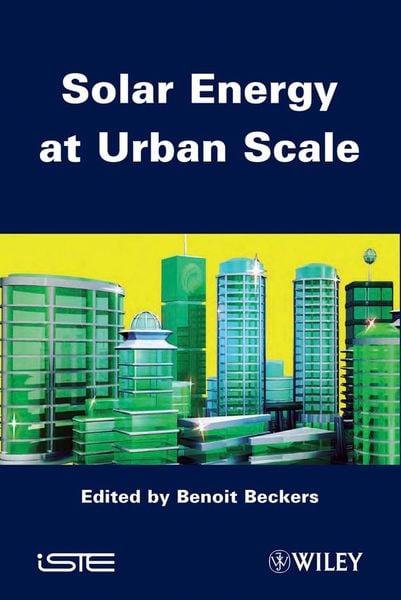
Solar Energy at Urban Scale
226,99 €
inkl. MwSt,
Lieferung nach Hause
Beschreibung
Details
Einband
Gebundene Ausgabe
Erscheinungsdatum
18.06.2012
Herausgeber
Benoit BeckersVerlag
John Wiley & Sons IncSeitenzahl
382
Maße (L/B/H)
24,1/15,9/2,7 cm
Gewicht
706 g
Auflage
1. Auflage
Sprache
Englisch
ISBN
978-1-84821-356-2
Increasing urbanization throughout the world, the depletion of fossil fuels and concerns about global warming have transformed the city into a physical problem of prime importance. This book proposes a multi-disciplinary and systematic approach concerning specialities as different as meteorology, geography, architecture and urban engineering systems, all surrounding the essential problem of solar radiation.
It collects the points of view of 18 specialists from around the world on the interaction between solar energy and constructions, combining territorial, urban and architectural scales to better regulate energetic efficiency and light comfort for the sustainable city.
The main subjects covered are: measures and models of solar irradiance (satellite observations, territorial and urban ground measurements, sky models, satellite data and urban mock-up), radiative contribution to the urban climate (local heat balance, radiative-aerodynamics coupling, evapotranspiration, Urban Heat Island), light and heat modeling (climate-based daylight modeling, geometrical models of the city, solar radiation modeling for urban environments, thermal simulation methods and algorithms) and urban planning, with special considerations for solar potential, solar impact and daylight rights in the temperate, northern and tropical climates, and the requirement of urban solar regulation.
Contents
1. The Odyssey of Remote Sensing from Space: Half a Century of Satellites for Earth Observations, Théo Pirard.
2. Territorial and Urban Measurements, Marius Paulescu and Viorel Badescu.
3. Sky Luminance Models, Matej Kobav and Grega Bizjak.
4. Satellite Images Applied to Surface Solar Radiation Estimation, Bella Espinar and Philippe Blanc.
5. Worldwide Aspects of Solar Radiation Impact, Benoit Beckers.
6. Local Energy Balance, Pierre Kastendeuch.
7. Evapotranspiration, Marjorie Musy.
8. Multiscale Daylight Modeling for Urban Environments, John Mardaljevic and George Janes.
9. Geometrical Models of the City, Daniel G. Aliaga.
10. Radiative Simulation Methods, Pierre Beckers and Benoit Beckers.
11. Radiation Modeling Using the Finite Element Method, Tom van Eekelen.
12. Dense Cities in the Tropical Zone, Edward Ng.
13. Dense Cities in Temperate Climates: Solar and Daylight Rights, Guedi Capeluto.
14. Solar Potential and Solar Impact, Frédéric Monette and Benoit Beckers.
Appendix 1. Table of Europe's Platforms (Micro- and Minisatellites) for Earth Observations, Théo Pirard.
Appendix 2. Commercial Operators of Earth Observation (EO) Satellites (as of January 1, 2012), Théo Pirard.
Appendix 3. Earth's Annual Global Mean Energy Budget, Benoit Beckers.
It collects the points of view of 18 specialists from around the world on the interaction between solar energy and constructions, combining territorial, urban and architectural scales to better regulate energetic efficiency and light comfort for the sustainable city.
The main subjects covered are: measures and models of solar irradiance (satellite observations, territorial and urban ground measurements, sky models, satellite data and urban mock-up), radiative contribution to the urban climate (local heat balance, radiative-aerodynamics coupling, evapotranspiration, Urban Heat Island), light and heat modeling (climate-based daylight modeling, geometrical models of the city, solar radiation modeling for urban environments, thermal simulation methods and algorithms) and urban planning, with special considerations for solar potential, solar impact and daylight rights in the temperate, northern and tropical climates, and the requirement of urban solar regulation.
Contents
1. The Odyssey of Remote Sensing from Space: Half a Century of Satellites for Earth Observations, Théo Pirard.
2. Territorial and Urban Measurements, Marius Paulescu and Viorel Badescu.
3. Sky Luminance Models, Matej Kobav and Grega Bizjak.
4. Satellite Images Applied to Surface Solar Radiation Estimation, Bella Espinar and Philippe Blanc.
5. Worldwide Aspects of Solar Radiation Impact, Benoit Beckers.
6. Local Energy Balance, Pierre Kastendeuch.
7. Evapotranspiration, Marjorie Musy.
8. Multiscale Daylight Modeling for Urban Environments, John Mardaljevic and George Janes.
9. Geometrical Models of the City, Daniel G. Aliaga.
10. Radiative Simulation Methods, Pierre Beckers and Benoit Beckers.
11. Radiation Modeling Using the Finite Element Method, Tom van Eekelen.
12. Dense Cities in the Tropical Zone, Edward Ng.
13. Dense Cities in Temperate Climates: Solar and Daylight Rights, Guedi Capeluto.
14. Solar Potential and Solar Impact, Frédéric Monette and Benoit Beckers.
Appendix 1. Table of Europe's Platforms (Micro- and Minisatellites) for Earth Observations, Théo Pirard.
Appendix 2. Commercial Operators of Earth Observation (EO) Satellites (as of January 1, 2012), Théo Pirard.
Appendix 3. Earth's Annual Global Mean Energy Budget, Benoit Beckers.
Unsere Kundinnen und Kunden meinen
Verfassen Sie die erste Bewertung zu diesem Artikel
Helfen Sie anderen Kund*innen durch Ihre Meinung
Kurze Frage zu unserer Seite
Vielen Dank für dein Feedback
Wir nutzen dein Feedback, um unsere Produktseiten zu verbessern. Bitte habe Verständnis, dass wir dir keine Rückmeldung geben können. Falls du Kontakt mit uns aufnehmen möchtest, kannst du dich aber gerne an unseren Kund*innenservice wenden.
zum Kundenservice