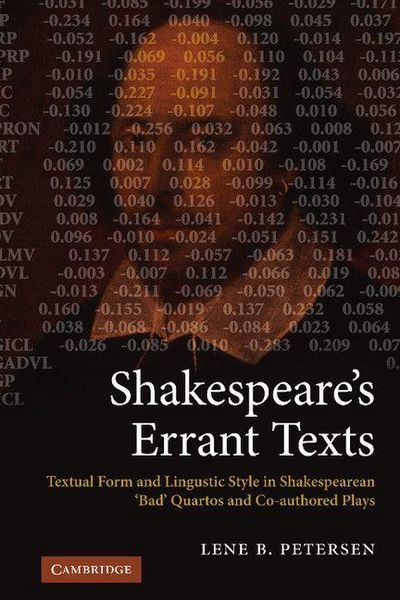
Shakespeare's Errant Texts Textual Form and Linguistic Style in Shakespearean 'Bad' Quartos and Co-Authored Plays
-
- Hardcover ausgewählt
- Taschenbuch
-
Sprache:Englisch
139,99 €
inkl. gesetzl. MwSt.,
Lieferung nach Hause
Beschreibung
Produktdetails
Einband
Gebundene Ausgabe
Erscheinungsdatum
18.10.2011
Verlag
Cambridge AcademicSeitenzahl
332
Maße (L/B/H)
23,5/15,7/2,2 cm
Gewicht
610 g
Sprache
Englisch
ISBN
978-0-521-76522-0
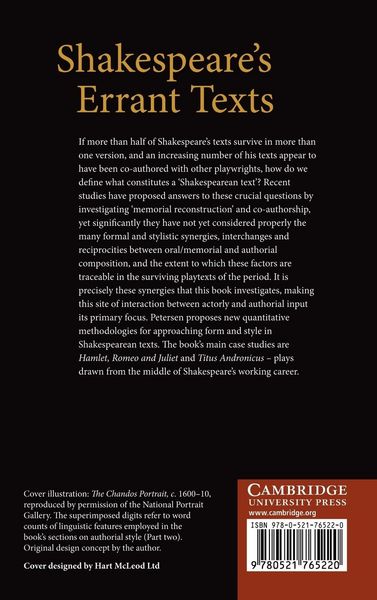
If more than half of Shakespeare's texts survive in more than one version, and an increasing number of his texts appear to have been co-authored with other playwrights, how do we define what constitutes a 'Shakespearean text'? Recent studies have proposed answers to this crucial question by investigating 'memorial reconstruction' and co-authorship, yet significantly they have not yet considered properly the many formal and stylistic synergies, interchanges and reciprocities between oral/memorial and authorial composition, and the extent to which these factors are traceable in the surviving playtexts of the period. It is precisely these synergies that this book investigates, making this site of interaction between actorly and authorial input its primary focus. Petersen proposes new quantitative methodologies for approaching form and style in Shakespearean texts. The book's main case studies are Hamlet, Romeo and Juliet and Titus Andronicus - plays drawn from the middle of Shakespeare's working career.
Kundinnen und Kunden meinen
Verfassen Sie die erste Bewertung zu diesem Artikel
Helfen Sie anderen Kund*innen durch Ihre Meinung
Kurze Frage zu unserer Seite
Vielen Dank für dein Feedback
Wir nutzen dein Feedback, um unsere Produktseiten zu verbessern. Bitte habe Verständnis, dass wir dir keine Rückmeldung geben können. Falls du Kontakt mit uns aufnehmen möchtest, kannst du dich aber gerne an unseren Kund*innenservice wenden.
zum Kundenservice