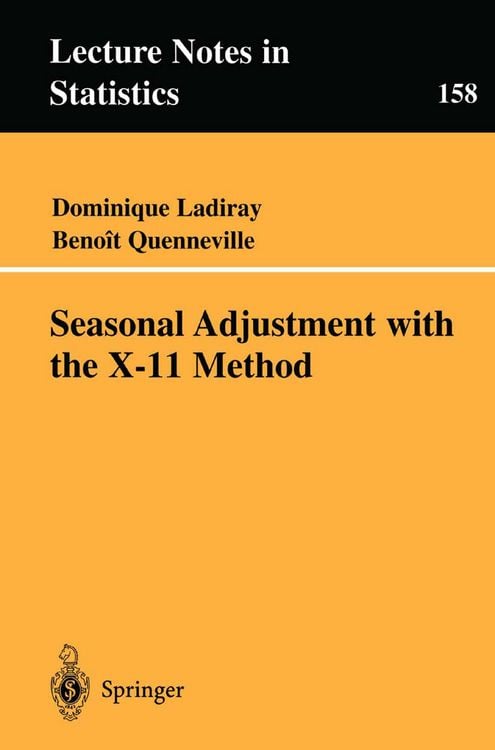
Produktbild: Seasonal Adjustment with the X-11 Method
Band 158

Seasonal Adjustment with the X-11 Method

117,99 €

inkl. MwSt, Versandkostenfrei

Lieferung nach Hause

Beschreibung

Details

Einband

Taschenbuch

Erscheinungsdatum

10.01.2001

Abbildungen

XXII, 24 schwarzweisse Abbildungen, 24 schwarzweisse Zeichnungen 235 mm

Verlag

Springer Us

Seitenzahl

256

Maße (L/B/H)

23,5/15,5/1,5 cm

Gewicht

800 g

Auflage

Softcover reprint of the original 1st ed. 2001

Sprache

Englisch

ISBN

978-0-387-95171-3

Beschreibung

Details

Einband

Taschenbuch

Erscheinungsdatum

10.01.2001

Abbildungen

XXII, 24 schwarzweisse Abbildungen, 24 schwarzweisse Zeichnungen 235 mm

Verlag

Springer Us

Seitenzahl

256

Maße (L/B/H)

23,5/15,5/1,5 cm

Gewicht

800 g

Auflage

Softcover reprint of the original 1st ed. 2001

Sprache

Englisch

ISBN

978-0-387-95171-3

Herstelleradresse

Springer-Verlag GmbH
Tiergartenstr. 17
69121 Heidelberg
DE

Email: ProductSafety@springernature.com

Weitere Bände von Lecture Notes in Statistics

Weitere Bände von Lecture Notes in Statistics

Unsere Kundinnen und Kunden meinen

0 Bewertungen

Informationen zu Bewertungen

Zur Abgabe einer Bewertung ist eine Anmeldung im Konto notwendig. Die Authentizität der Bewertungen wird von uns nicht überprüft. Wir behalten uns vor, Bewertungstexte, die unseren Richtlinien widersprechen, entsprechend zu kürzen oder zu löschen.

Verfassen Sie die erste Bewertung zu diesem Artikel

Helfen Sie anderen Kund*innen durch Ihre Meinung

Unsere Kundinnen und Kunden meinen

0 Bewertungen filtern

  • Produktbild: Seasonal Adjustment with the X-11 Method
  • 1 Brief History of Seasonal Adjustment.- 2 Outline of the X-11 Method.- 2.1 Components and Decomposition Models.- 2.2 Moving Averages.- 2.3 A Simple Seasonal Adjustment Algorithm.- 2.4 The Basic Algorithm of the X-11 Method.- 2.5 Extreme Observations and Calendar Effects.- 2.6 The Iterative Principle of X-11.- 2.6.1 Part A: Pre-Adjustments.- 2.6.2 Part B: First Automatic Correction of the Series.- 2.6.3 Part C: Second Automatic Correction of the Series.- 2.6.4 Part D: Seasonal Adjustment.- 2.6.5 Parts E, F and G: Statistics and Charts.- 2.7 From Census X-11 to X-11-ARIMA and X-12-ARIMA.- 3 Moving Averages.- 3.1 Some Definitions and a Little Theory.- 3.1.1 Definitions and Example.- 3.1.2 Gain and Phase Shift Functions.- 3.1.3 Trend Preservation.- 3.1.4 Elimination of Seasonality.- 3.1.5 Reduction of the Irregular Component.- 3.1.6 An Example of Construction of a Moving Average.- 3.2 The Symmetric Moving Averages Used in X-11.- 3.2.1 Composite Simple Moving Average.- 3.2.2 Henderson Moving Averages.- 3.3 Musgrave Asymmetric Moving Averages.- 3.3.1 Musgrave Asymmetric Moving Averages Associated with Henderson Symmetric Moving Averages.- 3.3.2 Comment About Musgrave Moving Averages.- 3.3.3 Asymmetric Moving Averages Associated With Composite Moving Averages.- 3.4 The X-11 Moving Average Filter.- 4 The Various Tables.- 4.1 B: Preliminary Estimation of Extreme Values and Calendar Effects.- 4.1.1 B1: Raw Series Adjusted a priori.- 4.1.2 B2: Trend-Cycle.- 4.1.3 B3: Unmodified Seasonal-Irregular.- 4.1.4 B4: Replacement Values for Extreme SI Values.- 4.1.5 B5: Seasonal Component.- 4.1.6 B6: Seasonally Adjusted Series.- 4.1.7 B7: Trend-Cycle.- 4.1.8 B8: Unmodified SI Component.- 4.1.9 B9: Replacement Values for Extreme SI Values.- 4.1.10 B10: Seasonal Component.- 4.1.11 B11 : Seasonlly Adjusted Series.- 4.1.12 B13: Irregular Component.- 4.1.13 The Trading-Day Component.- 4.1.14 B14: Irregular Values Excluded from the TD Regression.- 4.1.15 B15: Preliminary TD Regression.- 4.1.16 B16: Regression-D erived TD Adjustment Factors.- 4.1.17 B17: Preliminary Weights for the Irregular.- 4.1.18 B18: Combined TD Factors.- 4.1.19 B19: Raw Series Corrected for TD Effects.- 4.1.20 B20: Adjustment Values for Extreme Irregulars.- 4.2 C: Final Estimation of Extreme Values and Calendar Effects.- 4.2.1 C1: Modified Raw Series.- 4.2.2 C2: Trend-Cycle.- 4.2.3 C4: Modified SI.- 4.2.4 C5: Seasonal Component.- 4.2.5 C6: Seasonally Adjusted Series.- 4.2.6 C7: Trend-Cycle.- 4.2.7 C9: SI Component.- 4.2.8 C10: Seasonal Component.- 4.2.9 Cll: Seasonally Adjusted Series.- 4.2.10 C13: Irregular Component.- 4.2.11 C14: Irregulars Excluded from the TD Regression.- 4.2.12 C15: Final TD Regression.- 4.2.13 C16: Regression-Derived TD Adjustment Factors.- 4.2.14 C17: Final Weights for the Irregular.- 4.2.15 C18: Combined TD Factorstt.- 4.2.16 C19: Raw Series Corrected for TD Effects.- 4.2.17 C20: Adjustment Values for Extreme Irregulars.- 4.3 D: Final Estimation of the Different Componentst.- 4.3.1 D1: Modi fied Raw Series.- 4.3.2 D2: Trend-Cycle.- 4.3.3 D4: Modified SI.- 4.3.4 D5: Seasonal Componentt.- 4.3.5 D6: Seasonally Adjusted Seriestt.- 4.3.6 D7: Trend-Cycle.- 4.3.7 D8: Unmodified SI Component.- 4.3.8 D9: Replacement Values for Extreme SI Values.- 4.3.9 D9A: Moving Seasonality Ratios.- 4.3.10 Dl0: Final Seasonal Factors.- 4.3.11 D11 : Final Seasonally Adjusted Series 150.- 4.3.12 D11A: Final Seasonally Adjusted Series with Revised Annual Totals.- 4.3.13 D12: Final Trend-Cycle.- 4.3.14 D13: Final Irregular Component.- 4.3.15 D16: Seasonal and Calendar Effects.- 4.3.16 D18: Combined Calendar Effects Factors.- 4.4 E: Components Modified for Large Extreme Values.- 4.4.1 E1: Raw Series Modified for Large Extreme Values.- 4.4.2 E2: SA Series Modified for Large Extreme Values.- 4.4.3 E3: Final Irregular Component Adjusted for Large Extreme Values.- 4.4.4 E4: Comparing the Annual Totals of Raw and SA Series.- 4.4.5 E5: Changes in the Raw Series.- 4.4.6 E6: Changes in the Final SA Series.- 4.4.7 E7: Changes in the Final Trend-Cycle.- 4.4.8 E11: Robust Estimation of the Final SA Series.- 4.5 F: Seasonal Adjustment Quality Measures.- 4.5.1 F1: Smoothing the SA Series Using an MCD MA.- 4.5.2 F2A: Changes, in Absolute Value, of the Principal Components.- 4.5.3 F2B: Relative Contribution of Components to Changes in the Raw Series.- 4.5.4 F2C: Averages and Standard Deviations of Changes as a Function of the Time Lag.- 4.5.5 F2D: Average Duration of Run.- 4.5.6 F2E: Calculation of the MCD Ratio.- 4.5.7 F2F: Relative Contribution of Components to the Variance of the Stationary Part of the Original Series.- 4.5.8 F2G: Autocorrelations of the Irregular Component.- 4.5.9 F2H: % MathType!MTEF!2!1!+-
    % feaagaart1ev2aaatCvAUfKttLearuqr1ngBPrgarmWu51MyVXguY9
    % gCGievaerbd9wDYLwzYbWexLMBbXgBcf2CPn2qVrwzqf2zLnharyav
    % P1wzZbItLDhis9wBH5garqqtubsr4rNCHbGeaGqiVu0Je9sqqrpepC
    % 0xbbL8F4rqqrFfpeea0xe9Lq-Jc9vqaqpepm0xbba9pwe9Q8fs0-yq
    % aqpepae9pg0FirpepeKkFr0xfr-xfr-xb9adbaqaaeGaciGaaiaabe
    % qaamaaeaqbaaGcbaGafmysaKKbaebacqGGVaWlcuWGdbWqgaqeaaaa
    % !3F17!
    $$
    \bar I/\bar C
    $$ and % MathType!MTEF!2!1!+-
    % feaagaart1ev2aaatCvAUfKttLearuqr1ngBPrgarmWu51MyVXguY9
    % gCGievaerbd9wDYLwzYbWexLMBbXgBcf2CPn2qVrwzqf2zLnharyav
    % P1wzZbItLDhis9wBH5garqqtubsr4rNCHbGeaGqiVu0Je9sqqrpepC
    % 0xbbL8F4rqqrFfpeea0xe9Lq-Jc9vqaqpepm0xbba9pwe9Q8fs0-yq
    % aqpepae9pg0FirpepeKkFr0xfr-xfr-xb9adbaqaaeGaciGaaiaabe
    % qaamaaeaqbaaGcbaGafmysaKKbaebacqGGVaWlcuWGtbWugaqeaaaa
    % !3F37!
    $$
    \bar I/\bar S
    $$ Ratios.- 4.5.10 F2I: Tests for the Presence of Seasonality.- 4.5.11 F3: Monitoring and Quality Assessment Statistics.- 5 Modelling of the Easter Effect.- 5.1 The Easter Holiday.- 5.1.1 A Brief History.- 5.1.2 Calculation of the Dates of Easter.- 5.1.3 Easter and Seasonal Adjustment.- 5.2 The X-11-ARIMA Models.- 5.2.1 The Immediate Impact Model.- 5.2.2 The Corrected Immediate Impact Model.- 5.2.3 The Gradual Impact Model.- 5.3 The X-12-ARIMA Models.- 5.3.1 The Bateman-Mayes Model.- 5.3.2 The Sceaster Model.- 5.3.3 The Easter Model.- References.