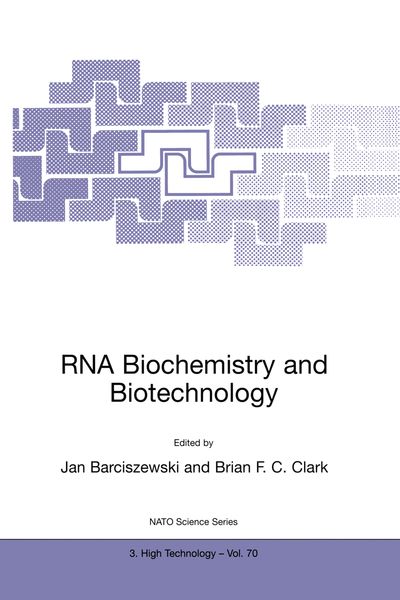
RNA Biochemistry and Biotechnology
-
- Hardcover
- Taschenbuch ausgewählt
- eBook
-
Sprache:Englisch
93,99 €
UVP
106,99 €
inkl. MwSt,
Lieferung nach Hause
Beschreibung
Details
Einband
Taschenbuch
Erscheinungsdatum
31.08.1999
Herausgeber
Jan Barciszewski + weitereVerlag
Springer NetherlandSeitenzahl
370
Maße (L/B/H)
24/16/2,2 cm
Gewicht
625 g
Auflage
Softcover reprint of the original 1st ed. 1999
Sprache
Englisch
ISBN
978-0-7923-5862-6
Readership: Advanced graduate students, Ph.D. students and young scientists as well as specialists in the field.
Weitere Bände von NATO Science Partnership Subseries: 3
-
Advanced Photonics with Second-Order Optically Nonlinear Processes von A.D. Boardman
 Band 61
A.D. Boardman
Advanced Photonics with Second-Order Optically Nonlinear ProcessesBuch
48,99 €
-
High-Temperature Superconductors and Novel Inorganic Materials von G. Van Tendeloo
 Band 62
G. Van Tendeloo
High-Temperature Superconductors and Novel Inorganic MaterialsBuch
195,99 €
-
Symmetry and Pairing in Superconductors von M. Ausloos
 Band 63 - 12%
M. Ausloos
Symmetry and Pairing in SuperconductorsBuch
93,99 €
106,99 €* -
The Chloroplast: From Molecular Biology to Biotechnology von Joan H. Argyroudi-Akoyunoglou
 Band 64 - 12%
Joan H. Argyroudi-Akoyunoglou
The Chloroplast: From Molecular Biology to BiotechnologyBuch
187,99 €
213,99 €* -
Smart Structures von Jan Holnicki-Szulc
 Band 65 - 12%
Jan Holnicki-Szulc
Smart StructuresBuch
139,99 €
160,49 €* -
Mössbauer Spectroscopy in Materials Science von Marcel Miglierini
 Band 66 - 12%
Marcel Miglierini
Mössbauer Spectroscopy in Materials ScienceBuch
93,99 €
106,99 €* -
Advanced Technologies Based on Wave and Beam Generated Plasmas von H. Schlüter
 Band 67 - 13%
H. Schlüter
Advanced Technologies Based on Wave and Beam Generated PlasmasBuch
185,99 €
213,99 €* -
Materials Science of Carbides, Nitrides and Borides von Yury G. Gogotsi
 Band 68 - 13%
Yury G. Gogotsi
Materials Science of Carbides, Nitrides and BoridesBuch
203,99 €
235,39 €* -
Thermodynamic Optimization of Complex Energy Systems von Adrian Bejan
 Band 69
Adrian Bejan
Thermodynamic Optimization of Complex Energy SystemsBuch
187,99 €
-
RNA Biochemistry and Biotechnology von Jan Barciszewski
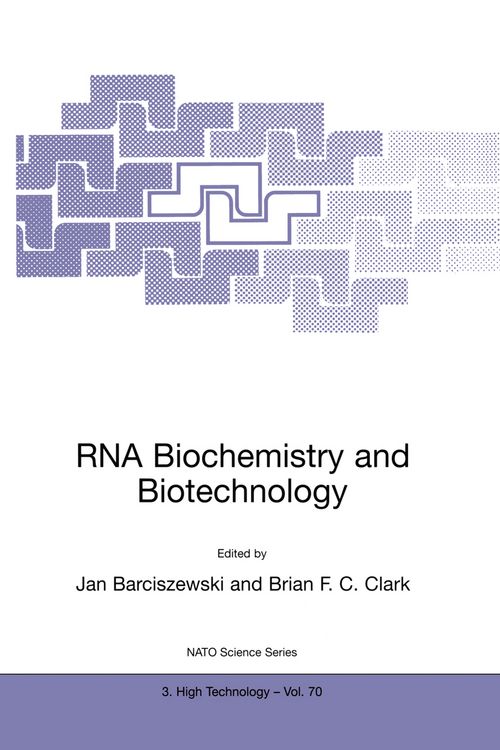 Band 70 - 12%
Jan Barciszewski
RNA Biochemistry and BiotechnologyBuch
93,99 €
106,99 €* -
Structural Biology and Functional Genomics von E. Morton Bradbury
 Band 71 - 12%
E. Morton Bradbury
Structural Biology and Functional GenomicsBuch
187,99 €
213,99 €* -
Nano-Crystalline and Thin Film Magnetic Oxides von Ivan Nedkov
 Band 72 - 12%
Ivan Nedkov
Nano-Crystalline and Thin Film Magnetic OxidesBuch
187,99 €
213,99 €*
Unsere Kundinnen und Kunden meinen
Verfassen Sie die erste Bewertung zu diesem Artikel
Helfen Sie anderen Kund*innen durch Ihre Meinung
Kurze Frage zu unserer Seite
Vielen Dank für dein Feedback
Wir nutzen dein Feedback, um unsere Produktseiten zu verbessern. Bitte habe Verständnis, dass wir dir keine Rückmeldung geben können. Falls du Kontakt mit uns aufnehmen möchtest, kannst du dich aber gerne an unseren Kund*innenservice wenden.
zum Kundenservice