
Band 59
Research in Atomic Structure
Aus der Reihe
Lecture Notes in Chemistry
-
- Taschenbuch ausgewählt
- eBook
-
Sprache:Englisch
97,99 €
inkl. gesetzl. MwSt.,
Lieferung nach Hause
Beschreibung
Produktdetails
Einband
Taschenbuch
Erscheinungsdatum
29.01.1993
Verlag
Springer BerlinSeitenzahl
143
Maße (L/B/H)
23,5/15,5/0,9 cm
Gewicht
1 g
Auflage
Softcover reprint of the original 1st ed. 1993
Sprache
Englisch
ISBN
978-3-540-56237-5
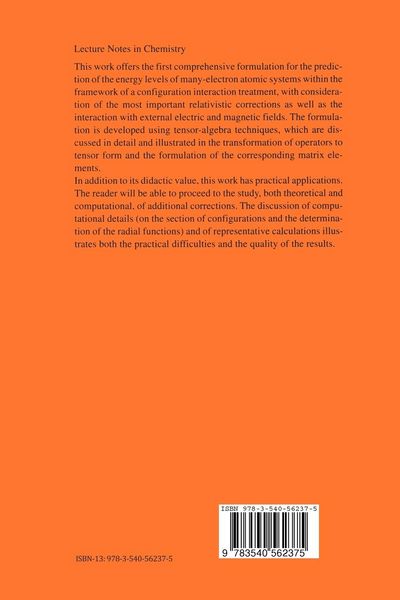
Impressive advances have been made in the study of atomic structures, at both the experimental and theoretical levels. And yet, the scarcity of information on atomic energy levels is evident At the same time there exists a need for data, because of the developments in such diverse fields as astrophysics and plasma and laser research, all of them of fundamental importance as well as practical impact. This project of research in atomic structure, consisting of three components (formulation, computer program, and numerical results), constitutes a basic and comprehensive work with a variety of uses. In its most practical application, it will yield a rather accurate prediction of the energy levels of any atomic system, of use per se or in the interpretation and confirmation of experimental results. On the other hand, it will also be of use in the comparative study of the appropriateness of the various levels of approximation and as a point of reference.
Kundinnen und Kunden meinen
Verfassen Sie die erste Bewertung zu diesem Artikel
Helfen Sie anderen Kund*innen durch Ihre Meinung
Kurze Frage zu unserer Seite
Vielen Dank für dein Feedback
Wir nutzen dein Feedback, um unsere Produktseiten zu verbessern. Bitte habe Verständnis, dass wir dir keine Rückmeldung geben können. Falls du Kontakt mit uns aufnehmen möchtest, kannst du dich aber gerne an unseren Kund*innenservice wenden.
zum Kundenservice