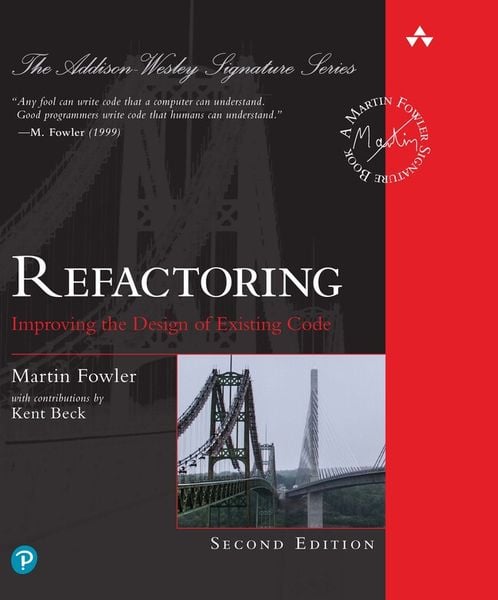
Refactoring: Improving the Design of Existing Code
62,99 €
inkl. gesetzl. MwSt.,
Beschreibung
Produktdetails
Verkaufsrang
11473
Einband
Gebundene Ausgabe
Erscheinungsdatum
19.11.2018
Verlag
Pearson Education LimitedSeitenzahl
448
Maße (L/B/H)
23,5/18,9/2,3 cm
Gewicht
898 g
Farbe
Tabak
Auflage
2
Sprache
Englisch
ISBN
978-0-13-475759-9
Martin Fowler’s guide to reworking bad code into well-structured code
Refactoring improves the design of existing code and enhances software maintainability, as well as making existing code easier to understand. Original Agile Manifesto signer and software development thought leader, Martin Fowler, provides a catalog of refactorings that explains why you should refactor; how to recognize code that needs refactoring; and how to actually do it successfully, no matter what language you use.
- Refactoring principles: understand the process and general principles of refactoring
- Code smells: recognize “bad smells” in code that signal opportunities to refactor
- Application improvement: quickly apply useful refactorings to make a program easier to comprehend and change
- Building tests: writing good tests increases a programmer’s effectiveness
- Moving features: an important part of refactoring is moving elements between contexts
- Data structures: a collection of refactorings to organize data, an important role in programs
- Conditional Logic: use refactorings to make conditional sections easier to understand
- APIs: modules and their functions are the building blocks of our software, and APIs are the joints that we use to plug them together
- Inheritance: it is both very useful and easy to misuse, and it’s often hard to see the misuse until it’s in the rear-view mirror---refactorings can fix the misuse
Examples are written in JavaScript, but you shouldn’t find it difficult to adapt the refactorings to whatever language you are currently using as they look mostly the same in different languages.
"Whenever you read [ Refactoring ], it’s time to read it again. And if you haven’t read it yet, please do before writing another line of code." –David Heinemeier Hansson, Creator of Ruby on Rails, Founder & CTO at Basecamp
“Any fool can write code that a computer can understand. Good programmers write code that humans can understand.” –M. Fowler (1999)
Noch keine Bewertungen vorhanden
Verfassen Sie die erste Bewertung zu diesem Artikel
Helfen Sie anderen Kundinnen und Kunden durch Ihre Meinung.
Kurze Frage zu unserer Seite
Vielen Dank für dein Feedback
Wir nutzen dein Feedback, um unsere Produktseiten zu verbessern. Bitte habe Verständnis, dass wir dir keine Rückmeldung geben können. Falls du Kontakt mit uns aufnehmen möchtest, kannst du dich aber gerne an unseren Kund*innenservice wenden.
zum Kundenservice