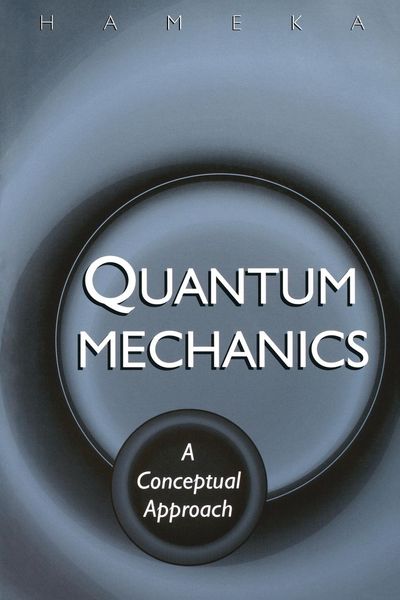
Produktbild: Quantum Mechanics

Quantum Mechanics A Conceptual Approach

128,99 €

inkl. gesetzl. MwSt., Versandkostenfrei

Lieferung nach Hause

Beschreibung

Produktdetails

Einband

Taschenbuch

Erscheinungsdatum

19.03.2004

Verlag

John Wiley & Sons

Seitenzahl

208

Maße (L/B/H)

23,4/15,6/1,1 cm

Gewicht

349 g

Auflage

1. Auflage

Sprache

Englisch

ISBN

978-0-471-64965-6

Beschreibung

Rezension

"...the treatment of individual topics and concepts is very good and informative..." ( Journal of Chemical Education , January 2005)
"...this book serves as a skeletal summary of arguments presented in class..." ( CHOICE , October 2004)

Produktdetails

Einband

Taschenbuch

Erscheinungsdatum

19.03.2004

Verlag

John Wiley & Sons

Seitenzahl

208

Maße (L/B/H)

23,4/15,6/1,1 cm

Gewicht

349 g

Auflage

1. Auflage

Sprache

Englisch

ISBN

978-0-471-64965-6

Kundinnen und Kunden meinen

0 Bewertungen

Informationen zu Bewertungen

Zur Abgabe einer Bewertung ist eine Anmeldung im Konto notwendig. Die Authentizität der Bewertungen wird von uns nicht überprüft. Wir behalten uns vor, Bewertungstexte, die unseren Richtlinien widersprechen, entsprechend zu kürzen oder zu löschen.

Die Bewertungen sind nach Format, Anzahl Sterne und Datum sortiert.

Verfassen Sie die erste Bewertung zu diesem Artikel

Helfen Sie anderen Kund*innen durch Ihre Meinung

Kundinnen und Kunden meinen

0 Bewertungen filtern

Die Leseprobe wird geladen.
  • Produktbild: Quantum Mechanics
  • Preface.
     
    1. The Discovery of Quantum Mechanics.
     
    I Introduction.
     
    II Planck and Quantization.
     
    III Bohr and the Hydrogen Atom.
     
    IV Matrix Mechanics.
     
    V The Uncertainty Relations.
     
    VI Wave Mechanics.
     
    VII The Final Touches of Quantum Mechanics.
     
    VIII Concluding Remarks.
     
    2. The Mathematics of Quantum Mechanics.
     
    I Introduction.
     
    II Differential Equations.
     
    III Kummer's Function.
     
    IV Matrices.
     
    V Permutations.
     
    VI Determinants.
     
    VII Properties of Determinants.
     
    VIII Linear Equations and Eigenvalues.
     
    IX Problems.
     
    3. Classical Mechanics.
     
    I Introduction.
     
    II Vectors and Vector Fields.
     
    III Hamiltonian Mechanics.
     
    IV The Classical Harmonic Oscillator.
     
    V Angular Momentum.
     
    VI Polar Coordinates.
     
    VII Problems.
     
    4. Wave Mechanics of a Free Particle.
     
    I Introduction.
     
    II The Mathematics of Plane Waves.
     
    III The Schrödinger Equation of a Free Particle.
     
    IV The Interpretation of the Wave Function.
     
    V Wave Packets.
     
    VI Concluding Remarks.
     
    VII Problems.
     
    5. The Schrödinger Equation.
     
    I Introduction.
     
    II Operators.
     
    III The Particle in a Box.
     
    IV Concluding Remarks.
     
    V Problems.
     
    6. Applications.
     
    I Introduction.
     
    II A Particle in a Finite Box.
     
    III Tunneling.
     
    IV The Harmonic Oscillator.
     
    V Problems.
     
    7. Angular Momentum.
     
    I Introduction.
     
    II Commuting Operators.
     
    III Commutation Relations of the Angular Momentum.
     
    IV The Rigid Rotor.
     
    V Eigenfunctions of the Angular Momentum.
     
    VI Concluding Remarks.
     
    VII Problems.
     
    8. The Hydrogen Atom.
     
    I Introduction.
     
    II Solving the Schrödinger Equation.
     

    III Deriving the Energy Eigenvalues.
     
    IV The Behavior of the Eigenfunctions.
     
    V Problems.
     
    9. Approximate Methods.
     
    I Introduction.
     
    II The Variational Principle.
     
    III Applications of the Variational Principle.
     
    IV Perturbation Theory for a Nondegenerate State.
     
    V The Stark Effect of the Hydrogen Atom.
     
    VI Perturbation Theory for Degenerate States.
     
    VII Concluding Remarks.
     
    VIII Problems.
     
    10. The Helium Atom.
     
    I Introduction.
     
    II Experimental Developments.
     
    III Pauli's Exclusion Principle.
     
    IV The Discovery of the Electron Spin.
     
    V The Mathematical Description of the Electron Spin.
     
    VI The Exclusion Principle Revisited.
     
    VII Two-Electron Systems.
     
    VIII The Helium Atom.
     
    IX The Helium Atom Orbitals.
     
    X Concluding Remarks.
     
    XI Problems.
     
    11 Atomic Structure.
     
    I Introduction.
     
    II Atomic and Molecular Wave Function.
     
    III The Hartree-Fock Method.
     
    IV Slater Orbitals.
     
    V Multiplet Theory.
     
    VI Concluding Remarks.
     
    VII Problems.
     
    12 Molecular Structure.
     
    I Introduction.
     
    II The Born-Oppenheimer Approximation.
     
    III Nuclear Motion of Diatomic Molecules.
     
    IV The Hydrogen Molecular Ion.
     
    V The Hydrogen Molecule.
     
    VI The Chemical Bond.
     
    VII The Structures of Some Simple Polyatomic Molecules.
     

    VIII The Hückel Molecular Orbital Method.
     
    IX Problems.
     
    Index.