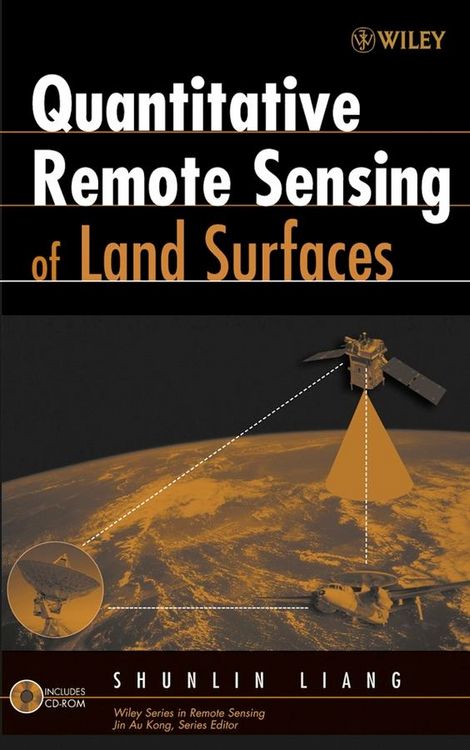
Produktbild: Quantitative Remote Sensing of Land Surfaces
Band 1

Quantitative Remote Sensing of Land Surfaces

298,99 €

inkl. MwSt, Versandkostenfrei

Lieferung nach Hause

Beschreibung

Details

Einband

Gebundene Ausgabe

Erscheinungsdatum

12.12.2003

Herausgeber

Jin Au Kong

Verlag

John Wiley & Sons Inc

Seitenzahl

550

Maße (L/B/H)

24,1/16,3/3,1 cm

Gewicht

907 g

Auflage

1. Auflage

Sprache

Englisch

ISBN

978-0-471-28166-5

Beschreibung

Rezension

"...a well-researched book that the environmental modelling community will find an indispensable reference." ( Progress in Physical Geography , Vol.29, No.1, 2005)
"...extremely well produced, with good layout, clear type, a useful list of acronyms and a comprehensive index...timely and refreshing..." (The Photogrammetric Record , December 2004)

"This volume a very useful and practical addition to the literature on remote sensing." ( E-STREAMS , August 2004)

Details

Einband

Gebundene Ausgabe

Erscheinungsdatum

12.12.2003

Herausgeber

Jin Au Kong

Verlag

John Wiley & Sons Inc

Seitenzahl

550

Maße (L/B/H)

24,1/16,3/3,1 cm

Gewicht

907 g

Auflage

1. Auflage

Sprache

Englisch

ISBN

978-0-471-28166-5

Herstelleradresse

Produktsicherheitsverantwortliche/r
Europaallee 1
36244 Bad Hersfeld
DE

Email: gpsr@libri.de

Weitere Bände von Wiley Series in Remote Sensing and Image Processing

Weitere Bände von Wiley Series in Remote Sensing and Image Processing

Unsere Kundinnen und Kunden meinen

0 Bewertungen

Informationen zu Bewertungen

Zur Abgabe einer Bewertung ist eine Anmeldung im Konto notwendig. Die Authentizität der Bewertungen wird von uns nicht überprüft. Wir behalten uns vor, Bewertungstexte, die unseren Richtlinien widersprechen, entsprechend zu kürzen oder zu löschen.

Verfassen Sie die erste Bewertung zu diesem Artikel

Helfen Sie anderen Kund*innen durch Ihre Meinung

Unsere Kundinnen und Kunden meinen

0 Bewertungen filtern

  • Produktbild: Quantitative Remote Sensing of Land Surfaces
  • Preface.

    Acronyms.

    Chapter 1. Introduction.

    1.1 Quantitative Models in Optical remote Sensing.

    1.2 Basic Concepts.

    1.3 Remote Sensing Modeling System.

    1.4 Summary.

    1.5 References.

    Chapter 2. Atmospheric Shortwave Radiative Transfer Modeling.

    2.1 Radiative Transfer Equation.

    2.2 Surface Statistical BRDF Models.

    2.3 Atmospheric Optical Properties.

    2.4 Solving Radiative Transfer Equations.

    2.5 Approximate Representation for Incorporating Surface BRDF.

    2.6 Summary.

    2.7 References.

    Chapter 3. Canopy Reflectance Modeling.

    3.1 Canopy Radiative Transfer Formulation.

    3.2 Leaf Optical Models.

    3.3 Solving Radiative Transfer Equations.

    3.4 Geometric Optical Models.

    3.5 Computer Simulation Models.

    3.6 Summary.

    3.7 References.

    Chapter 4. Soil and Snow Reflectance Modeling.

    4.1 Single Scattering Properties of Snow and Soil.

    4.2 Multiple Scattering Solutions for Angular Reflectance from Snow and Soil.

    4.3 Geome tric Optical Modeling.

    4.4 Inversion of Snow Parameters.

    4.5 Practical Issues.

    4.6 Summary.

    4.7 References.

    Chapter 5. Satellite Sensor Radiometric Calibration.

    5.1 Background.

    5.2 Post-launch Calibration Methods.

    5.3 Calibration Coefficients for Landsat TM and AVHRR Reflective Bands.

    5.4 Summary.

    5.6 References.

    Chapter 6. Atmospheric Correction.

    6.1 Introduction.

    6.2 Methods for Correcting Single Viewing-angle Imagery.

    6.3 Methods for Correcting Multiangular Observations.

    6.4 Methods for Estimating Total Column Water Vapor Content.

    6.5 Summary.

    6.6 References.

    Chapter 7. Topographic Correction Methods.

    7.1 Introduction.

    7.2 Cosine Correction Algorithms.

    7.3 IPW Method.

    7.4 Shadowing Function Algorithms.

    7.5 DEM Data and Generation.

    7.6 Summary.

    7.7 References.

    Chapter 8. Estimation of Land Surface Biophysical variables.

    8.1 Statistical Methods.

    8.2 Optimization Inversion Method.

    8.3 Generic Algorithm (GA).

    8.4 Table Look-up Methods.

    8.5 Hybrid Inversion Methods.

    8.6 Comparisons of Different Inversion Methods.

    8.7 Summary.

    8.8 References.

    Chapter 9. Estimation of Surface Radiation Budget: I. Broadband Albedo.

    9.1 Introduction.

    9.2 Broadband Albedo Characteristics.

    9.3 Narrowband to Broadband Conversion.

    9.4 Direct Estimation of Surface Broadband Albedos.

    9.5 Diurnal Cycle Modeling.

    9.6 Summary.

    9.7 References.

    Chapter 10. Estimation of Surface Radiation Budget (II): Longwave.

    10.1 Introduction.

    10.2 Monochromatic Radiative Transfer Formulation and Solutions.

    10.3 Line-by-line Methods.

    10.4 Band Models.

    10.5 Correlated k-Distribution Methods.

    10.6 Atmospheric Correction Methods.

    10.7 Split-window Algorithm for Estimating LST.

    10.8 Multispectral Algorithms for Separating Temperature and Emissivity.

    10.9 Computing Broadband Emissivity.

    10.10 Surface Energy Balance Modeling.

    10.11 Summary.

    10.12 References.

    Chapter 11. Four-Dimensional (4D) Data Assimilation.

    11.1 Introduction.

    11.2 Assimilation Algorithms.

    11.3 Minimization Algorithms.

    11.4 Data Assimilation in Hydrology.

    11.5 Data Assimilationdata with Crop Growth Models.

    11.6 Summary.

    11.7 References.

    Chapter 12. Validation and Spatial Scaling.

    12.1 Rationale of Validation.

    12.2 Validation Methodology.

    12.3 Spatial Scaling Techniques.

    12.4 Summary.

    12.5 References.

    Chapter 13. Applications.

    13.1 Methodologies for Integrating Remote Sensing with Ecological Process Models.

    13.2 Agricultural Applications.

    13.3 "Urban Heat Island" Effects.

    13.4 Carbon Cycle Studies.

    13.5 Land-atmospheric Interaction.

    13.6 Summary.

    References.

    Appendix.

    CD-ROM Content.

    Data Directory

    Software Directory.

    Index.