
Quantification in the Theory of Grammar
-
- Hardcover
- Taschenbuch ausgewählt
- eBook
-
Sprache:Englisch
103,99 €
UVP
117,69 €
inkl. MwSt,
Lieferung nach Hause
Beschreibung
Details
Einband
Taschenbuch
Erscheinungsdatum
28.02.1990
Verlag
Springer NetherlandSeitenzahl
240
Maße (L/B/H)
22,3/15,2/1,5 cm
Gewicht
367 g
Auflage
Softcover reprint of the original 1st ed. 1990
Sprache
Englisch
ISBN
978-0-7923-0644-3
Weitere Bände von Studies in Linguistics and Philosophy
-
Quantification in the Theory of Grammar von Taisuke Nishigauchi
 Band 37 - 11%
Taisuke Nishigauchi
Quantification in the Theory of GrammarBuch
103,99 €
117,69 €* -
Properties, Types and Meaning von G. Chierchia
 Band 38 - 12%
G. Chierchia
Properties, Types and MeaningBuch
139,99 €
160,49 €* -
Properties, Types and Meaning von G. Chierchia
 Band 39 - 13%
G. Chierchia
Properties, Types and MeaningBuch
138,99 €
160,49 €* -
Logical Structure and Linguistic Structure von C-T James Huang
 Band 40
C-T James Huang
Logical Structure and Linguistic StructureBuch
48,99 €
-
Entities and Indices von M.J. Cresswell
 Band 41 - 12%
M.J. Cresswell
Entities and IndicesBuch
93,99 €
106,99 €* -
From Discourse to Logic von Hans Kamp
 Band 42 - 12%
Hans Kamp
From Discourse to LogicBuch
69,99 €
80,24 €* -
The Parameter of Aspect von C.S. Smith
 Band 43 - 12%
C.S. Smith
The Parameter of AspectBuch
206,99 €
235,39 €* -
Principle-Based Parsing von R.C. Berwick
 Band 44
R.C. Berwick
Principle-Based ParsingBuch
179,99 €
-
Structures for Semantics von Fred Landman
 Band 45
Fred Landman
Structures for SemanticsBuch
139,99 €
-
Indian Philosophy of Language von Mark Siderits
 Band 46
Mark Siderits
Indian Philosophy of LanguageBuch
107,99 €
-
Purpose Clauses von C. Jones
 Band 47
C. Jones
Purpose ClausesBuch
92,99 €
-
Control and Grammar von R.K. Larson
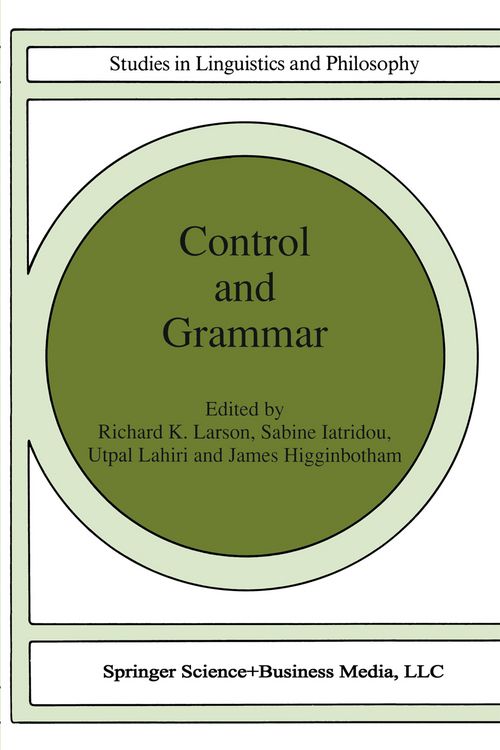 Band 48 - 13%
R.K. Larson
Control and GrammarBuch
138,99 €
160,49 €*
Unsere Kundinnen und Kunden meinen
Verfassen Sie die erste Bewertung zu diesem Artikel
Helfen Sie anderen Kund*innen durch Ihre Meinung
Kurze Frage zu unserer Seite
Vielen Dank für dein Feedback
Wir nutzen dein Feedback, um unsere Produktseiten zu verbessern. Bitte habe Verständnis, dass wir dir keine Rückmeldung geben können. Falls du Kontakt mit uns aufnehmen möchtest, kannst du dich aber gerne an unseren Kund*innenservice wenden.
zum Kundenservice