• Produktbild: Purpose Clauses
  • Produktbild: Purpose Clauses
Band 47 - 12%

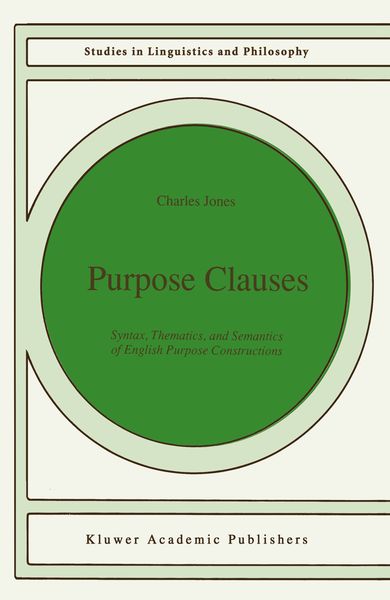
Purpose Clauses Syntax, Thematics, and Semantics of English Purpose Constructions

12% sparen

93,99 € UVP 106,99 €

inkl. gesetzl. MwSt., Versandkostenfrei

Lieferung nach Hause

Beschreibung

Produktdetails

Einband

Gebundene Ausgabe

Erscheinungsdatum

30.09.1991

Verlag

Springer Netherland

Seitenzahl

263

Maße (L/B/H)

24,1/16/2 cm

Gewicht

588 g

Auflage

1991

Sprache

Englisch

ISBN

978-0-7923-1400-4

Beschreibung

Produktdetails

Einband

Gebundene Ausgabe

Erscheinungsdatum

30.09.1991

Verlag

Springer Netherland

Seitenzahl

263

Maße (L/B/H)

24,1/16/2 cm

Gewicht

588 g

Auflage

1991

Sprache

Englisch

ISBN

978-0-7923-1400-4

Herstelleradresse

Springer-Verlag GmbH
Tiergartenstr. 17
69121 Heidelberg
DE

Email: [email protected]

Kundinnen und Kunden meinen

0 Bewertungen

Informationen zu Bewertungen

Zur Abgabe einer Bewertung ist eine Anmeldung im Konto notwendig. Die Authentizität der Bewertungen wird von uns nicht überprüft. Wir behalten uns vor, Bewertungstexte, die unseren Richtlinien widersprechen, entsprechend zu kürzen oder zu löschen.

Die Bewertungen sind nach Format, Anzahl Sterne und Datum sortiert.

Verfassen Sie die erste Bewertung zu diesem Artikel

Helfen Sie anderen Kund*innen durch Ihre Meinung

Kundinnen und Kunden meinen

0 Bewertungen filtern

  • Produktbild: Purpose Clauses
  • Produktbild: Purpose Clauses
  • I. Introduction.- 1. Two Theoretical Frameworks.- 1.1. Government-Binding Theory.- 1.1.1. The Subtheories of GB.- 1.1.2. Passive in GB.- 1.2. ?-Theory.- 1.2.1. Argument Assignment.- 1.2.2. ?-Binding.- 1.2.3. The ?-Theory of Passive and Raising.- 1.2.4. The ?-Criterion and the Projection Principle.- 2. Purpose Constructions.- 2.1. Syntax.- 2.1.1. External Syntax.- 2.1.2. Internal Syntax.- 2.2. Semantics.- 2.2.1. Quantification.- 2.2.2. Control.- 2.3. ?-Theory and the Organization of the Grammar.- II. External Syntax.- 1. Distinguishing Purpose Clauses.- 1.1. Obligatory and Nonobligatory Control.- 1.1.1. Williams (1980) and Control.- 1.1.2 PC, IOC, and Control.- 1.1.3. The Thematic Nature of the PC Controller.- 1.2. Unexpected PC Properties.- 1.2.1. Prepositional Phrase Control of OPC.- 1.2.2. SPC and Intransitives.- 1.3. Purpose Clauses and Infmitival Relatives.- 2.Adjunction of IOC and PC.- 2.1. IOC and PC Distributions.- 2.2. IOC, PC, and Recursion.- 2.3. Syntactic Tests.- 2.3.1. Preposing.- 2.3.2. Negation.- 2.3.3. Pseudoclefts.- 2.3.4. Relative Order of IOC and PC.- 2.3.5. VP—Deletion.- 2.3.6. Conjunction.- 3. Purpose Clauses as Adjuncts.- 3.1. The Argument/Adjunct Distinction.- 3.1.1. Semantic Optionality.- 3.1.2. Syntactic Optionality.- 3.1.3. Iterability and Constrained Adjuncts.- 3.2. PC and the Lexicon.- 4. Wh-Extraction.- III. Internal Syntax.- 1. Inside In Order Clauses.- 2. Inside Subject-Gap Purpose Clauses.- 2.1. SPC as VP.- 2.2. Consequences of the VP Analysis of SPC.- 3. Inside Object-Gap Purpose Clauses.- 3.1. The Standard Analysis of OPC.- 3.2. OPC as VP.- 3.2.1. Suppression of the External ?-Role.- 3.2.2. External Projection of Internal ?-Roles.- 3.3. Consequences of the VP Analysis of OPC.- 3.3.1. The SPC Tests.- 3.3.2. Lexical Material in Comp.- 3.33. NP Within NP.- 3.3.4. Parasitic Gaps Within Syntactic Subjects.- 3.3.5. Weak Crossover.- 3.3.6. Long Distance Gaps.- 3.3.7. Parasitic Gaps.- 4. The PP ‘Subject’ of OPC.- 5. PC and Be.- IV. Easy-Clauses.- 1. Easy-S’.- 2. Easy-Clause = OPC.- 2.1. The VP Tests Revisited.- 2.2. The ‘Subject’ of EC.- 3. The New Tough Movement.- 3.1. Tough Problems With ?-Marking.- 3.2. Tough Reanalysis.- 3.2.1. Tough Reanalysis and Complex Adjectives.- 3.2.2. Tough Extractions.- 4. Related Constructions.- 4.1. Pretty to Look Ar. Object Deletion.- 4.2. Too/Enough Complements.- 4.3. An Easy Pan to Fry Eggs In: Mixed Relatives.- 4.4. A Fool to Love Mary.- V. Quantification.- 1. Quantification and Predication.- 2. Quantifying PRO arb.- 2.1. Epstein (1984) and PROarb.- 2.2. Lebeaux (1984) and PROarb.- 3. Control via Empty Operators.- 3.1. Generalized Quantificational Control.- 3.1.1. PRO as Anaphor _.- 3.1.2. Empty Operator as ?-Anaphor.- 3.1.3. Clark (1990) and Control.- 3.2. PC, EC, and Quantificational Control.- 3.2.1. The Implicit Argument Quantifier.- 3.2.2. Adverbs of Quantification.- 3.3. Licensing Conditions on Empty Operators.- 4. Conclusion.- VI. Control.- 1. A Semantics for Control.- 1.1 ?-Roles and Control.- 1.2 Augmentation of an Argument Structure.- 2. What is a ?-Role?.- 2.1. With Respect to a Predicate.- 2.2. Beyond the Predicate.- 3. Control of Purpose Clauses.- 3.1. Purpose Clauses.- 3.2. Control of Posessor-PP and Easy-Clauses.- 3.2.1. Possessor-PP.- 3.2.2. Easy-Clauses.- 4. Generalized Control.- 4.1. Farkas (1988) and Complement Control.- 4.1.1. Controller Choice.- 4.1.2. Thematic Matching.- 4.2. Thematic Matching in the Grammar.- 5. Obligatory Control and the Argument/Adjunct Distinction.- VII. Conclusion.- Index of Names.- Index of Subjects.