Gutscheinbedingungen

**Gültig vom 15.06.2026 bis 17.06.2026 | Gültig für nicht preisgebundene fremdsprachige Bücher | Einzelne Artikel können ausgeschlossen sein | Maximaler rabattfähiger Warenkorbwert 500 € | Nicht kombinierbar mit weiteren Aktionen | Nur einmal pro Person einlösbar | Nur solange der Vorrat reicht

Produktbild: Problematic Wildlife II

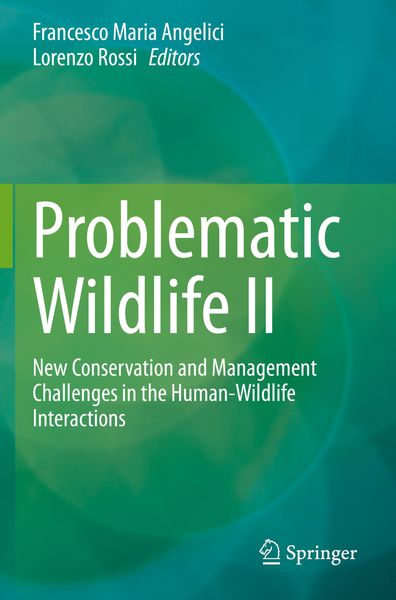
Problematic Wildlife II New Conservation and Management Challenges in the Human-Wildlife Interactions

194,99 €

inkl. gesetzl. MwSt., Versandkostenfrei

Lieferung nach Hause

Beschreibung

Produktdetails

Einband

Taschenbuch

Erscheinungsdatum

08.05.2021

Herausgeber

Francesco Maria Angelici + weitere

Verlag

Springer

Seitenzahl

649

Maße (L/B/H)

23,5/15,5/3,6 cm

Gewicht

990 g

Auflage

1st ed. 2020

Sprache

Englisch

ISBN

978-3-030-42337-7

Beschreibung

Portrait

Francesco Maria Angelici,  PhD,   currently works in the areas of biology, behavioral ecology, fauna, zoogeography, and mammal systematic and conservation studies, particularly concerning carnivores, lagomorphs and ungulates. His other fields of research are: ornithology (the biology and ecology of Falconiformes, Passeriformes and Strigiformes) and herpetology (the ecology of snakes and their trophic relationship with mammals). He studies Italian and tropical fauna, with particular reference to the conservation of vertebrates.  He also works in the areas of planning and environmental conservation. In particular, he has worked in the area of wildlife management at national parks, reserves and other protected areas in Italy and abroad. He currently works as a zoologist conservationist, with hunting management agencies. He is also a specialist in African savannah environments as well as desert and tropical rain forests. He is currently the scientific head of an international project dedicated to the conservation of the lion ( Panthera leo ) in Ghana.  He has published about 220 scientific papers in journals with international committees of reference, in addition to some scientific and popular articles. He has also written several chapters in monographs and books in Italy and abroad, in addition to being the editor of various Italian books. He co-authored the “Checklist of fauna species in Italy, Vertebrates" in the Mammals section, and authored several species sections in the new edition of  Fauna d’Italia  (Texbook of Italian Mammals), some species sections in  Handbuch der Säugetiere Europas  (Monograph on the Mammals of Europe), and some species sections in  Mammals of Africa   (Bloomsbury Publishing).  He contributes as a referent to 23 international journals, and he is associate editor of two international journals. He was a lecturer in courses in zoology (Vertebrate Zoology, Wildlife Management, Animal Ecology, and Zoogeography) at  Sapienza University of Rome from 1990 to 1996, and at the University of Tuscia, Viterbo from 2007 to 2009. He is a member of seventeen scientific and/or conservation societies in both Italy and abroad, including the IUCN.

Lorenzo Rossi  is a science communicator who deals with the history of zoology, ethnozoology and the relationship between science and pseudoscience. For this topics he is the author of exhibits, conferences, books and scientific publications. His most recent works concern the relationship between folklore and the discovery of new species of primates and the morphometric and genetic study of the island population of wolves that became extinct in Sicily (Italy) at the beginning of 1900.  He currently deals with public relations for the Museo dell'Ecologia di Cesena (Italy) and the organisation of events related to citizen science projects.


Produktdetails

Einband

Taschenbuch

Erscheinungsdatum

08.05.2021

Herausgeber

Verlag

Springer

Seitenzahl

649

Maße (L/B/H)

23,5/15,5/3,6 cm

Gewicht

990 g

Auflage

1st ed. 2020

Sprache

Englisch

ISBN

978-3-030-42337-7

Herstelleradresse

Springer-Verlag KG
Sachsenplatz 4-6
1201 Wien
AT

Email: ProductSafety@springernature.com

Kundinnen und Kunden meinen

0 Bewertungen

Informationen zu Bewertungen

Zur Abgabe einer Bewertung ist eine Anmeldung im Konto notwendig. Die Authentizität der Bewertungen wird von uns nicht überprüft. Wir behalten uns vor, Bewertungstexte, die unseren Richtlinien widersprechen, entsprechend zu kürzen oder zu löschen.

Die Bewertungen sind nach Format, Anzahl Sterne und Datum sortiert.

Verfassen Sie die erste Bewertung zu diesem Artikel

Helfen Sie anderen Kund*innen durch Ihre Meinung

Kundinnen und Kunden meinen

0 Bewertungen filtern

  • Produktbild: Problematic Wildlife II
  • Preface.- Part 1. Introduction to 'Problematic Wildlife II'. Problematic species are increasing, in a world that is constantly changing.- Chapter 1. The need and relevance of the book. Problematic Wildlife and the Modern World.- Part 2. From direct danger to humans to negative impact on human activities.- Chapter 2. Large Felid Predators and ‘Man-eaters’: Can we successfully balance conservation of endangered apex predators with the safety and needs of rapidly expanding human populations?.- Chapter 3. A large carnivore among people and livestock: the common leopard.- Chapter 4. Recent changes in wolf habitat occupancy and feeding habits in Italy: implications for conservation and reducing conflict with humans.- Part 3. Urban wildlife conflicts are an emerging problem.- Chapter 5. ‘Good’ and ‘bad’ urban wildlife.- Chapter 6. Wildlife and traffic – an inevitable but not unsolvable problem?.- Chapter 7. The colonization of the Western Yellow-legged Gull (Larus michahellis) in an Italian city: evolution and management of the phenomenon.- Part 4. Hunting and eco-tourism: possible mechanisms for conservation and coexistence?.- Chapter 8. How hunting and wildlife conservation can coexist. Review and case studies.- Chapter 9. What do we know about wild boar in Iberia?.- Chapter 10. Travelling in a fragile world: The value of Ecotourism.- Part 5. Species extinction.- Chapter 11. Assessing presence, decline and extinction for the conservation of difficult-to-observe species.- Chapter 12. Extinct or perhaps surviving relict populations of big cats. Their controversial stories and implications for conservation.- Part 6. Zoos, Conservation, Animal Rights.- Chapter 13. Alternative facts and alternative views: Scientists, managers, and animal rights activists.- Chapter 14. Zoos and conservation in the Anthropocene: opportunities and problems.- Chapter 15. Problematic Animals in the Zoo: the issue of charismatic megafauna.- Chapter 16. Cryptic problematic species and troublesome taxonomists: A tale of the Apennine bear and the Nile white rhinoceros.- Chapter 17. Communication and wildlife conservation (grey wolf and brown bear in Italy).- Part 7. Humans and Herpetofauna.- Chapter 18. Snakes, snakebites, and humans.- Chapter 19. Giant Snake-Human Relationships.- Chapter 20. Risk assessment model for brown treesnake introduction into the continental United States.- Chapter 21. The Asian toad (Duttaphrynus melanostictus) in Madagascar: A report of an ongoing invasion.- Index.