Gutscheinbedingungen

**Gültig vom 15.06.2026 bis 17.06.2026 | Gültig für nicht preisgebundene fremdsprachige Bücher | Einzelne Artikel können ausgeschlossen sein | Maximaler rabattfähiger Warenkorbwert 500 € | Nicht kombinierbar mit weiteren Aktionen | Nur einmal pro Person einlösbar | Nur solange der Vorrat reicht

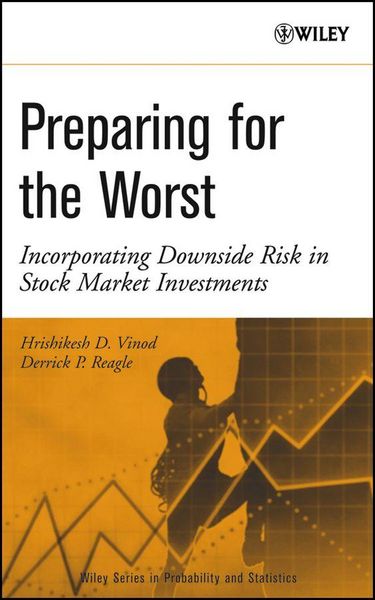
Produktbild: Preparing for the Worst

Preparing for the Worst Incorporating Downside Risk in Stock Market Investments

194,99 €

inkl. gesetzl. MwSt., Versandkostenfrei

Lieferung nach Hause

Beschreibung

Produktdetails

Einband

Gebundene Ausgabe

Erscheinungsdatum

22.10.2004

Verlag

John Wiley & Sons

Seitenzahl

320

Maße (L/B/H)

24,3/15,4/2 cm

Gewicht

561 g

Auflage

1. Auflage

Sprache

Englisch

ISBN

978-0-471-23442-5

Beschreibung

Rezension

"...most students in market finance would benefit from using it as an introduction to downside risks." ( Journal of the American Statistical Association , December 2005)
"...presents the latest ideas in the field from the ground up..." ( Zentralblatt MATH , Vol. 1064 (15), 2005)

Produktdetails

Einband

Gebundene Ausgabe

Erscheinungsdatum

22.10.2004

Verlag

John Wiley & Sons

Seitenzahl

320

Maße (L/B/H)

24,3/15,4/2 cm

Gewicht

561 g

Auflage

1. Auflage

Sprache

Englisch

ISBN

978-0-471-23442-5

Herstelleradresse

Libri GmbH
Europaallee 1
36244 Bad Hersfeld
DE

Email: gpsr@libri.de

Kundinnen und Kunden meinen

0 Bewertungen

Informationen zu Bewertungen

Zur Abgabe einer Bewertung ist eine Anmeldung im Konto notwendig. Die Authentizität der Bewertungen wird von uns nicht überprüft. Wir behalten uns vor, Bewertungstexte, die unseren Richtlinien widersprechen, entsprechend zu kürzen oder zu löschen.

Die Bewertungen sind nach Format, Anzahl Sterne und Datum sortiert.

Verfassen Sie die erste Bewertung zu diesem Artikel

Helfen Sie anderen Kund*innen durch Ihre Meinung

Kundinnen und Kunden meinen

0 Bewertungen filtern

Die Leseprobe wird geladen.
  • Produktbild: Preparing for the Worst
  • List of Figures.
     
    List of Tables.
     
    Preface.
     
    1. Quantitative Measures of the Stock Market.
     
    1.1. Pricing Future Cash Flows.
     
    1.2. The Expected Return.
     
    1.3. Volatility.
     
    1.4. Modeling of Stock Price Diffusion.
     
    1.5. Efficient Market Hypothesis.
     
    Appendix: Simple Regression Analysis.
     
    2. A Short Review of the Theory of Risk Measurement.
     
    2.1. Quantiles and Value at Risk.
     
    2.2. CAPM Beta, Sharpe, and Treynor Performance Measures.
     
    2.3. When You Assume . . . .
     
    2.4. Extensions of the CAPM.
     
    Appendix: Estimating the Distribution from the Pearson Family of Distributions.
     
    3. Hedging to Avoid Market Risk.
     
    3.1. Derivative Securities: Futures, Options.
     
    3.2. Valuing Derivative Securities.
     
    3.3. Option Pricing Under Jump Diffusion.
     
    3.4. Implied Volatility and the Greeks.
     
    Appendix: Drift and Diffusion.
     
    4. Monkey Wrench in the Works: When the Theory Fails.
     
    4.1. Bubbles, Reversion, and Patterns.
     
    4.2. Modeling Volatility or Variance Explicitly.
     
    4.3. Testing for Normality.
     
    4.4. Alternative Distributions.
     
    5. Downside Risk.
     
    5.1. VaR and Downside Risk.
     
    5.2. Lower Partial Moments (Standard Deviation, Beta, Sharpe, and Treynor).
     
    5.3. Implied Volatility and Other Measures of Downside Risk.
     
    6. Portfolio Valuation and Utility Theory.
     
    6.1. Utility Theory.
     
    6.2. Nonexpected Utility Theory.
     
    6.3. Incorporating Utility Theory into Risk Measurement and Stochastic Dominance.
     

    6.4. Incorporating Utility Theory into Option Valuation.
     
    6.5. Forecasting Returns Using Nonlinear Structures and Neural Networks.
     
    7. Incorporating Downside Risk.
     
    7.1. Investor Reactions.
     
    7.2. Patterns of Downside Risk.
     
    7.3. Downside Risk in Stock Valuations and Worldwide Investing.
     
    7.4. Downside Risk Arising from Fraud, Corruption, and International Contagion.
     
    8. Mathematical Techniques.
     
    8.1. Matrix Algebra.
     
    8.2. Matrix-Based Derivation of the Efficient Portfolio.
     
    8.3. Principal Components Analysis, Factor Analysis, and Singular Value Decomposition.
     
    8.4. Ito's Lemma.
     
    8.5. Creation of Risk-Free Nonrandom g(S, t) as a Hedge Portfolio.
     
    8.6. Derivation of Black-Scholes Partial Differential Equation.
     
    8.7. Risk-Neutral Case.
     
    9. Computational Issues.
     
    9.1. Sampling, Compounding, and Other Data Issues in Finance.
     
    9.2. Numerical Procedures.
     
    9.3. Simulations and Bootstrapping.
     
    Appendix A: Regression Specification, Estimation, and Software Issues.
     
    Appendix B: Maximum Likelihood Estimation Issues.
     
    Appendix C: Maximum Entropy (ME) Bootstrap for State-Dependent Time Series of Returns.
     
    10. What Does It All Mean?
     
    Glossary of Greek Symbols.
     
    Glossary of Notations.
     
    Glossary of Abbreviations.
     
    References.
     
    Name Index.
     
    Index.