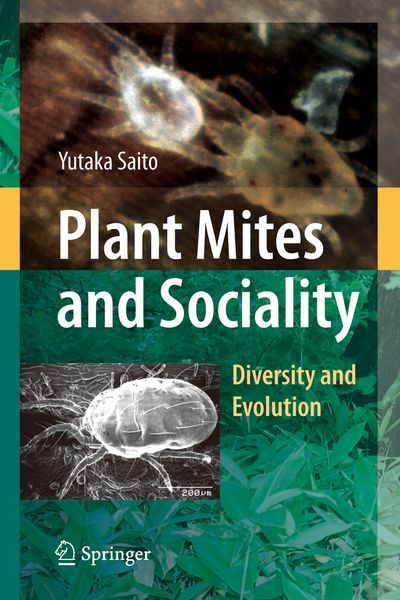
Produktbild: Plant Mites and Sociality
- 12%

Plant Mites and Sociality Diversity and Evolution

12% sparen

168,99 € UVP 192,59 €

inkl. MwSt, Versandkostenfrei

Lieferung nach Hause

Beschreibung

Details

Einband

Gebundene Ausgabe

Erscheinungsdatum

17.12.2009

Verlag

Springer Tokyo

Seitenzahl

187

Maße (L/B/H)

24,1/16/1,6 cm

Gewicht

471 g

Auflage

1. Auflage

Sprache

Englisch

ISBN

978-4-431-99455-8

Beschreibung

Rezension

From the reviews:

“Saito’s book should be of appeal to students learning about and researchers working on animal behavior and behavioral ecology, especially those interested in the evolution of cooperative behaviors and social organization. It may also be of interest to researchers working in pest management … . Saito’s book gives a fascinating glimpse of how wonderful the life of mites can be and should stimulate many of its readers to focus in their research on mites and pick up and dive into topics related to behavioral ecology.” (Peter Schausberger, Experimental and Applied Acarology, Vol. 52, October, 2010)

Details

Einband

Gebundene Ausgabe

Erscheinungsdatum

17.12.2009

Verlag

Springer Tokyo

Seitenzahl

187

Maße (L/B/H)

24,1/16/1,6 cm

Gewicht

471 g

Auflage

1. Auflage

Sprache

Englisch

ISBN

978-4-431-99455-8

Herstelleradresse

Springer-Verlag GmbH
Tiergartenstr. 17
69121 Heidelberg
DE

Email: ProductSafety@springernature.com

Unsere Kundinnen und Kunden meinen

0 Bewertungen

Informationen zu Bewertungen

Zur Abgabe einer Bewertung ist eine Anmeldung im Konto notwendig. Die Authentizität der Bewertungen wird von uns nicht überprüft. Wir behalten uns vor, Bewertungstexte, die unseren Richtlinien widersprechen, entsprechend zu kürzen oder zu löschen.

Verfassen Sie die erste Bewertung zu diesem Artikel

Helfen Sie anderen Kund*innen durch Ihre Meinung

Unsere Kundinnen und Kunden meinen

0 Bewertungen filtern

  • Produktbild: Plant Mites and Sociality
  • 1 What Are Mites?
    1.1 Brief Systematic Overview of Acari
    1.2 Peculiarities of Mites for Ecological and Evolutionary Studies
    2 Plant Mites
    2.1 Spider Mites and Plants
    2.2 Life History and Host Plants
    2.3 Life Type Diversity in Spider Mites
    What Is a Life Type?
    Supposed Function of LW and CW Life Types
    2.4 Diversity of Physiological Adaptation in Spider Mites
    Variation in Overwintering Stage
    Diapause
    2.5 Diversity of Plant Mites Other Than Spider Mites
    Phytoseiids
    Predators Other Than Phytoseiids
    3 Diverse Microcosmos on Sasa
    3.1 Diversity in Sasa-Inhabiting Mites
    3.2 Is the Flattened Body an Antipredator Strategy?
    3.3 Do Oviposition and Undergoing Quiescence on Tips of Leaf
    Hairs Constitute Antipredatory Behaviors?
    3.4 Do Compartment-Type Nests Have Antipredator Functions?
    3.5 Woven Nests of Stigmaeopsis
    What Is Stigmaeopsis?
    Is Nest Size Variation a Refl ection of Antipredator Strategy?
    Advantages of Small Nests
    Additional Advantages of Small Nests
    Why Are There Large Nest Builders?
    Disruptive Selection on Nest Size?
    A Further Question
    3.6 Explanation of Diversity in Life Type and Life History Variation on Sasa
    3.7 Other Variation in Spider Mites on Sasa
    4 Mite Sociality
    4.1 Diversity in Genetic System
    4.2 Sexual Behavior
    4.3 Sex Ratio
    4.4 Sociality in Stigmaeopsis
    4.5 Sociality in Spider Mites
    4.6 Overview of Mite Sociality
    4.7 Background of Social Evolution in Mites
    5 Inbreeding Depression in Haplo-diploidy
    6 Kin Selection
    6.1 Variation in Male Aggressiveness Between Species
    6.2 Variation in Male Aggressiveness Within a Species
    6.3 Egoism and Cooperation
    6.4 Two Groups Showing Different Levels of Male Aggressiveness
    Why Are There Two Groups Showing Different Clinal Trends?
    6.5 Sexual Selection
    6.6 Theoretical Explanation of Male Aggression and Cooperation
    Absolute Conditions for Cooperation
    Mixed Strategy of Aggression and Cooperation
    Fitting Practical Data to the Model
    Thought Exercise
    7 Is Basic Science the Father of Applied Science?
    7.1 What Has Happened in Chinese Bamboo Forests?
    Plausible Factors for Pest Outbreaks
    Approaching a Factor
    7.2 Simulation of One-Predator?Two-Prey Systems
    7.3 Epilogue: Japanese Sato-yama
    8 Further Research for Mite Behavioral and Evolutionary Ecology

    Afterword

    Appendices
    Appendix 1. Brief History of Reinstatement of Stigmaeopsis
    Appendix 2. Model of Repeated Blind Sampling
    Appendix 3. Calculation of Practical Parameters in Game Model
    References
    Index