
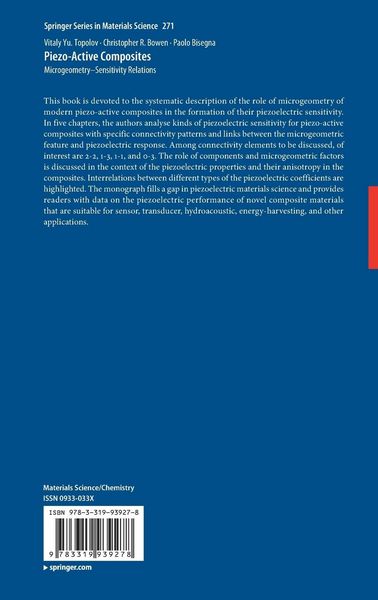
• Produktbild: Piezo-Active Composites
  • Produktbild: Piezo-Active Composites
Band 271

Piezo-Active Composites Microgeometry–Sensitivity Relations

106,99 €

inkl. gesetzl. MwSt., Versandkostenfrei

Lieferung nach Hause

Beschreibung

Produktdetails

Einband

Gebundene Ausgabe

Erscheinungsdatum

14.07.2018

Abbildungen

XVII, 61 illus., 52 illus. in color., schwarz-weiss Illustrationen, farbige Illustrationen

Verlag

Springer

Seitenzahl

179

Maße (L/B/H)

24,1/16/1,7 cm

Gewicht

471 g

Auflage

1st ed. 2018

Sprache

Englisch

ISBN

978-3-319-93927-8

Beschreibung

Produktdetails

Einband

Gebundene Ausgabe

Erscheinungsdatum

14.07.2018

Abbildungen

XVII, 61 illus., 52 illus. in color., schwarz-weiss Illustrationen, farbige Illustrationen

Verlag

Springer

Seitenzahl

179

Maße (L/B/H)

24,1/16/1,7 cm

Gewicht

471 g

Auflage

1st ed. 2018

Sprache

Englisch

ISBN

978-3-319-93927-8

Herstelleradresse

Springer-Verlag GmbH
Tiergartenstr. 17
69121 Heidelberg
DE

Email: [email protected]

Kundinnen und Kunden meinen

0 Bewertungen

Informationen zu Bewertungen

Zur Abgabe einer Bewertung ist eine Anmeldung im Konto notwendig. Die Authentizität der Bewertungen wird von uns nicht überprüft. Wir behalten uns vor, Bewertungstexte, die unseren Richtlinien widersprechen, entsprechend zu kürzen oder zu löschen.

Die Bewertungen sind nach Format, Anzahl Sterne und Datum sortiert.

Verfassen Sie die erste Bewertung zu diesem Artikel

Helfen Sie anderen Kund*innen durch Ihre Meinung

Kundinnen und Kunden meinen

0 Bewertungen filtern

  • Produktbild: Piezo-Active Composites
  • Produktbild: Piezo-Active Composites
  • Preface

    1. Piezoelectric Medium and Piezoelectric Sensitivity

    1.1. Piezoelectric Effect and Electromechanical Coupling  

    1.2. Piezoelectric Coefficients and Sensitivity

    1.3. Figures of Merit and Sensitivity   

    1.4. Effective Electromechanical Properties in Heterogeneous Piezoelectric Materials  

    1.4.1. Polydomain Ferroelectric Single Crystals

    1.4.2. Domain-engineered Relaxor-Ferroelectric Single Crystals 

    1.4.3. Poled Ferroelectric Ceramics

    1.4.4. Piezo-active Composites

    1.5. Conclusion

    1.6. References

    2. Effective Piezoelectric Coefficients dij *: From Microgeometry to Anisotropy     

    2.1. 2–2-type Composites

    2.1.1. Ceramic / Polymer

    2.1.2. Single Crystal / Polymer

    2.2. 1–3-type Composites

    2.2.1. Ceramic / Polymer

    2.2.2. Single Crystal / Polymer

    2.2.3. 1–3–0 Composites Based on Single Crystals

    2.2.4. 1–0–3 Composites Based on Single Crystals

    2.3. 1–1-type Composites

    2.3.1. Ceramic / Polymer

    2.3.2. 1–1–0 Ceramic / Porous Polymer Composites

    2.4. 0–3-type Composites

    2.5. 3–3-type Composites

    2.6. Electromechanical Coupling Factors and Their Relations to dij *

    2.7. Hydrostatic Piezoelectric Response and Its Relation to dij *

    2.8. Conclusion

    2.9. References

    3. Microgeometry of Composites and Their Piezoelectric Coefficients gij *  

    3.1. 2–2-type Composites

    3.2. 1–3-type Composites

    3.3. 1–1-type Composites

    3.4. 0–3-type Composites

    3.5. 3–3-type Composites

    3.6. Piezoelectric Sensitivity, Figures of Merit and Anisotropy 

    3.7. Hydrostatic Piezoelectric Sensitivity and Figures of Merit

    3.8. Conclusion

    3.9. References

    4. Piezoelectric Coefficients eij * and dij *: Combination of Properties at Specific Microgeometry 

    4.1. 2–2-type Composites

    4.2. 1–3-type Composites

    4.3. 0–3-type Composites

    4.4. Conclusion

    4.5. References

    5. Piezoelectric Coefficients eij * and hij *: Other Combination of Properties

    5.1. 2–2-type Composites

    5.2. 1–3-type Composites

    5.3. 0–3-type Composites

    5.5. Conclusion

    5.6. References

    6. Ways to Improve Piezoelectric Sensitivity of Modern Piezo-active Composites     

    References 

    Acknowledgements

    Appendix A. List of Abbreviations

    Appendix B. About the Authors

    Index