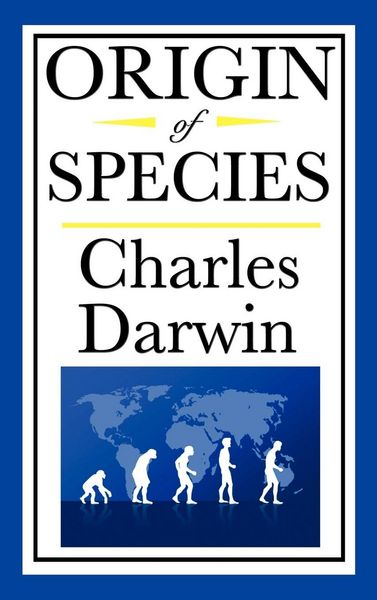
Origin of Species
1-
- Hardcover ausgewählt
- Taschenbuch
- eBook
- Hörbuch
-
Sprache:Englisch
- Deutsch 48,00 €
- Englisch 39,99 € ausgewählt
-
Verlag:A & D Publishing
- Ezreads Publications, LLC 34,99 €
- The Natural History Museum 16,49 €
- A & D Publishing 39,99 € ausgewählt
- Cosimo 36,99 €
- Flame Tree 21,99 €
- Arcturus Publishing Ltd 24,99 €
- Hawk Press 35,99 €
- Pan Macmillan 12,29 €
- Www.snowballpublishing.com 29,99 €
- Everyman 28,99 €
- Prakash Books 17,99 €
- Creative Media Partners, LLC 38,99 €
- Start Publishing PD 35,99 €
- 1828 Press 22,99 €
- Ancient Wisdom Publications 32,99 €
- Everyman s Library PRH USA 34,99 €
- Gröls Verlag 24,90 €
39,99 €
inkl. MwSt,
Lieferung nach Hause
Beschreibung
Details
Einband
Gebundene Ausgabe
Erscheinungsdatum
23.01.2008
Verlag
A & D PublishingSeitenzahl
296
Maße (L/B/H)
23,5/15,7/2,2 cm
Gewicht
634 g
Sprache
Englisch
ISBN
978-1-60459-243-6
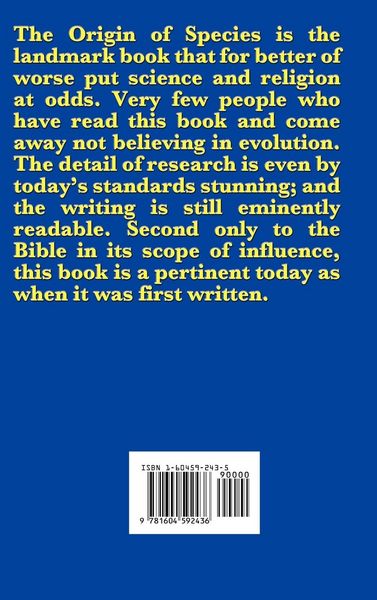
The Origin of Species is the landmark book that for better of worse put science and religion at odds. Very few people who have read this book and come away not believing in evolution. The detail of research is even by today's standards stunning; and the writing is still eminently readable. Second only to the Bible in its scope of influence, this book is a pertinent today as when it was first written.
Unsere Kundinnen und Kunden meinen
A masterpiece of its time
Bewertung am 31.05.2021
Bewertungsnummer: 1488923
Bewertet: Buch (Taschenbuch)
Charles Darwin’s "On the origin of species by means of natural selection, or the preservation
of favoured races in the struggle for life." from 1859 is not just a book. His work is a masterpiece
of its time. Precocious thoughts are revealed. The wide knowledge and experience acquired
throughout his voyages and studies, as well as his undeniable passion for trying to understand
the origin of organic beings can be felt through all his words.
I was surprised how pleasant it is to read, considering this scientific work was written over 160
years ago, when science and humanity were on another level. Still, his innumerous and detailed
observations of characteristics and structure of many different organic beings, like plants and
animals, mammals and insects etc., from all over the world are long, but necessary in order to
set the context for his revolutionary theory of descent with modification through variation and
natural selection.
He guides us from the variations between and within species under domestication and compares
it to the ones under nature by the means of a various experiment of crossing and assessing the
fertility. He then goes on explaining the struggle for life that leads to his theory of natural
selection by the survival of the fittest, made possible by mutable species over long periods of
time. He then gives further arguments with a focus on the large importance of embryological
character to support his theory and mentions the difficulties encountered for the differentiation
and classifications of species, genera and what he calls varieties. He basically mentions what will
later be described as taxonomy. A look at the geological proofs and gaps and the observations of
the geographical distributions and variations, is given. At the end he gives some last arguments
for his theory, before his conclusive words.
It is clear, that with his work he represents a revolutionary step for the natural science opposed
to the traditional, religious point of view on which nature was created by the creator. It is almost
hard to imagine how his new thoughts may have shaken the world at his time. Criticism was
large towards his theory but Darwin was well aware of this. Though, it is remarkable how he
avoids elegantly to make any offence towards Christianity and the theory of Creation which can
clearly not match the one he is elaborating.
He himself believed in God, at least in the beginning of his life, but this did not hold him
back from asking the right questions about the origin of the organic beings beyond what was
thought to be right at this time. In doing so, he leads the way for open mindedness towards more
rigorous thinking. Indeed he is confident, that in the future more naturalists will be convinced of
his theory.
In order to attempt to persuade the sceptic reader, he brings up important points of his work
and he sincerely agree with the fact that there are still some inexplicable relations. So, on the
one hand, he shows, that he is convinced of his arguments but on the other hand he admits not
having the answer to every question. He is noble in the way he admits, that still little is known
from the history of ancient species that gone extinct. Incomplete geological record seem to be an
issue to prove every step of evolution for his theory, as it is still the case today, with many gaps
and unexplored parts of the world. Further, for instance he claims that it can not be proven that
species are clearly differentiable from each other and that there is no proof that species would be
invariable, like the theory of Creation is suggesting. In the contrary, likewise his statement that
the laws governing inheritance are quite unknown, today with genetics there are more answers to
his questions in favour of his theory.
He also insists on the fact that it is hard for a human being to be able to imagine such tiny,
very slow and constant changes by means of progressive adaptation occurring over millions of
years. This is in my opinion, still an issue today. And, the importance
of domestication and his attention brought towards future need of further domestication, shows
the growing impact of humans on nature. Which was an important part of the 20th century, and
which built the base for the modern world we know now.
Concerning his writing, it is very scientific in the means of the exactitude of the detailed
descriptions made and at the same time he is able to bring his studies and observations as a
fascinating story to the reader. He also ensures, that the reader is still following by summing
the content at the end of each chapter. It is sometimes hard to imagine that this work has been
made so long ago, but the use of terms like savages or even negroes remind us brusquely that this
was another time.
Overall, it is really impressive to think about what his work procured in the future, as we
can clearly see how important his theory still is today. Many of his findings belong to general
knowledge for us now, where back to his time, it was new and very brave to bring such a new
theory contradicting the religion point of view, which was of much higher importance at this time.
His arguments are solid and undeniably critical questions are asked in his great work. Scientific
history since, has showed that the main part of his theory are still valid today. With a far larger
and complete knowledge of the topic, with genetics, discovered just a few years after Darwin’s
oeuvre, as well as new technologies that are available to us know, this is just impressive and
Darwin himself would most probably be very pleased to see what his work initiated. He would
probably also love to see what more could have been discovered since, on the foundations of his
findings.
Kurze Frage zu unserer Seite
Vielen Dank für dein Feedback
Wir nutzen dein Feedback, um unsere Produktseiten zu verbessern. Bitte habe Verständnis, dass wir dir keine Rückmeldung geben können. Falls du Kontakt mit uns aufnehmen möchtest, kannst du dich aber gerne an unseren Kund*innenservice wenden.
zum Kundenservice