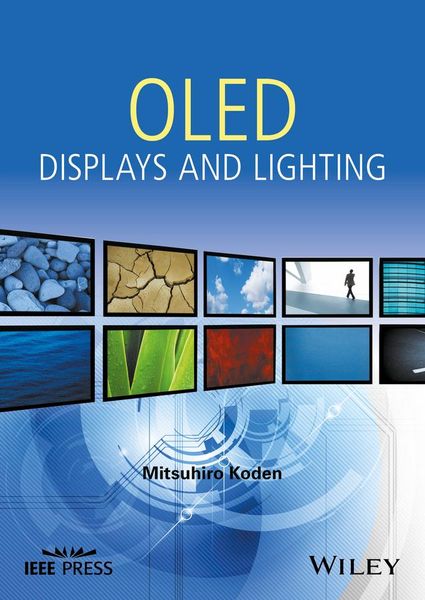
OLED Displays and Lighting
Aus der Reihe
Wiley - IEEE
113,99 €
inkl. gesetzl. MwSt.,
Lieferung nach Hause
Beschreibung
Produktdetails
Einband
Gebundene Ausgabe
Erscheinungsdatum
27.12.2016
Verlag
John Wiley & SonsSeitenzahl
232
Maße (L/B/H)
25,1/17,7/1,7 cm
Gewicht
499 g
Auflage
1. Auflage
Sprache
Englisch
ISBN
978-1-119-04045-3
Explains the fundamentals and practical applications of flat and flexible OLEDs for displays and lighting
Organic light-emitting diodes (OLEDs) have emerged as the leading technology for the new display and lighting market. OLEDs are solid-state devices composed of thin films of organic molecules that create light with the application of electricity. OLEDs can provide brighter, crisper displays on electronic devices and use less power than conventional light-emitting diodes (LEDs) or liquid crystal displays (LCDs) used today. This book covers both the fundamentals and practical applications of flat and flexible OLEDs.
Key features:
* Covers all of the aspects necessary to the design and manufacturing of OLED displays and lighting.
* Explains the fundamental basic technologies and also related technologies which might contribute to the next innovation in the industry.
* Provides several indications for future innovation in the OLED industry.
* Includes coverage of OLED vacuum deposition type and solution type materials.
The book is essential reading for early career engineers developing OLED devices and OLED related technologies in industrial companies, such as OLED device fabrication companies.
Organic light-emitting diodes (OLEDs) have emerged as the leading technology for the new display and lighting market. OLEDs are solid-state devices composed of thin films of organic molecules that create light with the application of electricity. OLEDs can provide brighter, crisper displays on electronic devices and use less power than conventional light-emitting diodes (LEDs) or liquid crystal displays (LCDs) used today. This book covers both the fundamentals and practical applications of flat and flexible OLEDs.
Key features:
* Covers all of the aspects necessary to the design and manufacturing of OLED displays and lighting.
* Explains the fundamental basic technologies and also related technologies which might contribute to the next innovation in the industry.
* Provides several indications for future innovation in the OLED industry.
* Includes coverage of OLED vacuum deposition type and solution type materials.
The book is essential reading for early career engineers developing OLED devices and OLED related technologies in industrial companies, such as OLED device fabrication companies.
Kundinnen und Kunden meinen
Verfassen Sie die erste Bewertung zu diesem Artikel
Helfen Sie anderen Kund*innen durch Ihre Meinung
Kurze Frage zu unserer Seite
Vielen Dank für dein Feedback
Wir nutzen dein Feedback, um unsere Produktseiten zu verbessern. Bitte habe Verständnis, dass wir dir keine Rückmeldung geben können. Falls du Kontakt mit uns aufnehmen möchtest, kannst du dich aber gerne an unseren Kund*innenservice wenden.
zum Kundenservice